MBA Abroad vs MBA in India: Salary, ROI, Scholarships & Admissions Compared (2026)
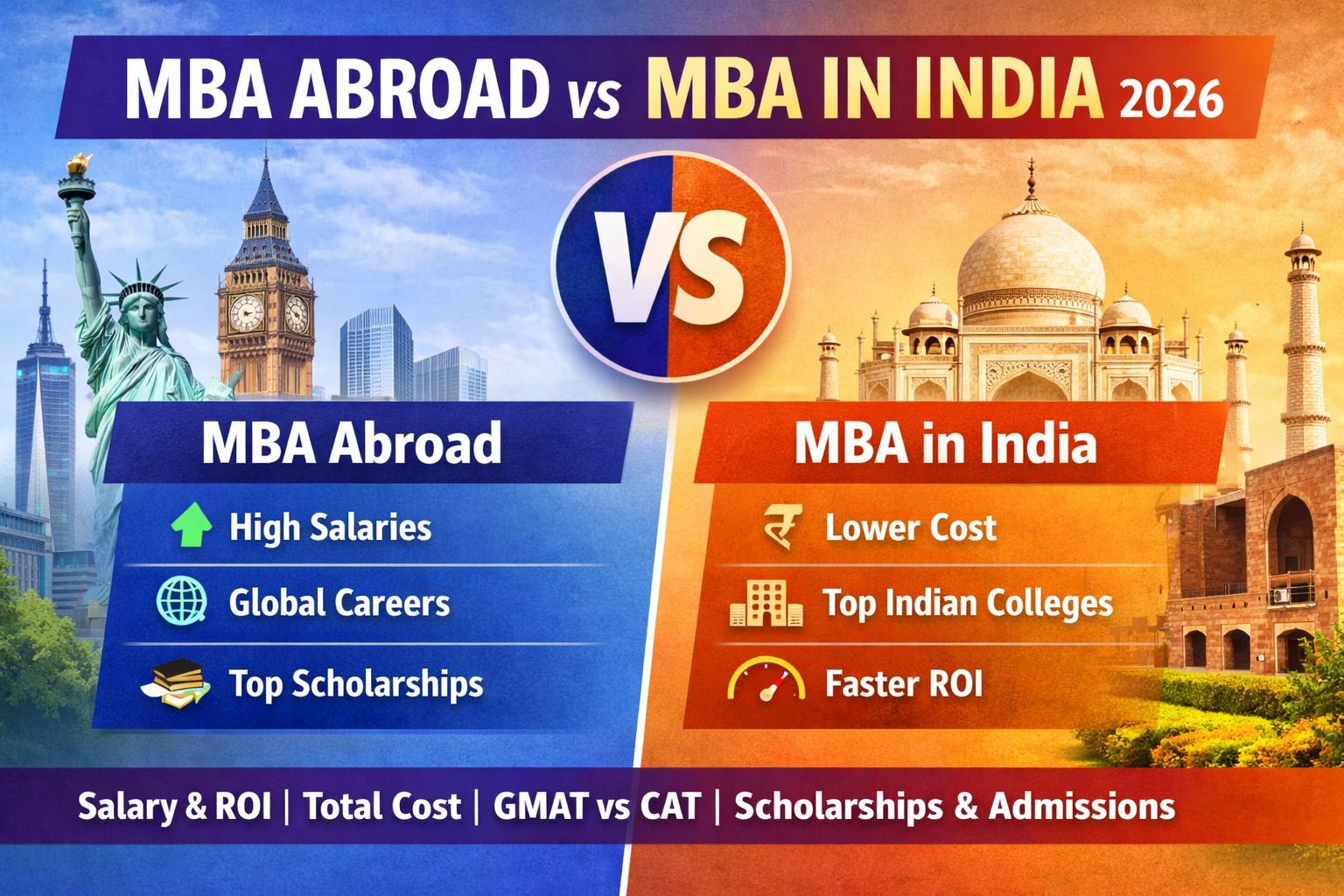
Searching “MBA abroad vs MBA in India” usually means one thing: you want the best salary growth, the best ROI, and the best career outcomes for your profile. The right answer depends on where you plan to work after the MBA, how much debt you can safely manage, and whether you can realistically secure a strong post-MBA role in your target country.
This guide compares MBA in India vs MBA abroad across salary, total cost, ROI, scholarships, and admissions—so you can decide with clarity for 2026 intakes.
MBA Abroad vs MBA in India: Quick Comparison (2026)
| Parameter | MBA in India | MBA Abroad |
|---|---|---|
| Total Cost | Usually lower | Usually higher (tuition + living + currency risk) |
| Salary Potential | Strong in India (especially top institutes) | Often higher in some markets (not guaranteed) |
| ROI / Payback | Usually faster | Can be strong, but depends on job + visa + debt |
| Scholarships | Limited size, available | More variety (merit/need/diversity) but competitive |
| Admissions | CAT-driven (plus interview) | Holistic (GMAT/GRE + essays + leadership) |
| Best for | India placements, lower risk | Global mobility, international recruiting |
1) Salary After MBA: India vs Abroad (What Matters Most)
MBA Salary in India (Typical Outcomes)
Your MBA salary in India depends mainly on:
- institute tier (top vs mid-tier),
- role (consulting/product/finance usually higher),
- your work experience and interview performance.
High-paying post-MBA roles in India: Consulting, Product Management, Strategy, Finance, Analytics Leadership.
SEO insight: People searching “MBA in India salary after MBA” should focus on role + institute tier, not a single “average salary” number.
MBA Salary Abroad (Typical Outcomes)
MBA abroad salaries can be higher in absolute terms in certain markets, but outcomes vary significantly by:
- country and city,
- industry (consulting/tech/finance),
- work authorization/visa pathway,
- local recruiting network.
Important: Your “salary abroad” must be evaluated as net savings after tax, rent, insurance, and loan repayment—not just gross pay.
2) ROI of MBA: The Best Way to Compare India vs Abroad
Best ROI Formula (Simple Payback)
Use a practical payback metric first:
MBA Payback Period (years)
= Total MBA Cost ÷ (Post-MBA annual net income − Pre-MBA annual net income)
What counts in “Total MBA Cost” (Do not miss these)
- tuition and program fees
- living expenses during MBA
- travel/visa/insurance
- opportunity cost (salary you forgo)
- loan interest (major ROI factor)
Most common ROI mistake: comparing tuition only, ignoring living + opportunity cost + interest.
3) Total Cost: MBA in India vs MBA Abroad (Realistic Breakdown)
Total Cost of MBA in India
Generally lower due to:
- affordable tuition relative to abroad,
- lower cost of living,
- smaller loan requirement for many students.
Total cost components: fees + hostel/living + personal expenses + opportunity cost.
Total Cost of MBA Abroad
Generally higher due to:
- higher tuition in many countries,
- high rent and living costs in top cities,
- mandatory insurance and travel,
- currency exchange risk (INR vs USD/EUR/GBP),
- larger loans and interest burden.
SEO phrase to remember: “all-in cost of MBA abroad from India” = tuition + living + opportunity cost.
4) MBA Scholarships: Abroad vs India (How Indian Students Can Win)
MBA Scholarships Abroad (Most Common Types)
- Merit scholarships (profile + GMAT/GRE + leadership)
- Need-based scholarships
- Diversity scholarships (women, underrepresented groups, emerging markets)
- Industry/impact scholarships (sustainability, tech, social impact)
- External scholarships (foundations/government/partners)
How to maximize scholarship chances (high-SEO actionable):
- Apply early (scholarship pools can be limited)
- Build leadership proof (impact, growth, outcomes)
- Align story with school strengths (“why this MBA, why now, why this school”)
- Strong recommendation strategy (specific examples, measurable results)
MBA Scholarships in India
Scholarships/fee support exist, often through:
- merit waivers,
- need-based assistance,
- institutional scholarships,
- education loans (very common).
5) Admissions: GMAT vs CAT (MBA Abroad vs MBA India)
MBA Admissions in India (CAT-led pathway)
Admissions are often driven by:
- CAT (or equivalent exam)
- academics and profile
- interview + WAT/GD (school dependent)
Best for: candidates with high exam performance and India placement goals.
MBA Admissions Abroad (Holistic evaluation)
Admissions often focus on:
- GMAT/GRE (plus IELTS/TOEFL if required)
- leadership progression and impact
- essays/SOP and clarity of goals
- recommendations
- interviews
- networking (for certain schools/program types)
Best for: candidates with strong leadership story, international goals, and consistent career trajectory.
6) Best Countries for MBA for Indian Students (Outcome-Based Shortlisting)
Instead of choosing by brand alone, shortlist using:
- post-MBA job outcomes and recruiting strength,
- visa/work authorization feasibility,
- all-in cost and scholarship probability,
- industry fit (consulting vs tech vs finance),
- long-term settlement goals (if relevant).
Common MBA abroad destinations for Indian students: US, UK, Canada, Europe (France/Germany/Netherlands/Spain), Singapore, Australia.
(Shortlist should be profile-specific; outcomes are not uniform across countries.)
7) Which Is Better: MBA Abroad or MBA in India?
Choose MBA Abroad if you want:
- global roles and international mobility
- a strong chance to work abroad for 3–5 years post-MBA
- a realistic plan for visa/work authorization
- high-fit recruiting industries (consulting/tech/finance)
- scholarship/financial control (manageable debt)
Choose MBA in India if you want:
- faster ROI and lower financial risk
- strong India placements and network
- top Indian institutes and structured campus recruiting
- growth in India consulting/product/finance/leadership roles
8) Decision Checklist (High-Intent Buyer Section)
Answer these honestly:
Career
- Do I want to work outside India for at least 3 years after MBA?
- Is my target role stronger abroad than in India?
Finance
- Can I manage all-in MBA cost without high-risk debt?
- Am I applying early enough for scholarship consideration?
Profile
- Do I have leadership impact I can prove with outcomes?
- Is my “why MBA” story clear and credible?
If you score higher on career mobility + finance readiness, MBA abroad is often justified.
If you score higher on risk control + fast ROI, MBA in India is often the better choice.
FAQs
Is MBA abroad better than MBA in India?
MBA abroad is better for global mobility and international roles when costs are controlled and post-MBA employment abroad is realistic. MBA in India is better for faster ROI and India placements.
Which MBA has better ROI: India or abroad?
Often MBA in India has faster ROI because total cost is lower. MBA abroad can have strong ROI if scholarships reduce cost and you work in a high-paying market long enough.
Can Indian students get MBA scholarships abroad?
Yes. Scholarships exist (merit/need/diversity/industry), but they are competitive. Early applications and strong leadership storytelling improve chances.
GMAT vs CAT: which should I choose?
Choose CAT if targeting top Indian MBAs. Choose GMAT/GRE if targeting MBA abroad (and some Indian programs that accept GMAT).
