Difference Between Fully Funded, Partial and Tuition Fee Waiver Scholarships for Indian Students (Study Abroad Guide 2025)
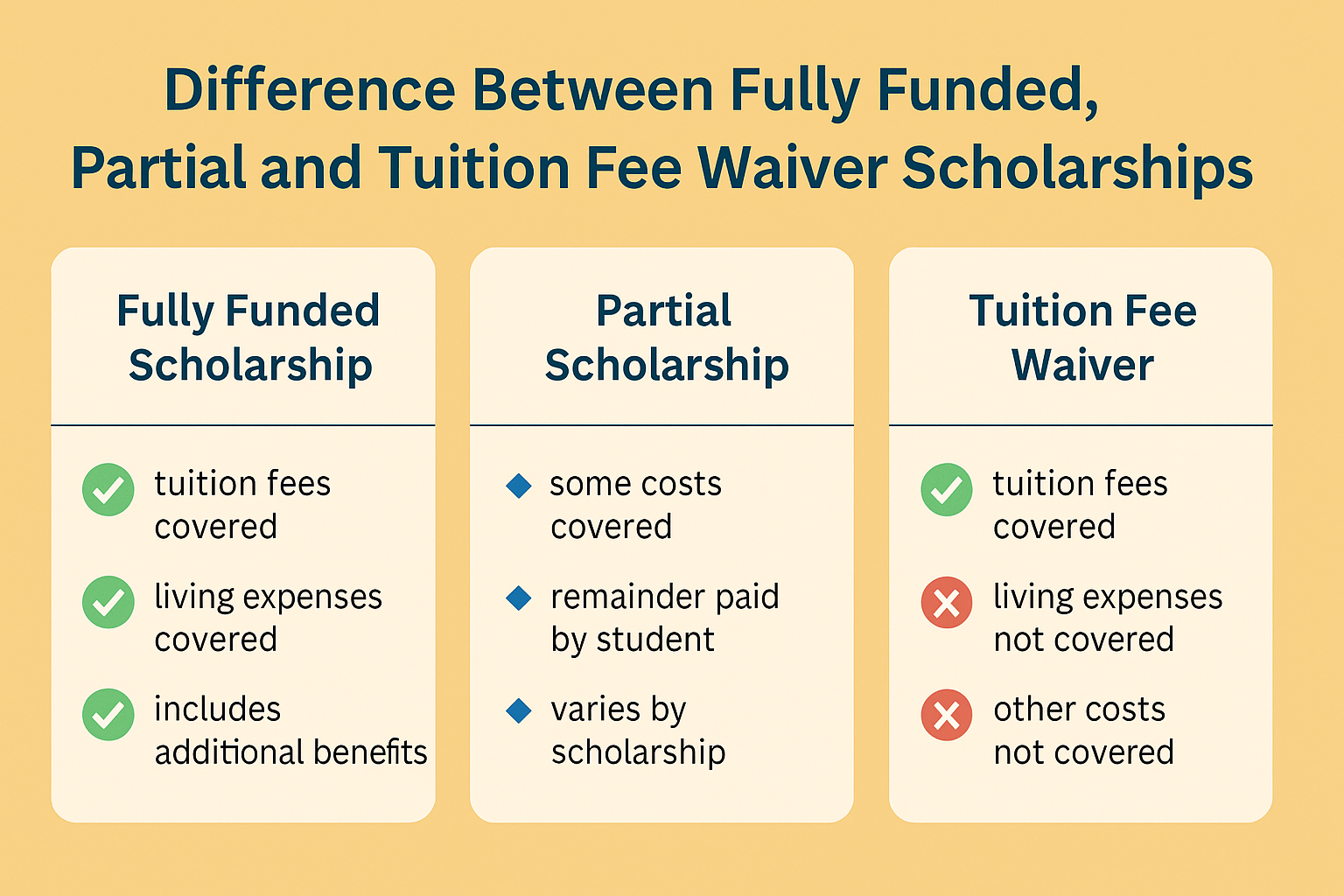
For many Indian students planning to study abroad, the biggest question is not “Which country?” but “How will I afford it?”
The good news is that there are multiple types of scholarships for study abroad – but the terminology can be confusing. You will often see:
- Fully funded scholarships
- Partial scholarships
- Tuition fee waiver scholarships
All three help you financially, but they do not provide the same level of support. Understanding the difference between fully funded, partial and tuition fee waiver scholarships is crucial before you plan your budget, loan, or destination country.
In this detailed guide, Education MESD explains each scholarship type in simple language, especially for Indian students applying in 2025–26, so you can make smart and realistic decisions.
What Is a Scholarship in Study Abroad?
A scholarship is financial assistance given to students to help cover the cost of their education.
Unlike an education loan:
- ✅ Scholarships do not have to be repaid
- ✅ They can be based on merit, financial need, country, course, or profile
- ✅ They may come from governments, universities, private organisations or NGOs
For Indian students, choosing the right study abroad scholarship often decides:
- Whether you can go at all
- Which country and university you can choose
- How much financial stress you and your family will face
Let’s now break down the three main types of scholarships you will see in most international applications.
1. Fully Funded Scholarship – Meaning, Benefits and Who Should Apply
What Is a Fully Funded Scholarship?
A fully funded scholarship is the most powerful and most desirable form of financial support. It is designed to cover almost all major expenses of studying abroad.
This type of scholarship is commonly seen in:
- Government-funded programs
- High-profile international schemes
- Competitive Master’s and PhD programs
What Does a Fully Funded Scholarship Typically Cover?
Most fully funded scholarships for Indian students include:
- ✅ 100% Tuition Fees – You do not pay any academic fees to the university.
- ✅ Living Expenses / Monthly Stipend – Money for rent, food, local transport and basic needs.
- ✅ Health Insurance – Medical coverage during your stay abroad.
- ✅ Travel Costs – One or more flight tickets (to and from the destination country).
- ✅ Sometimes: visa application costs, books, research grants, conference travel and internship support.
You’ll often see phrases like:
- “This is a fully funded scholarship for international students”
- “Covers tuition, living expenses and travel costs”
- “All program-related costs are covered”
These are strong indicators of full funding.
Why Are Fully Funded Scholarships So Popular?
- They reduce your out-of-pocket cost to almost zero.
- You can study in top universities even if your family cannot afford it.
- They are ideal for students from low or middle-income backgrounds.
However, competition is extremely high. Selection committees look at:
- Academic performance
- Statement of Purpose (SOP)
- CV and achievements
- Research potential or leadership activities
- Overall profile and motivation
💡 SEO Tip (for your blog editor): Internally link from here to another article like “How to Get Fully Funded Scholarships for Indian Students”.
2. Partial Scholarships – Meaning, Coverage and When They Make Sense
What Is a Partial Scholarship?
A partial scholarship covers only a portion of your total study cost. You still need to arrange the remaining amount through:
- Family savings
- Education loans
- Part-time jobs (where legally allowed)
- Other small grants
Partial scholarships are very common in university-level funding schemes and merit-based awards.
What Can a Partial Scholarship Cover?
A partial scholarship can take many forms:
- 🔹 Percentage of Tuition Fees – e.g., 25%, 50%, 75% tuition fee reduction.
- 🔹 Fixed Amount Each Year – e.g., ₹2,00,000 per year or $5,000 per semester.
- 🔹 Living Stipend Only – Your living expenses are covered, but tuition is not.
- 🔹 Accommodation Only – Free or discounted hostel or student housing.
- 🔹 One-Time Grant – Travel grant, joining bonus, or settling-in allowance.
Typical phrases include:
- “Up to 50% tuition fee reduction for international students”
- “Scholarship worth €3,000 per academic year”
- “Living allowance only; tuition fee not included”
All of these are indicators of a partially funded scholarship.
Who Should Consider Partial Scholarships?
Partial scholarships are ideal for students who:
- Can manage some of the total cost through family or loans
- Are willing to combine scholarships + bank loans + part-time work
- Want to reduce the financial pressure without depending on full funding
For many Indian students, a strong partial scholarship combined with smart budgeting and planning can make study abroad achievable.
✅ Education MESD helps students plan a realistic financial strategy by combining partial scholarships with country selection, cost of living analysis, and loan planning.
3. Tuition Fee Waiver Scholarship – Meaning and Practical Impact
What Is a Tuition Fee Waiver?
A tuition fee waiver scholarship (or tuition scholarship) is focused purely on university tuition fees. It reduces or removes tuition charges, but does not pay for your living expenses.
This is one of the most common scholarship types for Indian students applying to Europe, the UK, Australia, Canada and other study destinations.
What Does a Tuition Fee Waiver Cover?
A typical tuition fee waiver may include:
- ✅ Full tuition fee waiver – 100% of academic fees are waived.
- ✅ Partial tuition fee waiver – 25%, 50% or 75% tuition reduction.
- ❌ No support for rent, food, local travel, visa, flight tickets or insurance.
- ❌ You must fully manage living expenses on your own.
You might notice phrases such as:
- “100% tuition fee waiver for high-achieving students”
- “Merit-based tuition scholarship”
- “Tuition discount for international students”
These are all examples of tuition-focused scholarships.
Who Benefits Most from Tuition Fee Waivers?
Tuition fee waivers are best for students who:
- Can afford living costs (through family, savings or part-time work)
- Want to reduce only the tuition burden
- Prefer countries where part-time work can support their lifestyle
For example, some Indian students choose tuition waiver scholarships in Europe along with low living-cost cities to balance their overall budget.
Side-by-Side Comparison: Fully Funded vs Partial vs Tuition Fee Waiver
To quickly understand the difference between fully funded, partial and tuition fee waiver scholarships, here is a comparison table:
| Feature | Fully Funded Scholarship | Partial Scholarship | Tuition Fee Waiver Scholarship |
|---|---|---|---|
| Tuition Fees | ✅ Usually 100% covered | ✅❓ Sometimes partially or fully covered | ✅ Fully or partially covered |
| Living Expenses / Stipend | ✅ Usually included | ❓ Sometimes included (depends on scheme) | ❌ Not included |
| Travel (Flights, Visa, etc.) | ✅ Often covered | ❓ Occasionally included | ❌ Usually not included |
| Health Insurance | ✅ Commonly included | ❓ Depends on the program | ❌ Usually not included |
| Your Out-of-Pocket Cost | 💰 Very low / close to zero | 💰 Medium – you share part of the cost | 💰 High – you pay all living expenses |
| Competition Level | 🔥 Extremely high | 🔥 High | 🔥 Medium to high |
| Best For | Students needing maximum financial support | Students who can handle partial expenses | Students who can manage living costs but not tuition |
How to Decide Which Scholarship Type Is Best for You
Before applying for any study abroad scholarship, ask yourself:
- What is my realistic yearly budget?
- Can my family support living expenses abroad (rent + food + transport)?
- Am I okay with taking an education loan, or do I want to avoid loans?
- How strong is my profile? (CGPA, English test scores, projects, work experience, extracurriculars)
General Guidance
- If you cannot afford almost anything, target fully funded scholarships first.
- If you can manage some part of the cost, aim for partial scholarships + tuition waivers.
- If your family can comfortably support your living expenses, focus on tuition fee waiver scholarships in good universities and low-cost cities.
Education MESD can help you explore realistic options instead of blindly applying everywhere and getting rejections.
FAQ: Common Questions About Scholarship Types for Indian Students
1. Is a fully funded scholarship always the best option?
Financially, yes, because it covers the maximum. But you should also consider:
- Quality of the course
- Post-study work visa rules
- Job and PR opportunities
- Safety, culture and long-term career goals
Sometimes, a partial scholarship in a high-opportunity country may give better ROI than a fully funded scholarship with limited career options.
2. Can I combine a tuition fee waiver with other funding?
Often, yes.
Many students combine:
- Tuition fee waiver + bank education loan
- Tuition scholarship + part-time job (within legal working hours abroad)
- University tuition discount + external government or private scholarship
Always check each scholarship’s terms and conditions. Some allow multiple funding sources, while others do not.
3. Are fully funded scholarships only for toppers?
Not necessarily.
While CGPA is important, many fully funded scholarships also look at:
- SOP quality and clarity of goals
- Research or project experience
- Leadership, volunteering and community work
- Work experience or internships
A strategically prepared profile can significantly increase your chances – and this is where Education MESD’s expert counselling becomes valuable.
Why Apply Through Education MESD for Scholarships?
At Education MESD, we specialise in helping Indian students understand and win study abroad scholarships, including:
- 🎯 Profile Evaluation – We assess your academic record, financial background and goals.
- 🌍 Country & University Shortlisting – Based on your budget and scholarship eligibility.
- 📝 SOP, CV and LOR Guidance – Structuring your documents to stand out in scholarship competitions.
- 🎓 Scholarship Mapping – Matching you to relevant fully funded, partial and tuition fee waiver scholarships.
- 🧾 Application & Documentation Support – End-to-end guidance until submission.
- ✈️ Pre-Departure & Part-Time Job Guidance – Cost of living, work rules, and survival planning.
✅ Apply through Education MESD for a complete, step-by-step roadmap to study abroad with scholarships, especially for the 2025–26 intakes.
Final Summary: Key Differences at a Glance
To remember the difference between fully funded, partial and tuition fee waiver scholarships:
- Fully Funded Scholarship
→ Tuition + Living + Often Travel + Insurance
→ Best for students needing maximum financial support. - Partial Scholarship
→ Covers some part of tuition/living/travel
→ Best when you can manage partial costs through family or loans. - Tuition Fee Waiver Scholarship
→ Covers only tuition fees (fully or partially)
→ Best when you can manage living expenses but need help with tuition.
If you’re confused about where you fit, connect with Education MESD.
We’ll help you analyse your profile, finances and goals – and guide you to the right scholarship type, country and course for your study abroad dream.
