Healthcare & Nursing Courses Abroad (2026): Scholarships, Jobs & PR Pathways for Indian Students
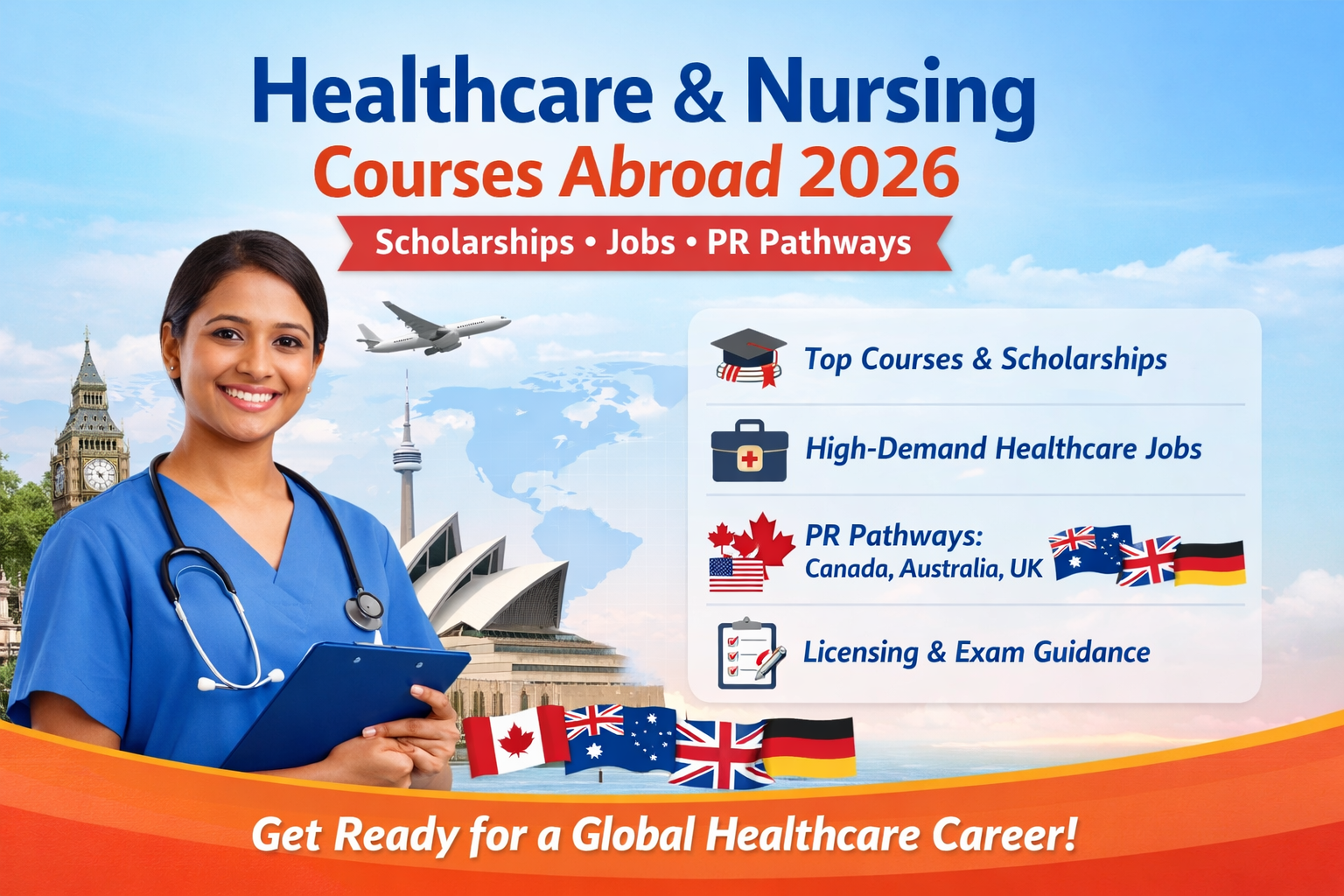
If you want a study-abroad pathway with high employability, long-term career stability, and realistic PR potential, healthcare and nursing consistently rank among the strongest options—especially in countries using skilled-immigration systems and actively recruiting regulated health professionals.
Why Healthcare & Nursing Abroad Is a High-ROI Career Move in 2026
1) Global demand is structural, not seasonal
Ageing populations, chronic care needs, and workforce shortages keep healthcare hiring strong across multiple regions.
2) Nursing is a “direct-to-employment” pathway—but licensing is the gate
Most countries hire nurses aggressively, but only after you complete regulator requirements (exam + verification + English).
3) Several countries run skilled-migration programs that explicitly include healthcare categories
For example, Canada’s Express Entry includes a Healthcare and social services occupations category.
Best Healthcare & Nursing Courses Abroad (High Job + PR Potential)
A) Nursing (Clinical, Regulated Pathway)
Best for: Hospital jobs, stable long-term settlement options (case-dependent)
Top programs:
- BSc Nursing / BSN (UG)
- MSc Nursing / MSN (PG)
- Specialisation-focused PG programs (varies by country/university)
Highest-demand nursing specialisations (globally):
- ICU / Critical Care
- Emergency Nursing
- Mental Health / Psychiatric Nursing
- Aged Care / Gerontology
- Pediatric Nursing
- Community / Public Health Nursing
SEO tip for your readers: If your end goal is “job + PR,” nursing is usually more aligned than generic healthcare programs—because it maps to regulated shortage roles.
B) Healthcare (Non-Clinical, High-Growth Pathway)
Best for: Students who want healthcare careers without bedside nursing registration
Top programs:
- Master of Public Health (MPH)
- Health Informatics / Clinical Informatics
- Healthcare Management / Hospital Administration
- Health Data Analytics
- Quality & Patient Safety
- Global Health / Health Policy
Best-fit profiles:
- Bio/health/psych/life-science grads
- Engineers/IT grads shifting into health informatics & analytics
- Business graduates targeting hospital operations & management
Scholarships for Healthcare & Nursing Courses Abroad (What Actually Works)
Many students waste time searching only “fully funded scholarships.” For healthcare/nursing, scholarships typically come through these five high-conversion buckets:
1) University merit scholarships (highest probability)
- Awarded based on academics + SOP + profile fit
- Often early applicants get better outcomes
2) School/Faculty scholarships (most “hidden”)
- Nursing school and public health school funds
- Sometimes separate forms + short essays
3) Government scholarships (high value, highly competitive)
- Strong academics + leadership + clear career plan usually required
4) Employer/hospital-linked funding (high practicality)
- Some regions support shortage-area hiring via contracts or training supports (availability varies)
5) Assistantships (common in MPH/informatics; less common in pure nursing UG)
- Research/TA roles depend on university structure and intake demand
Scholarship-winning SOP angle (high success rate):
Position your goals around national priorities: aged care, mental health, community healthcare, digital health, patient safety—and show measurable intent (skills, certification plan, and long-term contribution).
Jobs After Studying Healthcare & Nursing Abroad (Role Map)
Nursing jobs (regulated/licensed)
- Registered Nurse (RN)
- ICU nurse, Emergency nurse, Mental health nurse
- Aged care nurse / community nurse
- Clinical nurse specialist (after progression)
Healthcare jobs (often non-licensed)
- Health data analyst / clinical data coordinator
- Health informatics specialist
- Hospital operations executive
- Public health program officer
- Quality & patient safety associate
High-SEO clarity line:
Nursing has high job demand, but your registration timeline determines how fast you can start work.
Licensing & Registration (Country-Wise: What You Must Know)
UK (NMC): CBT + OSCE = Overseas Nursing Registration Path
The NMC explains the Computer Based Test (CBT) structure (Part A numeracy + Part B clinical), timing, and fees.
The OSCE is the practical exam; you must complete both CBT and OSCE to continue registration. NHS Employers also confirms overseas nurses must gain NMC registration as part of the UK recruitment pathway.
Australia (AHPRA / NMBA): English Standard Updated in 2025
NMBA’s English language skills registration standard (2025) took effect on 18 March 2025.
AHPRA publishes the English language skills standard resources and implementation information.
Practical implication: plan IELTS/OET/approved test readiness early, because English compliance is a registration bottleneck.
New Zealand (NCNZ): IQN Route + 1,800 Hours Requirement
NCNZ’s IQN pathway references the requirement to verify documents via TruMerit before applying.
TruMerit/NCNZ credential verification materials clearly reference the minimum 1,800 hours of post-registration experience requirements (and report issuance conditions).
NCNZ also announced implementation changes for internationally qualified enrolled nurses effective 1 September 2025, including the 1,800-hour requirement.
Canada (NNAS): Common Credentialing Start Point for IENs
NNAS describes itself as a credentialing service and “first step towards becoming a nurse in Canada.”
It also outlines the application steps/timeline for credential review.
Additionally, the Canadian Nurses Association summarizes that credential assessment/verification is typically a first step for many regulators.
Germany: Recognition (“Anerkennung”) is Essential for Regulated Nursing
Germany’s “Make it in Germany” portal explains recognition/equivalence assessment and indicates competent authorities often assess documents within three to four months once complete.
Germany’s official recognition portal provides similar timelines and process steps.
PR Pathways for Nursing & Healthcare (Country-by-Country)
1) Canada PR Pathways (Very PR-Aligned for Healthcare)
Canada’s IRCC explains Express Entry and category-based selection, including the healthcare category.
IRCC also outlines Express Entry program eligibility (“Who can apply”) and how rounds of invitations work.
Practical PR pathway (simplified):
Study → eligible work (where applicable) → skilled work experience → Express Entry + (sometimes) provincial routes (case-dependent).
High-SEO note: If your target is Canada, plan both tracks: (1) education/job readiness and (2) licensing readiness (if nursing).
2) Australia PR Pathways (Skilled Migration + Invitation System)
Australia’s Department of Home Affairs publishes key visas:
- Subclass 189 (Skilled Independent)
- Subclass 190 (Skilled Nominated)
- Subclass 491 (Skilled Work Regional – Provisional)
Australia also describes Skill Select and invitation rounds (how invitations are issued).
Practical implication: Your pathway is typically: skills/registration + EOI in SkillSelect + invitation dynamics.
3) United Kingdom (Strong Job Route; Keep an Eye on Policy Updates)
The UK’s Health and Care Worker visa states that after 5 years, you may be able to apply to settle permanently (ILR), subject to eligibility.
UK ILR guidance for skilled worker routes also provides rules on timing and qualifying periods.
High-SEO caution (important): the UK has seen active debate and reporting on potential immigration reforms affecting settlement timelines. Always verify the latest government rules at the time you apply.
4) Germany (Affordable Education + Long-Term Residency, Language Critical)
Germany’s pathway usually looks like:
Recognition → language readiness → employment → residence progression.
Recognition procedure details and timelines are documented by official portals.
5) New Zealand (Clear Residency Framework for Skilled Migrants)
New Zealand’s Skilled Migrant Category Resident Visa states you can stay indefinitely and can apply for a Permanent Resident Visa after 2 years (subject to conditions).
New Zealand also publishes skilled residence pathway details for people with skilled jobs, occupational registration, qualifications, or wage thresholds.
SEO freshness note: New Zealand has also had recent reporting on upcoming policy reforms—verify rules close to your intake year.
6) Ireland (Critical Skills Employment Permit)
Ireland’s government explains that the Critical Skills Employment Permit is designed to attract highly skilled talent and encourage permanent residence.
Best Countries for Nursing Abroad (Quick Decision Matrix)
| Your Priority | Best-Fit Countries (Typical) | Why |
|---|---|---|
| Fast job entry for regulated nursing | UK | NMC pathway (CBT + OSCE) + care visa route |
| PR-aligned skilled migration | Canada | Express Entry + healthcare category |
| High salary + skilled PR options | Australia | 189/190/491 + SkillSelect invitations |
| Low tuition + stability (language needed) | Germany | Recognition-based pathway |
| Structured residence model | New Zealand | Resident → PR after 2 years (conditions apply) |
Admissions Requirements (UG/PG) for Indian Students
Typical requirements vary by country/university, but commonly include:
- Academic transcripts, degree certificates
- IELTS/TOEFL/OET (depending on course + regulator)
- SOP + LORs
- CV (especially for MPH/management)
- Nursing pathways may require: clinical documentation, experience letters, registration proofs (often needed during licensing)
Step-by-Step Roadmap (High-Conversion Plan)
- Choose 2–3 countries based on budget, licensing feasibility, and PR goal
- Decide track: Nursing (clinical) vs Healthcare (non-clinical)
- Shortlist 8–12 universities using a scholarship-first approach
- Prepare SOP around shortage priorities + measurable career plan
- Apply early intake windows (scholarships are often first-come/limited)
- Start licensing documentation early (CBT/OSCE or AHPRA/NMBA or NCNZ/NNAS pathways)
- Create a PR-ready profile: language + work experience + compliance documentation
FAQ
Is nursing abroad good for PR?
It can be, especially where healthcare occupations are targeted within skilled immigration systems (e.g., Canada’s healthcare category in Express Entry).
Can I settle in the UK after the Health and Care Worker visa?
The UK states you may be able to apply for settlement after 5 years, subject to eligibility and the route’s requirements.
What is the CBT and OSCE for UK nursing?
CBT is the computer-based exam; OSCE is the practical clinical exam. You must complete both to proceed with NMC registration.
Is Australia good for nursing?
Australia can be strong, but you must meet registration standards, including the updated English language skills standard effective 18 March 2025.
What are the key requirements for New Zealand nursing registration?
NCNZ requires document verification (TruMerit) and references minimum practice-hour requirements (1,800 hours) for IQN pathways.
