How to Build a Strong Profile for Top Universities with Average Marks (2026 Guide)
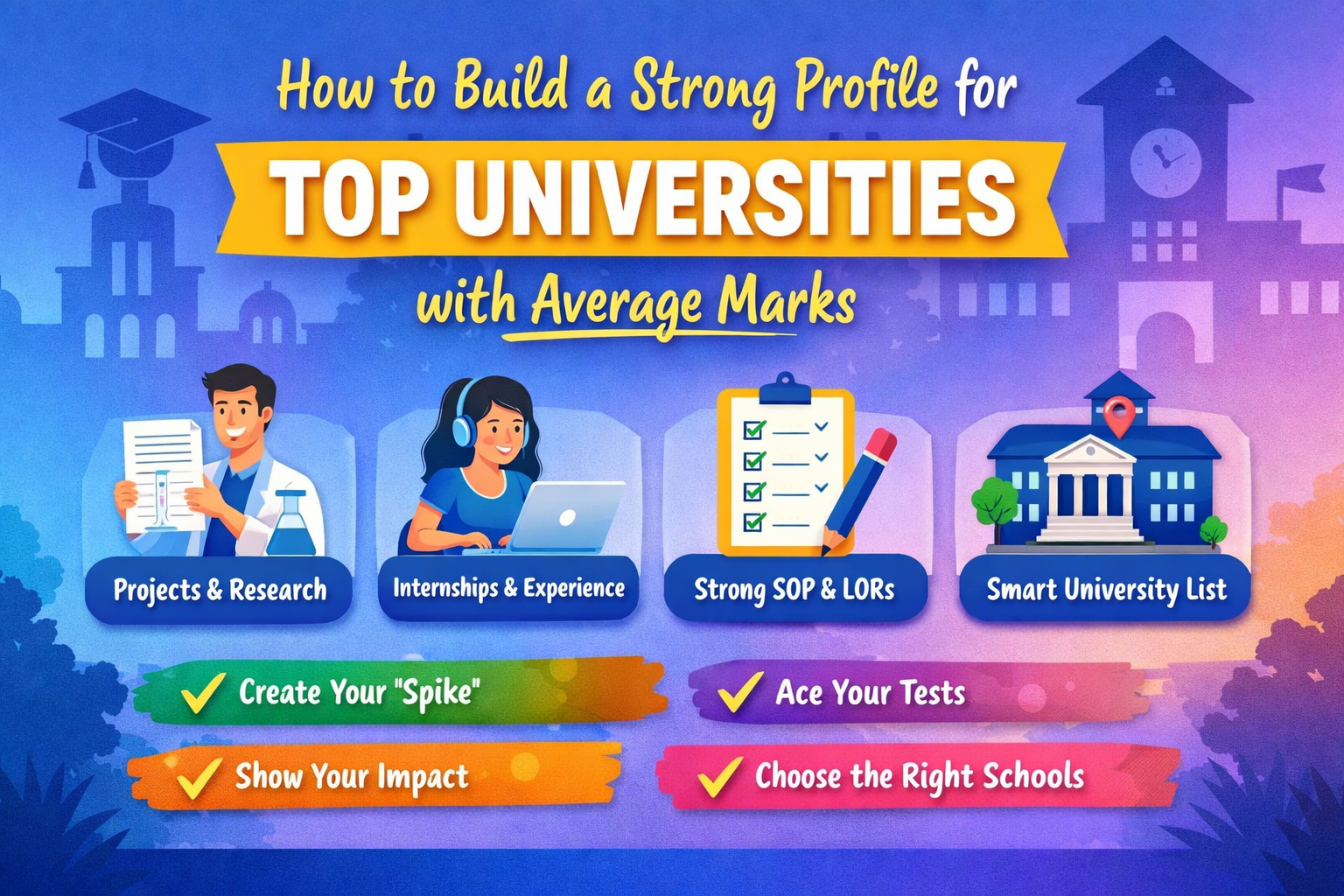
Introduction: Yes, You Can Get Into Top Universities With Average Marks
If your grades are average, your admission strategy must be intentional. Top universities do not admit only “toppers”—they admit students who demonstrate academic readiness, clear direction, and high potential through projects, research, internships, leadership, and a strong application narrative.
Your transcript is one signal. Your overall profile is the decision.
In this guide, you’ll learn exactly how to build a strong profile for top universities with average marks—step-by-step—so your application competes with high-CGPA candidates.
Table of Contents
- What Top Universities Actually Evaluate
- How to Offset Average Marks (Without Making Excuses)
- Create a “Spike”: The #1 Differentiator in Admissions
- High-Impact Projects That Impress Top Programs
- Research Profile: How to Start Even Without a Big College Tag
- Internships & Work Experience That Strengthen Your Case
- SOP Strategy: Turn Your Profile Into a Clear Story
- LORs That Can Compensate for Grades
- GRE/GMAT: When to Submit and When Not To
- University Shortlisting Strategy (Dream/Match/Safe)
- 90-Day Profile Building Roadmap
- FAQs
1) What Top Universities Actually Evaluate (Beyond Marks)
Most top universities follow holistic admissions, meaning your grades are evaluated alongside:
Key Admission Factors
- Academic readiness: relevant subjects, course rigor, grade trend
- Projects/portfolio: proof-of-work, depth, results
- Research potential: publications, labs, research internships, preprints
- Internships/work experience: outcomes, ownership, impact
- SOP: clarity, fit, goals, maturity
- LORs: strong validation by credible recommenders
- Standardized tests: GRE/GMAT (if submitted), IELTS/TOEFL/DET
- Leadership & impact: initiatives, community work, entrepreneurship
Why this matters for average marks
If your CGPA is moderate, you must:
- reduce perceived academic risk, and
- increase evidence of potential and fit.
2) How to Offset Average Marks (Without Making Excuses)
Average marks are not a “rejection guarantee.” But you must handle them strategically.
A) Highlight academic strengths within the transcript
Admissions teams look for:
- strong performance in core/relevant subjects
- improvement in later semesters (an upward trend)
- difficulty level (math-heavy, core CS, advanced electives)
If your overall CGPA is average but core subjects are strong, that is a meaningful signal.
B) Add external proof of academic ability
Use high-quality, relevant proof such as:
- advanced MOOCs (with real projects, not just certificates)
- research replication reports
- technical blogs demonstrating conceptual depth
- a portfolio showcasing applied skills
- competitions/hackathons with measurable outcomes
C) If needed, explain marks briefly and professionally
Only explain marks if there is a real reason (health, financial constraints, family responsibilities). Keep it:
- factual
- short (4–6 lines)
- improvement-focused
Never make excuses. Show maturity, ownership, and growth.
3) Create a “Spike”: The #1 Differentiator for Top Admits
A “spike” is a standout strength that makes you memorable.
If you have average marks, a spike can become the reason you get admitted.
Examples of powerful spikes
- Research spike: strong research internship + paper/preprint + faculty fit
- Project spike: 2–3 advanced projects with real results + deployment
- Industry spike: impactful internships/work experience + outcomes
- Entrepreneurship spike: product built, users, revenue, partnerships
- Impact spike: measurable community impact + leadership + recognition
How to choose your spike
Pick one core domain aligned with your target program:
- MS CS / AI / DS → projects + GitHub + research exposure
- MBA / Management → leadership + impact + business outcomes
- Public policy / sustainability → research + community/field impact + writing
Rule: A focused profile beats a scattered profile.
4) High-Impact Projects That Impress Top Universities
Projects are the fastest way to beat high-CGPA candidates who lack proof-of-work.
What top universities want to see in projects
A good project has:
- a real problem statement
- technical depth
- measurable outcomes
- clean documentation
- reproducibility (code + dataset references)
- limitations and future work
Project types that impress (especially for CS/AI/DS)
- End-to-end ML system: data → model → evaluation → deployment
- Research-style project: baseline comparison, ablation, experiments
- Open-source contribution: PRs, issues, documented commits
- Real-world project with users: adoption metrics, feedback, iterations
- Portfolio-based project: strong UI/UX + backend + cloud deploy
Minimum “top-university” standard
- 2–3 strong projects > 10 weak projects
- Each project must include:
- GitHub repo with README
- results + screenshots
- dataset description
- clear installation instructions
- learnings and improvements
If you need, I can convert your existing work into “admissions-ready” project documentation.
5) Research Profile: How to Start Even Without Elite College Access
You don’t need a famous institute to build a credible research profile.
Practical ways to build research credibility
- Replication study: reproduce a published paper’s results
- Mini literature review + experiments: topic-focused and well-structured
- Research internship under a professor: offer deliverables
- Poster/paper submission: legitimate venues (avoid predatory journals)
- Preprint/report: a structured technical report can still add value
What matters most
Admissions committees value:
- rigor
- clear methodology
- evidence of thinking like a researcher
- strong alignment to target faculty/labs
Even one well-executed research deliverable can offset average marks significantly.
6) Internships & Work Experience: Make Outcomes Measurable
“Worked on a project” is weak. “Delivered outcomes” is strong.
Strong internship bullets look like this
Instead of:
- “Worked on machine learning model”
Write:
- “Built a classification pipeline; improved F1 from 0.72 to 0.83; automated evaluation; reduced manual review time by 25%.”
What top universities look for in work experience
- ownership
- accountability
- measurable impact
- communication skills
- consistency and professionalism
If you can show impact, your CGPA becomes less central.
7) SOP Strategy: Your SOP Must Sell Fit + Potential
A strong SOP is not a motivational story. It’s a logical case for admission.
High-conversion SOP structure
- Your focus area + motivation (short, specific)
- Your preparation (projects/research/work with outcomes)
- Your academic readiness (relevant subjects, growth, learning plan)
- Why this university (faculty + labs + courses + resources)
- Your goals (what you will do there, and post-study direction)
How to handle average marks in SOP
- mention briefly (if needed)
- emphasize improvement + preparation
- shift focus back to achievements and fit
Important: Over-explaining grades makes them look bigger.
8) LORs That Can Compensate for Grades
A strong Letter of Recommendation can neutralize average marks.
Best recommenders
- professor who supervised your research/project
- internship manager who saw your impact
- HOD or faculty who can compare you to peers with evidence
What makes a top-tier LOR
- specific examples
- performance ranking (top 5–10%)
- technical and behavioral strengths
- reliability, integrity, initiative
- growth mindset
You should also provide recommenders a brag sheet (project links, outcomes, goals).
9) GRE/GMAT: When It Helps (and When It Doesn’t)
If your program is test-optional, a strong score can still help in some cases.
Submit GRE/GMAT if:
- your marks are average and your quant/verbal score is strong
- the program values testing
- you want an extra academic signal (especially for US programs)
Skip GRE/GMAT if:
- your score will be average and your profile spike is strong
- you can invest time better in projects/research/SOP
For IELTS/TOEFL: aim high—language readiness reduces risk perception.
10) University Shortlisting Strategy (Dream/Match/Safe)
Many students with average marks lose because they shortlist wrongly.
Best approach
- Dream (20–30%): top-ranked, high competition
- Match (40–50%): strong fit + realistic admits
- Safe (20–30%): good programs with higher acceptance probability
Shortlist based on:
- faculty fit
- program outcomes
- location and job opportunities
- course structure
- alumni outcomes
- realistic entry requirements
11) 90-Day Profile Building Roadmap (High Impact)
Weeks 1–2: Strategy + Positioning
- choose your spike (domain)
- shortlist 20–30 programs
- gap analysis (what is missing?)
- finalize 2 project ideas aligned to target programs
Weeks 3–6: Build Project 1 (Admissions-grade)
- end-to-end build + evaluation
- GitHub + README + results
- write 1 technical blog explaining it
Weeks 7–10: Build Project 2 OR research replication
- deeper work + baseline comparisons
- publish report/preprint if possible
- write 1 more blog or create a demo
Weeks 11–12: Application packaging
- SOP finalization
- LOR briefing
- resume polishing
- finalize shortlist and deadlines
If you follow this, average marks stop being the headline of your profile.
Conclusion: Average Marks Are a Starting Point, Not a Limit
If you build:
- a focused spike,
- 2–3 high-quality projects/research outputs,
- a strong SOP and LORs,
- and a smart shortlist,
you can absolutely compete for top universities—even with average marks.
FAQs
1) Can I get into top universities with average marks?
Yes—if you show strong projects, research, internships, and fit. Holistic review rewards potential and evidence of readiness.
2) What matters most if my CGPA is low or average?
A strong spike (projects/research), SOP clarity, strong LORs, and measurable outcomes.
3) Should I explain my low marks in SOP?
Only if necessary. Keep it brief, factual, and improvement-focused.
4) Do projects really matter more than grades?
For many tech programs, strong projects can significantly strengthen your profile because they prove skills and readiness.
5) Is GRE required to compensate for average marks?
Not always. A strong GRE can help, but quality projects/research often provide better returns.
