
What Is the 15% All India Quota in MBBS Admission? Complete AIQ Guide 2026
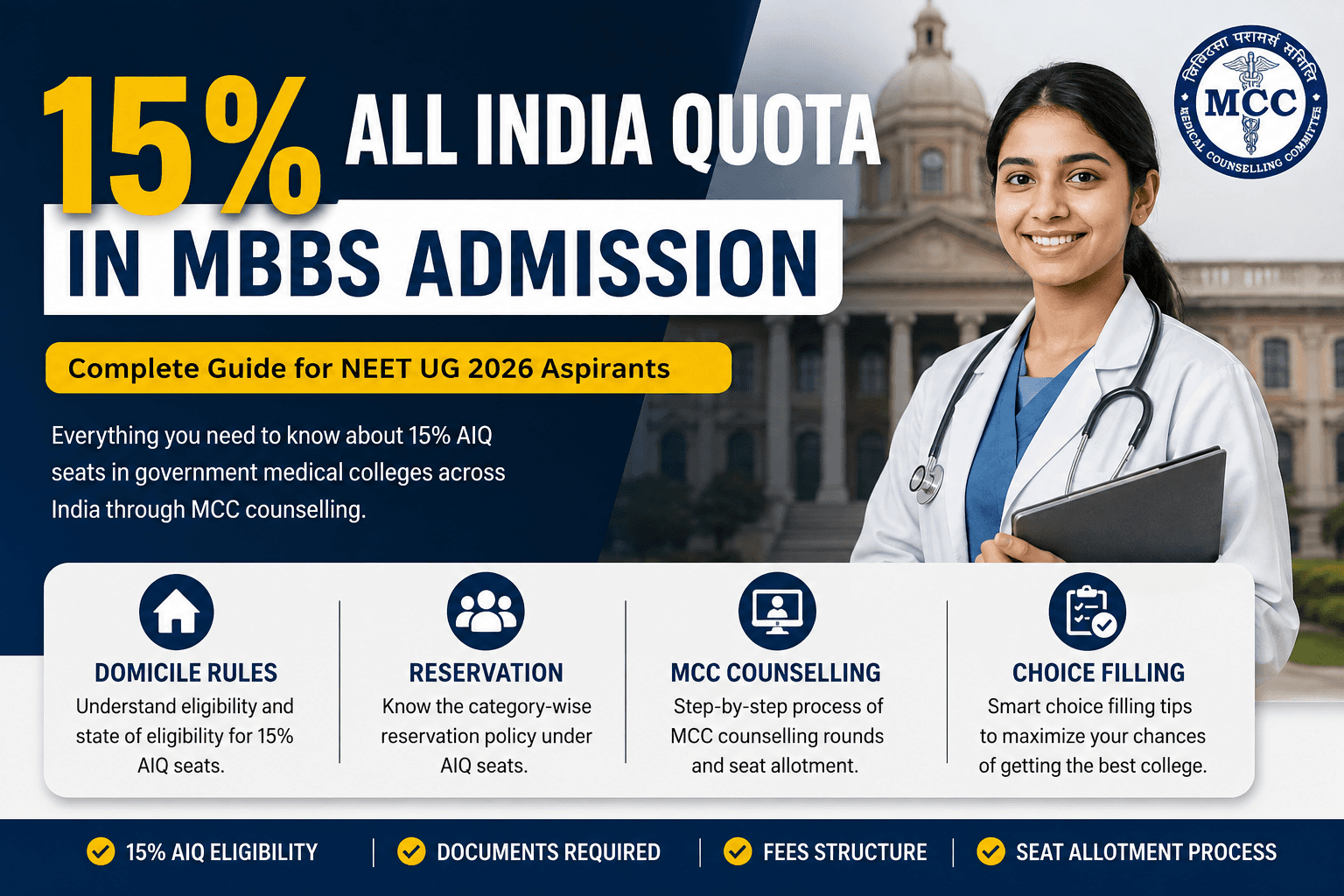
The 15% All India Quota in MBBS admission, commonly called the 15% AIQ, allows NEET-qualified candidates to compete for government medical college seats across India without being restricted to their home state.
Participating government medical and dental colleges contribute 15% of their seats to the All India Quota pool. The Medical Counselling Committee, or MCC, conducts online counselling for these seats based on the candidate’s NEET UG rank, reservation category, eligibility, submitted preferences and available seats.
The remaining seats in these colleges are generally filled through the respective state counselling authorities under State Quota rules. However, the exact seat distribution can differ for central universities, AIIMS, JIPMER, ESIC institutions and other special categories.
For the 2026 admission session, MCC published its UG Information Bulletin on 1 August 2026, and registration for UG counselling is scheduled to begin on 5 August 2026. Candidates should continue checking the official MCC portal because counselling dates and instructions may be revised.
Quick Answer: What Is the 15% All India Quota?
The 15% All India Quota in MBBS admission is a national pool of MBBS seats offered by participating government medical colleges.
These seats are:
- Open to eligible NEET-qualified candidates from across India
- Generally free from state-domicile restrictions
- Allotted through MCC NEET UG counselling
- Distributed according to NEET merit, reservation and candidate choices
- Separate from the 85% State Quota counselling process
A student from West Bengal, for example, can compete for a 15% AIQ seat in a participating government medical college in Maharashtra, Rajasthan, Uttar Pradesh, Karnataka, Gujarat, Assam or another state.
Latest MCC NEET UG Counselling 2026 Update
The MCC NEET UG Counselling 2026 Information Bulletin confirms several important points:
- MCC will conduct online counselling for 15% AIQ MBBS and BDS seats.
- AIQ counselling will have Round 1, Round 2, Round 3 and the Stray Vacancy Round.
- Open AIQ seats are domicile-free.
- Central Government reservation rules apply to the 15% AIQ pool.
- New Freeze and Float reporting options have been introduced for 2026.
- Both Freeze and Float candidates must upload the required documents online.
- Candidates joining a Round 3 seat cannot resign or participate in further counselling rounds.
What Does 15% AIQ Mean in NEET Counselling?
The term AIQ stands for All India Quota.
Under this system, 15% of MBBS and BDS seats in participating state government colleges are placed in a common national counselling pool. Eligible candidates from different states compete for these seats through MCC counselling.
Example of 15% AIQ seat calculation
Suppose a government medical college has 200 MBBS seats.
| Seat category | Illustrative number of seats |
|---|---|
| 15% All India Quota | 30 |
| Remaining State Quota | 170 |
| Total MBBS seats | 200 |
This is only a basic example. The actual seat matrix may differ because of:
- Reservation rosters
- Institutional quotas
- Seat increases or withdrawals
- Central university rules
- Special categories
- Court directions
- Changes issued by MCC or the institution
Candidates must therefore check the official MCC seat matrix before filling choices.
Who Conducts the 15% All India Quota Counselling?
The Medical Counselling Committee of the Directorate General of Health Services, under the Ministry of Health and Family Welfare, conducts counselling for the 15% All India Quota.
MCC is responsible for:
- Publishing the counselling schedule
- Opening online registration
- Collecting the registration fee and security deposit
- Publishing the participating college list
- Releasing the AIQ seat matrix
- Conducting choice filling and locking
- Processing seat allotment
- Publishing counselling results
- Managing reporting and upgradation
- Conducting subsequent counselling rounds
MCC states that it does not allot seats manually or through nomination. Candidates must register and complete the process through the official MCC portal.
Is Domicile Required for 15% All India Quota MBBS Seats?
No. Domicile is generally not required for open 15% AIQ seats.
The MCC 2026 bulletin specifically describes 15% All India Quota counselling as domicile-free. A candidate can therefore apply for eligible AIQ seats in participating government medical colleges outside their home state.
However, candidates should not assume that every seat listed on the MCC portal is domicile-free. MCC also conducts counselling for institutional, internal and state quota seats of certain central universities and institutes.
Before selecting a college, check whether the seat is listed under:
- 15% All India Quota
- Open quota
- State quota
- Institutional quota
- Internal quota
- ESIC Insured Persons quota
- NRI quota
- Deemed university quota
Eligibility can differ between these seat types.
Who Is Eligible for 15% AIQ MBBS Admission?
A candidate must satisfy the applicable NEET UG, NMC, MCC and institutional eligibility conditions.
In general, a candidate must:
- Qualify NEET UG 2026
- Be eligible for admission to the MBBS course
- Register separately for MCC NEET UG counselling
- Pay the required counselling fee and security deposit
- Provide accurate personal and category information
- Complete choice filling and choice locking
- Upload the prescribed documents
- Produce original documents during physical reporting
- Fulfil the allotted college’s eligibility requirements
Registering for MCC counselling does not create an automatic right to an MBBS seat. Admission depends on merit, category, eligibility, college preference and seat availability.
Is Separate MCC Registration Required?
Yes. NEET UG examination registration and MCC counselling registration are separate processes.
Qualifying NEET UG makes a candidate eligible to participate, but the candidate must register separately on the MCC website to be considered for AIQ seat allotment.
Candidates should use the mobile number and email address provided during NTA registration because MCC states that counselling OTPs will be sent to those registered contact details.
15% All India Quota vs 85% State Quota
One of the most searched questions among NEET candidates is the difference between 15% AIQ and 85% State Quota.
| Particular | 15% All India Quota | 85% State Quota |
|---|---|---|
| Counselling authority | Medical Counselling Committee | Respective state authority |
| Candidate pool | Eligible candidates across India | Candidates eligible under state rules |
| Domicile requirement | Generally not required | Usually required |
| Reservation policy | Central Government rules | State reservation policy |
| Registration portal | MCC portal | State counselling portal |
| Merit consideration | NEET UG rank and AIQ rules | NEET rank and state merit rules |
| Choice filling | Conducted through MCC | Conducted through state portal |
| College coverage | AIQ seats of participating institutions | Seats under state authority |
| Registration | Separate MCC registration | Separate state registration |
| Bond and fee rules | Depend on the allotted college/state | Depend on state and institution |
Candidates may generally participate in both AIQ and State Quota counselling, provided they meet the eligibility criteria and comply with the joining, resignation and seat-holding rules.
Which Seats Are Included in MCC UG Counselling?
MCC counselling includes more than the 15% All India Quota.
The MCC’s undergraduate responsibilities include counselling for:
- 15% AIQ MBBS and BDS seats of participating states
- 100% MBBS seats of AIIMS
- 100% JIPMER seats
- BHU seats
- AMU seats
- Certain Delhi University and IP University seats
- ESIC seats under applicable categories
- Faculty of Dentistry, Jamia Millia Islamia
- Deemed university MBBS and BDS seats
- AFMC registration
- Certain central institutes and universities
However, all these seats should not be described as 15% AIQ seats. For example, MCC conducts counselling for 100% of AIIMS MBBS seats, but AIIMS seats are different from the 15% seats contributed by state government colleges.
Reservation Policy for 15% AIQ MBBS Seats
The Central Government reservation policy applies to the 15% All India Quota.
| Category | Reservation under AIQ |
|---|---|
| Scheduled Castes | 15% |
| Scheduled Tribes | 7.5% |
| OBC–Non-Creamy Layer | 27% |
| Economically Weaker Section | 10% |
| Persons with Disabilities | 5% horizontal reservation |
The 5% PwD reservation is horizontal and is applied according to the applicable NMC norms.
OBC-NCL requirements for AIQ
Candidates seeking OBC reservation under AIQ should ensure that:
- Their community is included in the Central OBC List.
- They belong to the Non-Creamy Layer.
- Their certificate is issued by a competent authority.
- The certificate follows the prescribed format.
- The certificate is valid for the relevant counselling session.
A caste included only in a state OBC list may not qualify for OBC-NCL reservation under the Central All India Quota.
EWS certificate requirements
Candidates claiming EWS reservation must submit a valid EWS certificate in the prescribed Central Government format.
PwD certificate requirements
PwD candidates must fulfil the relevant disability and medical eligibility requirements and obtain the required certificate from an authorised assessment centre.
Incorrect category information or failure to produce valid supporting documents can result in cancellation of the allotted seat.
How Does 15% AIQ Counselling Work?
The 15% All India Quota counselling process includes registration, fee payment, choice filling, allotment and reporting.
Step 1: MCC counselling registration
Candidates must visit the MCC portal and complete online registration using their NEET UG details.
All information should be checked carefully before submission. MCC states that the information taken from the NTA record may be used during counselling and may not be changed later.
Step 2: Pay the registration fee and security deposit
Candidates must pay:
- A non-refundable registration fee
- A refundable security deposit
Only candidates who complete the required payment can proceed to choice filling.
Step 3: Check the AIQ seat matrix
Before filling choices, candidates should check:
- College name
- Course
- Seat category
- Quota type
- Number of available seats
- College fees
- Hostel charges
- Service bond
- Bond penalty
- Internship stipend
- Location and connectivity
Step 4: Fill college choices
Candidates can select colleges and arrange them in their genuine order of preference.
The most preferred college should be placed first. Candidates should not arrange colleges only according to predicted closing ranks.
Step 5: Lock the choices
Candidates must review and lock their choices within the MCC schedule.
Once choices are locked, changes may not be permitted. MCC advises candidates to verify fees, bonds and institutional conditions before finalising choices.
Step 6: Seat allotment
MCC processes allotment on the basis of:
- NEET UG rank
- Reservation category
- Submitted choices
- Seat availability
- Quota eligibility
- Institutional requirements
- Counselling rules
Step 7: Select Freeze or Float
A candidate receiving an allotment must follow the applicable Freeze or Float procedure.
Step 8: Upload documents
Both Freeze and Float candidates must upload clear scanned copies of the prescribed documents within the reporting period.
Step 9: Complete reporting or upgradation
Freeze candidates physically report to the allotted college, while eligible Float candidates can complete online document verification and seek upgradation.
Freeze and Float Options in MCC Counselling 2026
The MCC 2026 counselling scheme introduces a revised system for candidates who receive a seat.
Freeze: No upgradation
A Freeze candidate:
- Accepts the allotted seat
- Does not seek a better seat in the next round
- Uploads the required documents
- Physically reports to the allotted institution
- Completes original document verification
- Pays the institutional admission fee
- Finalises admission
Freeze is suitable for candidates who are satisfied with their allotted college.
Float: Willing to upgrade
A Float candidate:
- Provisionally accepts the allotted seat
- Remains willing to upgrade in the next round
- Submits willingness online
- Uploads the required documents
- Completes online document verification
- Does not initially need to visit the allotted college physically
The allotted institute can raise a query when it finds:
- Blurred documents
- Missing documents
- Incorrect certificates
- Category mismatches
- Inconsistencies between claims and documents
The candidate must upload corrected documents within the reporting schedule.
How Many Rounds Are There in AIQ Counselling?
MCC conducts four principal rounds for 15% All India Quota seats:
- AIQ Round 1
- AIQ Round 2
- AIQ Round 3
- AIQ Stray Vacancy Round
MCC also states that AIQ seats are not returned to participating states after Round 2 and that upgradation is available up to Round 3.
AIQ Round 1
Round 1 normally includes:
- Registration
- Fee payment
- Choice filling
- Choice locking
- Seat allotment
- Freeze or Float selection
- Document upload
- Reporting or upgradation
Round 1 generally permits free exit according to the applicable MCC schedule.
AIQ Round 2
Round 2 can include:
- Fresh registration for eligible candidates
- Fresh choice filling
- Seat allotment
- Joining or upgradation
- Exit with forfeiture in applicable cases
A candidate who receives a Round 2 or later seat and does not join may lose the security deposit.
AIQ Round 3
Round 3 has stricter rules.
Candidates should understand that:
- Non-joining can result in forfeiture of the security deposit.
- A joined Round 3 seat cannot be resigned.
- A candidate joining in Round 3 cannot participate in further counselling.
- Round 3 candidates and retained Float candidates must complete mandatory physical reporting according to MCC instructions.
AIQ Stray Vacancy Round
The Stray Vacancy Round fills seats remaining after earlier rounds.
Candidates may be ineligible when they:
- Already hold or have joined a medical seat
- Have been allotted a Round 3 seat
- Are included in the joined-candidate data shared between MCC and states
- Fail to fulfil stray-round registration requirements
- Fall under another MCC ineligibility condition
Candidates should read the specific Stray Vacancy Round notice before participating.
MCC Counselling Fees for 15% AIQ Seats in 2026
The MCC 2026 bulletin specifies the following payment structure for 15% AIQ and specified central institution seats:
| Candidate category | Non-refundable registration fee | Refundable security deposit | Total |
|---|---|---|---|
| UR/EWS | ₹1,000 | ₹10,000 | ₹11,000 |
| SC/ST/OBC/PwD | ₹500 | ₹5,000 | ₹5,500 |
The security deposit may be forfeited if a candidate receives a seat in Round 2 or a subsequent round and fails to join, or if admission is cancelled because of incorrect information or invalid documents.
The refundable security amount is normally returned to the same bank account or payment source from which it was deposited after completion of the counselling process, subject to MCC’s refund conditions.
Documents Required for 15% AIQ MBBS Admission
Candidates should keep original documents, scanned copies and photocopies ready.
Commonly required documents include:
- MCC seat allotment letter
- NEET UG admit card
- NEET UG scorecard or rank letter
- Class 10 certificate
- Date-of-birth proof
- Class 12 certificate
- Class 12 marksheet
- Valid identity proof
- Passport-size photographs
- SC certificate, where applicable
- ST certificate, where applicable
- Central OBC-NCL certificate, where applicable
- EWS certificate, where applicable
- PwD certificate, where applicable
- NRI, OCI or foreign-national documents, where applicable
- Additional documents required by the allotted institution
Candidates should check the MCC bulletin and the allotted college’s reporting notice before admission. Failure to produce the required original documents can result in cancellation.
What Is the AIQ Cut-Off for MBBS Admission?
There is no single fixed 15% AIQ MBBS cut-off for all government medical colleges.
The closing rank changes according to:
- NEET UG difficulty level
- Number of qualified candidates
- Number of available MBBS seats
- Candidate category
- College popularity
- College location
- Tuition fees
- Service bond
- Hospital patient flow
- Internship stipend
- Preference trends
- Counselling round
NEET qualifying cut-off vs AIQ admission cut-off
The NEET qualifying cut-off is the minimum score or percentile required to qualify for counselling.
The AIQ college cut-off is the opening or closing rank at which a particular college and category is allotted.
Qualifying NEET does not guarantee a government MBBS seat.
How to Prepare an AIQ Medical College Preference List
A well-planned preference list can significantly affect the final allotment.
Check medical college recognition
Verify the college, permitted seats and course information through official regulatory and institutional sources.
Compare the total MBBS fee
Do not examine only the annual tuition fee. Calculate:
- Tuition fees
- Admission charges
- Hostel fees
- Mess charges
- University fees
- Security deposit
- Examination fees
- Other institutional charges
Check the service bond
Government medical colleges in different states may have different bond conditions.
Check:
- Bond duration
- Bond penalty
- Compulsory service
- Rural service
- Post-MBBS obligations
- Exemption conditions
Evaluate hospital patient flow
A high-volume teaching hospital can provide broader clinical exposure during the clinical years and internship.
Compare internship conditions
Candidates should review:
- Internship stipend
- Duty conditions
- Departmental rotations
- Patient exposure
- Hostel availability
Consider location and language
Studying outside the home state may require adjustment to:
- Local language
- Climate
- Food
- Travel
- Cost of living
- Distance from family
Arrange choices by genuine preference
The most desired college should be placed first, followed by the second, third and subsequent preferences.
Do not place a less-preferred college above a better option merely because the less-preferred college appears more achievable.
Advantages of the 15% All India Quota
Access to colleges outside the home state
Candidates can compete for participating government medical colleges across India.
More MBBS admission options
Students can participate in AIQ counselling in addition to eligible State Quota counselling.
Domicile-free competition
Open 15% AIQ seats generally do not require domicile of the college’s state.
Centralised counselling
Allotment is processed through MCC on the basis of merit, eligibility, reservation and candidate preference.
Wider college comparison
Students can compare institutions based on fees, clinical exposure, infrastructure, bonds and location.
Limitations of the 15% All India Quota
Nationwide competition
AIQ seats attract candidates from across India and are often highly competitive.
Different state bond rules
An AIQ candidate remains subject to the bond and service conditions of the allotted college or state.
Relocation expenses
Candidates studying outside their home state may incur additional hostel, travel and living costs.
Language challenges
Students may need to communicate with patients in the local language during clinical training.
Complex counselling rules
Candidates must coordinate MCC counselling with State Quota counselling and carefully follow resignation deadlines.
Common Mistakes in 15% AIQ Counselling
1. Not completing separate MCC registration
NEET registration does not automatically enrol a candidate in MCC counselling.
2. Filling too few choices
Selecting only a few highly competitive colleges can reduce the chance of allotment.
3. Ignoring college fees
Government medical colleges do not necessarily have identical fee structures.
4. Not checking service bonds
Bond duration and penalty can affect postgraduate plans and future employment.
5. Using an incorrect OBC certificate
AIQ OBC reservation requires compliance with Central OBC-NCL rules.
6. Arranging choices according to cut-off rather than preference
Candidates should arrange colleges in the order they genuinely want to join.
7. Ignoring quota eligibility
The same institution may display AIQ, institutional, state, NRI or internal seats.
8. Depending only on previous-year cut-offs
Past ranks are useful references, but they do not guarantee the current year’s allotment.
9. Missing document-upload deadlines
Both Freeze and Float candidates must upload the required documents under the 2026 process.
10. Participating in Round 3 without understanding the consequences
Round 3 has strict non-resignation and further-participation restrictions.
11. Depending on unofficial agents
Candidates should verify information from MCC, NTA, NMC, state counselling and college websites.
12. Waiting until the last day
Technical problems, payment failures or document discrepancies can prevent completion.
Frequently Asked Questions About 15% All India Quota
What is the 15% All India Quota in MBBS admission?
It is a national pool containing 15% of MBBS seats contributed by participating government medical colleges. MCC allots these seats through NEET UG counselling.
Is domicile required for 15% AIQ seats?
No. Open 15% All India Quota seats are generally domicile-free.
Who conducts AIQ MBBS counselling?
The Medical Counselling Committee under DGHS, Ministry of Health and Family Welfare, conducts AIQ counselling.
Can I apply for both AIQ and State Quota counselling?
Yes. Eligible candidates can generally participate in both, but separate registration and choice filling are required.
Are AIIMS seats part of the 15% AIQ?
No. MCC conducts counselling for 100% of AIIMS MBBS seats, but AIIMS seats are not the same as the 15% state-contributed AIQ pool.
Is OBC reservation available under AIQ?
Yes. Eligible OBC-NCL candidates receive 27% reservation according to the Central OBC List and applicable rules.
What is the EWS reservation under AIQ?
EWS candidates receive 10% reservation according to Central Government norms.
How many rounds are conducted for AIQ counselling?
MCC conducts Round 1, Round 2, Round 3 and the Stray Vacancy Round.
What is the Freeze option?
Freeze means that the candidate accepts the allotted college and does not seek upgradation.
What is the Float option?
Float means that the candidate provisionally accepts the allotted seat but remains willing to upgrade in the next round.
Can I resign from a Round 3 AIQ seat?
A candidate cannot resign from an allotted and joined Round 3 seat under the MCC 2026 counselling scheme.
What happens if I do not join a Round 2 seat?
The candidate’s security deposit may be forfeited.
Are private medical colleges included in the 15% AIQ?
The traditional 15% AIQ primarily refers to seats contributed by participating government medical colleges. Private and deemed university seats follow separate quota, fee and counselling structures.
Is the AIQ cut-off higher than the State Quota cut-off?
It depends on the college, category, state and counselling year. AIQ involves nationwide competition, but some State Quota seats can also have highly competitive closing ranks.
How many colleges should I select during AIQ choice filling?
Candidates should include every college they are genuinely willing and financially able to join, subject to MCC’s choice-filling instructions.
Conclusion
The 15% All India Quota in MBBS admission gives NEET-qualified candidates an opportunity to compete for government medical college seats across India without being restricted to their domicile state.
However, a successful AIQ counselling strategy requires more than qualifying NEET. Candidates must understand MCC registration, reservation rules, counselling rounds, Freeze and Float options, document requirements, fees, service bonds and choice-filling principles.
For NEET UG 2026, candidates should pay particular attention to the revised online document-verification process and the strict Round 3 rules.
A carefully prepared AIQ preference list can help a candidate secure the most suitable available medical college according to rank, category, affordability and career priorities.
EducationMESD provides guidance for NEET UG counselling, AIQ and State Quota planning, MBBS college selection, document preparation and choice filling. Students and parents should verify all final decisions against the latest official MCC and institutional notices.
Disclaimer: Counselling schedules, seat matrices, fees, eligibility conditions, reservation rules and reporting procedures may be revised by MCC, NTA, NMC, state authorities or participating institutions. Candidates must check the latest official notices before registration, choice locking, payment or admission.