
Government vs Private Medical Colleges in India: Fees, Facilities and Career Opportunities in 2026
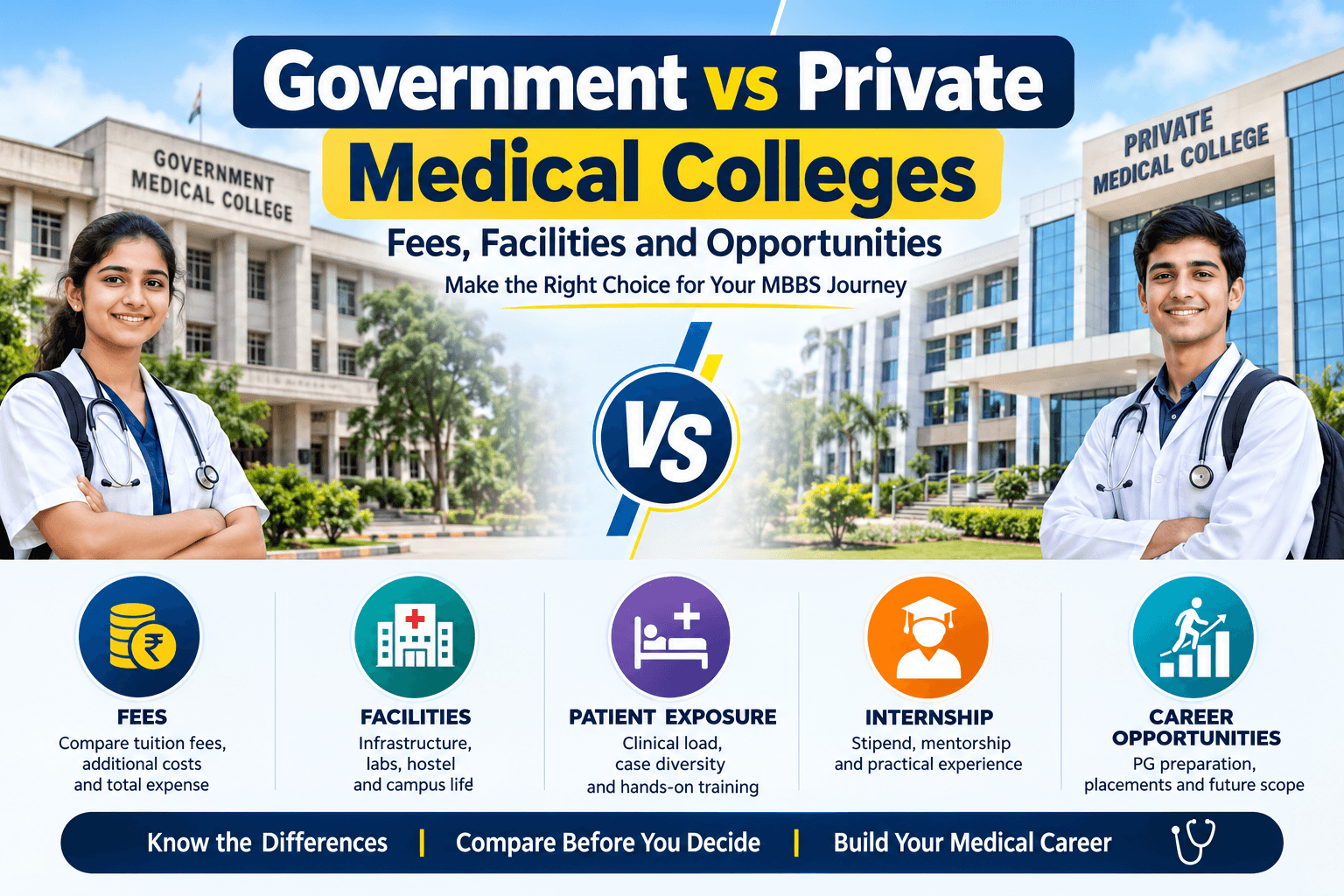
Choosing between government vs private medical colleges is one of the most important decisions candidates must make during NEET UG counselling. The type of medical college you select can affect your total MBBS expenses, clinical exposure, internship experience, campus life and future career planning.
Government medical colleges are usually preferred because of their comparatively affordable fees, established teaching hospitals and high patient inflow. Private medical colleges, on the other hand, may provide modern infrastructure, advanced laboratories, structured academic systems and better campus facilities.
However, a government medical college is not automatically better than every private medical college. Similarly, an attractive private medical college campus does not necessarily guarantee excellent clinical training.
Before filling and locking choices, candidates should compare:
- MBBS tuition fees
- Total course expenses
- NMC recognition status
- Teaching-hospital patient flow
- Faculty availability
- Clinical exposure
- Internship stipend
- Service bond
- Hostel facilities
- Location and safety
- Post-MBBS opportunities
This detailed guide explains the difference between government and private medical colleges in India and helps NEET UG 2026 candidates make a practical, informed and financially responsible decision.
Government vs Private Medical Colleges: Quick Comparison
| Comparison factor | Government medical colleges | Private medical colleges |
|---|---|---|
| MBBS tuition fees | Generally lower and subsidised | Usually considerably higher |
| NEET UG competition | Very high | Depends on college and seat category |
| Required NEET rank | Usually more competitive | Wider range depending on quota |
| Patient exposure | Often high because of large patient inflow | Varies according to the attached hospital |
| Clinical case diversity | Usually broad | Strong in established teaching hospitals |
| Infrastructure | May be older but functional | Often modern and well maintained |
| Simulation laboratories | Available in leading institutions | Common in many established private colleges |
| Hostel expenses | Usually lower | Generally higher |
| Faculty experience | Strong in many established colleges | Varies considerably between institutions |
| Internship workload | Often intensive | Depends on hospital occupancy and patient flow |
| Internship stipend | Governed by applicable institutional or state policy | Amount and regularity may vary |
| Service bond | Applicable in several states | May also apply according to state rules |
| Research opportunities | Strong in leading government institutions | Good in selected private and deemed universities |
| Campus amenities | Usually basic to moderate | Often better developed |
| Financial burden | Comparatively lower | Can be substantial |
| Career eligibility | Recognised MBBS graduates can pursue standard career pathways | Same, subject to recognised qualification and applicable rules |
What Is a Government Medical College?
A government medical college is established, funded or administered by the central government, a state government, a municipal authority or another government-controlled institution.
Because a significant portion of the cost is publicly funded, MBBS tuition fees in government medical colleges are generally lower than fees in private medical colleges.
Government medical colleges are commonly attached to large public hospitals that treat patients from different economic and social backgrounds. This can provide undergraduate students with exposure to a wide range of medical conditions, emergency cases, surgeries, maternal healthcare services and public-health programmes.
Examples of government-controlled medical institutions include:
- State government medical colleges
- Central government institutions
- All India Institute of Medical Sciences institutions
- Government autonomous medical colleges
- Municipal medical colleges
- Employee State Insurance medical colleges
- Medical colleges operated by government societies
Admission to most government MBBS seats is based on NEET UG rank, category, quota, domicile eligibility and counselling rules.
What Is a Private Medical College?
A private medical college is operated by a private educational trust, society, university, charitable organisation or private institution.
Private medical colleges may offer different categories of seats, depending on the state and institution, such as:
- Government-quota seats
- State-quota seats
- Private-quota seats
- Management-quota seats
- Minority-quota seats
- Institutional-quota seats
- NRI-quota seats
The fee for each seat category can be different, even within the same medical college.
Some private medical colleges are affiliated with state health universities, while others are part of deemed-to-be universities. Candidates must understand the applicable counselling authority before registration and choice filling.
MCC conducts counselling for 15% All India Quota MBBS and BDS seats contributed by participating states, along with specified central institutions and other categories under its jurisdiction. Candidates must follow the relevant state counselling authority for the applicable state-quota and private-college seats.
Government vs Private Medical Colleges: Detailed Comparison
1. MBBS Fees in Government vs Private Medical Colleges
The most significant difference between government and private medical colleges is the cost of MBBS education.
Government medical college fees
Government medical college fees are generally subsidised. This makes government colleges financially accessible to students from a wider range of socioeconomic backgrounds.
However, government medical college fees are not identical across India. The amount may depend on:
- State fee regulations
- Type of government institution
- University charges
- Candidate category
- Hostel selection
- Bond conditions
- Institutional policies
Candidates should not assume that every government medical college charges the same annual fee.
Private medical college fees
Private medical college fees are normally higher because the institutions receive less direct government funding and bear significant expenditure on faculty, hospitals, laboratories, equipment, infrastructure and campus administration.
The fee can vary according to:
- College reputation
- State fee regulation
- Government or management quota
- Minority status
- Deemed university status
- NRI quota
- Hostel type
- Location
- Attached hospital facilities
A government-quota seat in a private medical college may be considerably more affordable than a management or NRI seat in the same college.
Important rule regarding MBBS tuition duration
The National Medical Commission has clarified that MBBS course fees should be charged only for the prescribed academic duration of four and a half years. The academic course is followed by compulsory rotating medical internship.
Candidates should examine any demand for tuition beyond the prescribed academic duration and seek written clarification from the institution and appropriate counselling authority.
2. Total Cost of MBBS Education
Candidates frequently compare colleges using only the annual tuition fee. This can lead to serious financial miscalculations.
The total cost of MBBS in India may include much more than tuition.
Additional expenses to calculate
| Expense | Points to verify |
|---|---|
| Tuition fee | Annual amount and permitted escalation |
| Admission fee | One-time or recurring |
| Security deposit | Refundable or non-refundable |
| Hostel fee | Mandatory or optional |
| Mess charges | Monthly or annual |
| University registration | One-time or yearly |
| Examination fee | University and supplementary examinations |
| Laboratory fee | Included in tuition or separate |
| Library fee | Included or separately charged |
| Clinical instruments | Stethoscope, dissection kit and examination tools |
| Books and subscriptions | Printed and digital resources |
| Transport | Hostel-to-hospital or college transport |
| Electricity and internet | Included or separately charged |
| Internship-related charges | Verify whether any are applicable |
| Service-bond penalty | Amount payable for non-compliance |
| Discontinuation penalty | Consequences of leaving the course |
| Miscellaneous charges | Sports, cultural activities and student services |
Before selecting a private MBBS seat, families should prepare a complete course budget covering at least:
- Four-and-a-half years of academic study
- One year of compulsory internship
- Hostel and living expenses
- Annual fee increases
- Travel expenses
- Emergency financial requirements
A medical college should be considered affordable only when the family can manage the complete cost—not merely the first-year fee.
3. NEET Rank and Admission Competition
Government medical college seats are highly competitive because of their lower fees, established reputation and strong patient exposure.
Candidates generally require a better NEET rank to obtain:
- Government medical college seats
- Popular state-quota colleges
- All India Quota seats
- Government colleges in metropolitan cities
- Established institutions with strong postgraduate departments
Private medical colleges may remain available at a wider range of NEET ranks, depending on:
- Seat category
- State
- College demand
- Tuition fee
- Counselling round
- Candidate category
- Domicile rules
- NRI eligibility
However, qualifying NEET UG does not guarantee admission to a particular private college or seat category.
Candidates must participate only through the official counselling process. They should avoid agents or intermediaries who promise:
- Confirmed admission without counselling
- Admission without NEET eligibility
- A seat through cash payment
- Backdoor admission
- Guaranteed seat conversion
- Unofficial management approval
All medical colleges and approved MBBS seats should be verified through the National Medical Commission’s College and Course Search and the latest applicable seat matrix. NMC’s current search facility includes the institution’s management type, annual intake, recognition status and permission details.
4. Infrastructure and Campus Facilities
Infrastructure in government medical colleges
Established government medical colleges may have:
- Large teaching hospitals
- Emergency and trauma departments
- Operation theatres
- Intensive care units
- Blood banks
- Diagnostic laboratories
- Community medicine facilities
- Medical libraries
- Museums and demonstration rooms
- Speciality and super-speciality departments
- Rural and urban health centres
Some government colleges, particularly older institutions, may have ageing buildings, crowded wards or basic hostel facilities.
Candidates should not reject a government medical college only because the buildings appear old. A busy teaching hospital with experienced faculty and strong clinical exposure can provide excellent medical education even when the campus is not visually impressive.
Infrastructure in private medical colleges
Many private medical colleges invest heavily in:
- Modern lecture theatres
- Smart classrooms
- Digital libraries
- Clinical skills laboratories
- Simulation centres
- Advanced diagnostic equipment
- Air-conditioned academic blocks
- Well-maintained hostels
- Sports facilities
- Campus security
- Wi-Fi connectivity
- Hospital information systems
These facilities can create a structured and comfortable learning environment.
However, candidates must verify whether the equipment and laboratories are regularly used for undergraduate teaching. Infrastructure should support medical learning rather than function only as a promotional feature.
5. Patient Exposure and Clinical Training
Clinical exposure is one of the most important factors when choosing an MBBS college.
A medical student must learn how to:
- Take patient history
- Perform physical examinations
- Develop clinical reasoning
- Interpret laboratory reports
- Understand radiological findings
- Observe medical procedures
- Participate in supervised patient care
- Communicate with patients and families
- Respond to emergency situations
- Work with multidisciplinary healthcare teams
Patient exposure in government colleges
Government hospitals often receive a high number of patients because treatment is free or comparatively affordable.
This may provide exposure to:
- Common diseases
- Advanced untreated conditions
- Emergency cases
- Trauma
- Infectious diseases
- Maternal and child healthcare
- Surgical cases
- Chronic illnesses
- Rural healthcare challenges
- Public-health programmes
High patient inflow can be an important advantage, but the quality of learning also depends on faculty supervision, departmental organisation and opportunities for student participation.
Patient exposure in private colleges
Patient exposure in private medical colleges varies significantly.
Established private teaching hospitals may have:
- High outpatient attendance
- Strong surgical departments
- Advanced diagnostic facilities
- Modern intensive care units
- Speciality and super-speciality services
- Organised clinical documentation
- Experienced consultants
Newer or poorly located private colleges may have lower patient attendance, which can reduce clinical learning opportunities.
What candidates should verify
Before selecting a college, ask about:
- Average outpatient attendance
- Hospital bed occupancy
- Number of functioning beds
- Emergency patient volume
- Daily deliveries
- Major and minor surgeries
- ICU and NICU facilities
- Diagnostic workload
- Blood-bank availability
- Community health postings
- Clinical rotations
- Number of postgraduate departments
Do not judge clinical exposure only from the number of hospital beds mentioned in the brochure. Actual occupancy and patient turnover are more meaningful.
6. Faculty Quality and Academic Environment
Faculty quality depends on experience, availability, stability and involvement in undergraduate teaching.
Government medical college faculty
Established government medical colleges may provide:
- Experienced senior professors
- Faculty managing complex clinical cases
- Strong departmental traditions
- Exposure to postgraduate teaching
- Government healthcare experience
- Research guidance
- Public-health programme exposure
- Established alumni networks
Possible limitations may include:
- Large student batches
- Heavy patient workload
- Less individual attention
- Vacant faculty positions in some newer colleges
- Administrative delays
Private medical college faculty
Good private medical colleges may provide:
- Structured academic calendars
- Regular internal assessments
- Tutorial-based learning
- Digital learning systems
- Faculty mentoring
- Simulation-based teaching
- Smaller academic groups
- Research support
- International collaborations
However, faculty turnover can affect teaching continuity in some institutions.
Candidates should speak with current students to understand:
- Whether regular classes are conducted
- Whether professors are available
- How clinical postings are organised
- Whether internal assessments are fair
- Whether academic doubts are addressed
- Whether faculty members remain associated with the college long term
7. Hostel Facilities and Campus Life
MBBS is academically demanding, and students often spend five-and-a-half years around the college and hospital. Therefore, hostel conditions can significantly affect health, safety and academic performance.
Government medical college hostels
Government hostels are generally more affordable. However, facilities may vary in terms of:
- Room sharing
- Cleanliness
- Washrooms
- Water supply
- Internet connectivity
- Maintenance
- Mess quality
- Security
- Availability during internship
Private medical college hostels
Private colleges often provide:
- Better-maintained rooms
- Security systems
- Internet access
- Recreational facilities
- Housekeeping
- Attached washrooms in selected categories
- Modern mess facilities
- Campus transport
- Separate hostel blocks
These facilities usually come with higher hostel and mess charges.
Hostel checklist
Candidates should verify:
- Is hostel accommodation compulsory?
- Are hostel fees refundable?
- Is the hostel available during internship?
- How many students share one room?
- Is the campus safe?
- Is the hospital within walking distance?
- Are food and drinking water satisfactory?
- Is internet access available?
- Are there restrictions or curfew rules?
- Is electricity charged separately?
8. Internship Experience and Stipend
After completing the academic component of MBBS, students must complete compulsory rotating medical internship according to the applicable regulatory framework.
Internship commonly includes rotations in areas such as:
- General medicine
- General surgery
- Paediatrics
- Obstetrics and gynaecology
- Community medicine
- Emergency medicine
- Orthopaedics
- Psychiatry
- Anaesthesiology
- Elective or allied departments
Internship in government medical colleges
Government-college interns may receive extensive hands-on exposure because of:
- High patient volume
- Busy emergency departments
- Labour-room duties
- Ward responsibilities
- Public-health postings
- Frequent procedures
- High clinical workload
The stipend and working conditions depend on the relevant state or institutional policy.
Internship in private medical colleges
The quality of internship in private colleges depends on:
- Hospital patient flow
- Clinical workload
- Faculty supervision
- Institutional policy
- Availability of postgraduate residents
- Number of interns
- Stipend rules
Some private institutions provide strong, supervised clinical training, while others may offer limited responsibilities or variable stipend arrangements.
Questions to ask current interns
- What is the monthly internship stipend?
- Is it paid regularly?
- What is the average duty duration?
- Are interns allowed to perform procedures under supervision?
- How busy are the medicine and surgery departments?
- How many deliveries occur in the hospital?
- Is hostel accommodation available during internship?
- Are interns charged any additional fee?
- Is attendance managed transparently?
- Are rural or community postings properly organised?
9. Service Bond and Discontinuation Penalty
A service bond may require an MBBS graduate to work for a specified period in a government or designated health facility after graduation.
Bond rules vary by:
- State
- Institution
- Seat category
- Counselling authority
- Admission year
Candidates should verify:
- Mandatory service duration
- Rural-service requirement
- Bond penalty
- Conditions for exemption
- Postings after graduation
- Whether postgraduate admission affects the bond
- Rules for returning original documents
- Whether the bond applies to all seat categories
Students should also examine the discontinuation clause.
Leaving an MBBS course after admission may lead to:
- Loss of security deposit
- Payment of a discontinuation penalty
- Liability for remaining tuition
- Delay in returning documents
- Debarment under applicable counselling rules
- Forfeiture of counselling security money
Never accept a seat without reading the official bond and discontinuation conditions.
10. Research and Academic Opportunities
Research in government medical colleges
Leading government institutions may offer:
- Established research departments
- Faculty-led clinical studies
- Community health research
- Government-funded projects
- Institutional ethics committees
- Scientific conferences
- Case-report opportunities
- Postgraduate and super-speciality exposure
Research in private medical colleges
Selected private and deemed universities may provide:
- Modern research laboratories
- Institutional funding
- Biomedical engineering collaborations
- Medical simulation research
- International partnerships
- Digital health projects
- Artificial intelligence in healthcare research
- Dedicated research centres
Research opportunities depend more on the individual institution than on whether the college is government or private.
Candidates interested in research should check:
- Faculty publications
- Research laboratories
- Ethics committee activity
- Student research programmes
- Conference participation
- Institutional grants
- Interdisciplinary collaborations
11. Career Opportunities After MBBS
Graduates from recognised government and private medical colleges can pursue the same broad professional pathways, subject to applicable eligibility, registration and recruitment requirements.
Career options after MBBS
- Junior residency
- Postgraduate medical education
- Government medical officer
- Private hospital employment
- Clinical practice
- Public-health services
- Medical research
- Medical teaching
- Hospital administration
- Healthcare management
- Armed forces medical services
- Clinical informatics
- Digital health
- Medical writing
- Pharmaceutical research
- Overseas licensing pathways
The name of the college may influence early networking and exposure, but long-term success generally depends on:
- Clinical competence
- Communication skills
- Professional ethics
- Academic performance
- Postgraduate entrance preparation
- Practical experience
- Research profile
- Continuous medical education
A student from a private medical college is not automatically disadvantaged in postgraduate entrance examinations or government recruitment.
Similarly, admission to a government college does not guarantee postgraduate success without consistent study and clinical skill development.
Advantages of Government Medical Colleges
The major benefits of studying MBBS in a government medical college may include:
- Comparatively affordable tuition fees
- Lower overall financial burden
- High patient inflow in many institutions
- Exposure to diverse clinical conditions
- Busy emergency and trauma departments
- Established faculty in older colleges
- Affordable hostel facilities
- Strong alumni networks
- Exposure to public-health systems
- Opportunities to understand rural healthcare
- Competitive academic environment
- Reduced dependence on educational loans
Government medical colleges are particularly attractive for candidates who secure a competitive NEET rank and want strong clinical exposure at a manageable cost.
Disadvantages of Government Medical Colleges
Possible limitations may include:
- Extremely high admission competition
- Older infrastructure in some institutions
- Crowded hospitals
- Limited hostel capacity
- Heavy clinical workload
- Large student batches
- Service-bond requirements
- Rural or remote locations
- Basic campus amenities
- Administrative delays
- Limited individual mentoring in some departments
These disadvantages are not applicable to every government college. Candidates must assess each institution separately.
Advantages of Private Medical Colleges
The potential advantages of private medical colleges include:
- Modern infrastructure
- Advanced clinical skills laboratories
- Simulation-based learning
- Digitised academic systems
- Better-maintained hostels
- Structured internal assessment
- Campus security
- Modern diagnostic facilities
- Organised mentoring in selected colleges
- Availability across a wider range of NEET ranks
- Research opportunities in selected universities
- Better recreational facilities
- Technology-enabled classrooms
A well-established private college with a busy teaching hospital can provide excellent medical education and clinical exposure.
Disadvantages of Private Medical Colleges
The major concerns include:
- High tuition fees
- Expensive hostel and mess charges
- Financial pressure on families
- Different fees for different quotas
- Possibility of annual fee escalation
- Variable patient inflow
- Variation in internship stipend
- Faculty turnover in some institutions
- Additional institutional charges
- High discontinuation penalties
- Dependence on the quality of the attached hospital
- Risk of selecting a college based only on infrastructure
Families should avoid taking an unaffordable private MBBS seat without carefully evaluating the long-term financial consequences.
Government or Private Medical College: Which Is Better?
There is no universal answer.
A government medical college may be the better option when:
- The candidate has a competitive NEET rank.
- The college has a strong teaching hospital.
- The family wants to minimise educational expenses.
- The candidate values high-volume clinical exposure.
- The bond conditions are acceptable.
- Hostel and location are manageable.
A private medical college may be appropriate when:
- A government seat is not available.
- The total fee is affordable without creating unmanageable debt.
- The college is recognised.
- The attached hospital has sufficient patient flow.
- Faculty members are stable and experienced.
- Internship conditions are satisfactory.
- The fee structure is transparent.
- Infrastructure genuinely supports clinical education.
The correct comparison is not simply government college vs private college.
Candidates should compare:
One specific government medical college against one specific private medical college.
A reputed private medical college may be preferable to a newly established government college with limited faculty, inadequate connectivity or an underdeveloped hospital. Conversely, a government college with excellent patient exposure may offer greater educational value than an expensive private institution with limited clinical workload.
How to Choose the Best Medical College After NEET UG
Step 1: Verify NMC recognition
Confirm:
- College name
- MBBS course approval
- Annual seat intake
- Recognition status
- Permission status
- Year of establishment
NMC’s College and Course Search currently provides filters for government and private institutions and displays annual intake and recognition-related information.
Step 2: Check the official counselling authority
Identify whether the seat is offered through:
- MCC counselling
- State counselling
- Central university counselling under MCC
- Deemed university counselling
- Institutional category permitted by the authority
Do not rely only on college representatives or agents.
Step 3: Calculate the complete MBBS cost
Include:
- Tuition
- Hostel
- Mess
- University charges
- Security deposit
- Examination fees
- Travel
- Instruments
- Fee escalation
- Bond implications
Step 4: Evaluate the teaching hospital
Check:
- Outpatient attendance
- Bed occupancy
- Emergency services
- Surgery volume
- Deliveries
- ICU facilities
- Diagnostic services
- Clinical departments
Step 5: Examine faculty and academic performance
Ask about:
- Faculty stability
- Class regularity
- University results
- Clinical teaching
- Internal assessment
- Mentoring
- Research support
Step 6: Check internship conditions
Verify:
- Monthly stipend
- Payment regularity
- Clinical duties
- Supervision
- Working hours
- Accommodation
Step 7: Understand the service bond
Read all clauses concerning:
- Mandatory service
- Bond duration
- Penalty
- Rural postings
- Document retention
- Exemptions
Step 8: Speak with current students
Speak with students from different batches, particularly:
- Second- or third-year MBBS students
- Final-year students
- Interns
- Recent graduates
Do not depend only on one student’s opinion.
Step 9: Visit the college when possible
Inspect:
- Hospital wards
- OPD
- Emergency department
- Hostels
- Library
- Laboratories
- Campus safety
- Transport
- Surrounding area
Step 10: Arrange choices in genuine preference order
Choice filling should reflect the college you genuinely prefer.
Do not place an unaffordable college higher merely because it has better buildings or stronger advertising.
Medical College Selection Scorecard
Use this 100-point scorecard to compare shortlisted colleges objectively.
| Selection criterion | Suggested weight |
|---|---|
| Teaching hospital and patient exposure | 20 |
| Total MBBS cost | 15 |
| NMC approval and seat status | 15 |
| Faculty and academic quality | 10 |
| Internship experience and stipend | 10 |
| Service bond and discontinuation rules | 10 |
| Infrastructure and laboratories | 5 |
| Hostel and campus safety | 5 |
| Location and connectivity | 5 |
| Student feedback and academic record | 5 |
| Total | 100 |
Score every college independently. This reduces the risk of choosing a college based only on reputation, fees or campus appearance.
Red Flags to Avoid While Selecting a Medical College
Be cautious when:
- The college or approved intake cannot be verified through NMC.
- The institution refuses to provide the complete fee structure.
- An agent demands cash for a confirmed seat.
- Admission is offered outside official counselling.
- The teaching hospital has very low patient attendance.
- Major departments are not functional.
- Students report frequent faculty shortages.
- Internship stipend information is unclear.
- Hostel charges are not disclosed.
- The institution demands tuition beyond the prescribed academic duration.
- The service bond is not clearly explained.
- The discontinuation penalty is extremely high.
- Original documents are retained without transparent rules.
- The college pressures candidates to make immediate unofficial payments.
Frequently Asked Questions
1. Is a government medical college better than a private medical college?
Government medical colleges are generally preferred because of lower fees and potentially higher patient inflow. However, quality varies. An established private medical college with experienced faculty and a busy teaching hospital may provide better training than a poorly developed or newly established institution.
2. Why are government medical college fees lower?
Government colleges receive public funding and subsidies. Therefore, students usually pay a smaller portion of the actual cost of medical education.
3. Is MBBS from a private medical college valid?
Yes, provided the medical college and MBBS intake are duly recognised or permitted by the competent authority and the candidate obtains admission through the authorised counselling process.
4. Do private medical college graduates get government jobs?
Graduates holding a recognised medical qualification can apply for eligible government recruitment, junior residency and postgraduate programmes according to the applicable rules.
5. Which type of college offers better patient exposure?
Government hospitals often receive larger patient volumes, but this is not true in every case. Several established private teaching hospitals also provide excellent clinical exposure. Candidates should evaluate actual patient flow and hospital occupancy.
6. Are private medical colleges available at lower NEET ranks?
Some private, management and NRI seats may be available at lower closing ranks than government seats. Availability depends on the state, quota, fees, counselling round and candidate eligibility.
7. Is the MBBS degree different in government and private colleges?
The degree pathway is broadly the same when the programme is properly recognised and affiliated. The main differences are generally related to cost, institution, clinical environment, faculty, infrastructure and student experience.
8. Can an MBBS college charge tuition during internship?
NMC has clarified that MBBS course fees should be charged only for the prescribed four-and-a-half-year academic duration. Candidates should carefully verify any separately claimed internship-related charge.
9. Should I take an education loan for a private MBBS seat?
An education loan should be considered only after evaluating the total course cost, interest burden, repayment period, family income and likely post-MBBS financial position. Avoid taking an unsustainable loan only because a seat is immediately available.
10. What should I check before choosing a private medical college?
Check NMC status, total fees, patient exposure, faculty, hospital facilities, internship stipend, hostel conditions, bond rules and feedback from current students.
11. What is more important: infrastructure or patient exposure?
Both are important, but patient exposure and supervised clinical training are generally more critical for developing medical competence. Modern infrastructure has limited value if the hospital does not receive sufficient patients.
12. Can I upgrade from a private college to a government college?
Upgradation depends on the applicable counselling scheme, round, choice order, seat availability and rules. Candidates should read the official counselling information bulletin carefully before participating.
13. Is a government-quota seat in a private college a good option?
It can be a valuable option when the fee is regulated or comparatively affordable and the college has strong clinical exposure, good faculty and satisfactory internship conditions.
14. Should I prefer an old private college over a new government college?
Consider patient flow, faculty, fees, location, hospital development and recognition status. An established private college may offer better clinical and academic stability, while the new government college may offer lower fees. The decision should be based on a college-to-college comparison.
15. How can EducationMESD help during NEET counselling?
EducationMESD can assist candidates in understanding counselling procedures, quotas, college comparison, fee structures, choice filling, documentation and admission planning.
Final Verdict: Government vs Private Medical Colleges
For most NEET UG candidates, a recognised government medical college with good patient exposure is the preferred choice because it combines affordable education with extensive clinical learning.
However, securing a government MBBS seat requires a competitive rank, and the available college may not always match the candidate’s preferred location, infrastructure or personal circumstances.
A good private medical college can be a practical alternative when:
- The total cost is affordable.
- The college and seats are officially recognised.
- The attached hospital has adequate patient flow.
- Faculty members are experienced and stable.
- Internship training is meaningful.
- The stipend policy is transparent.
- Hostel and campus facilities are satisfactory.
- The family understands all bond and penalty conditions.
The best medical college is not necessarily the cheapest college, the most expensive college or the college with the most attractive campus.
The best choice is the institution that offers:
- Recognised medical education
- Strong clinical exposure
- Experienced faculty
- Transparent fees
- Financial sustainability
- Meaningful internship training
- A safe learning environment
- Opportunities for professional growth
Choose carefully, verify every claim and never make an MBBS admission decision under pressure from agents or unofficial representatives.
Need Help Choosing the Right Medical College?
Selecting a medical college requires much more than comparing NEET cut-offs.
EducationMESD supports students and parents with:
- Government and private medical college comparison
- MBBS fee analysis
- All India Quota and state-quota guidance
- Domicile and category eligibility
- Choice filling and preference-list preparation
- Bond and penalty evaluation
- Counselling documentation
- College shortlisting
- MBBS admission guidance
Make your medical college decision using verified information, realistic financial planning and a properly structured choice list.
Contact EducationMESD before locking your NEET UG counselling choices.