
How to Find and Contact a PhD Supervisor Abroad in 2027: Complete Guide
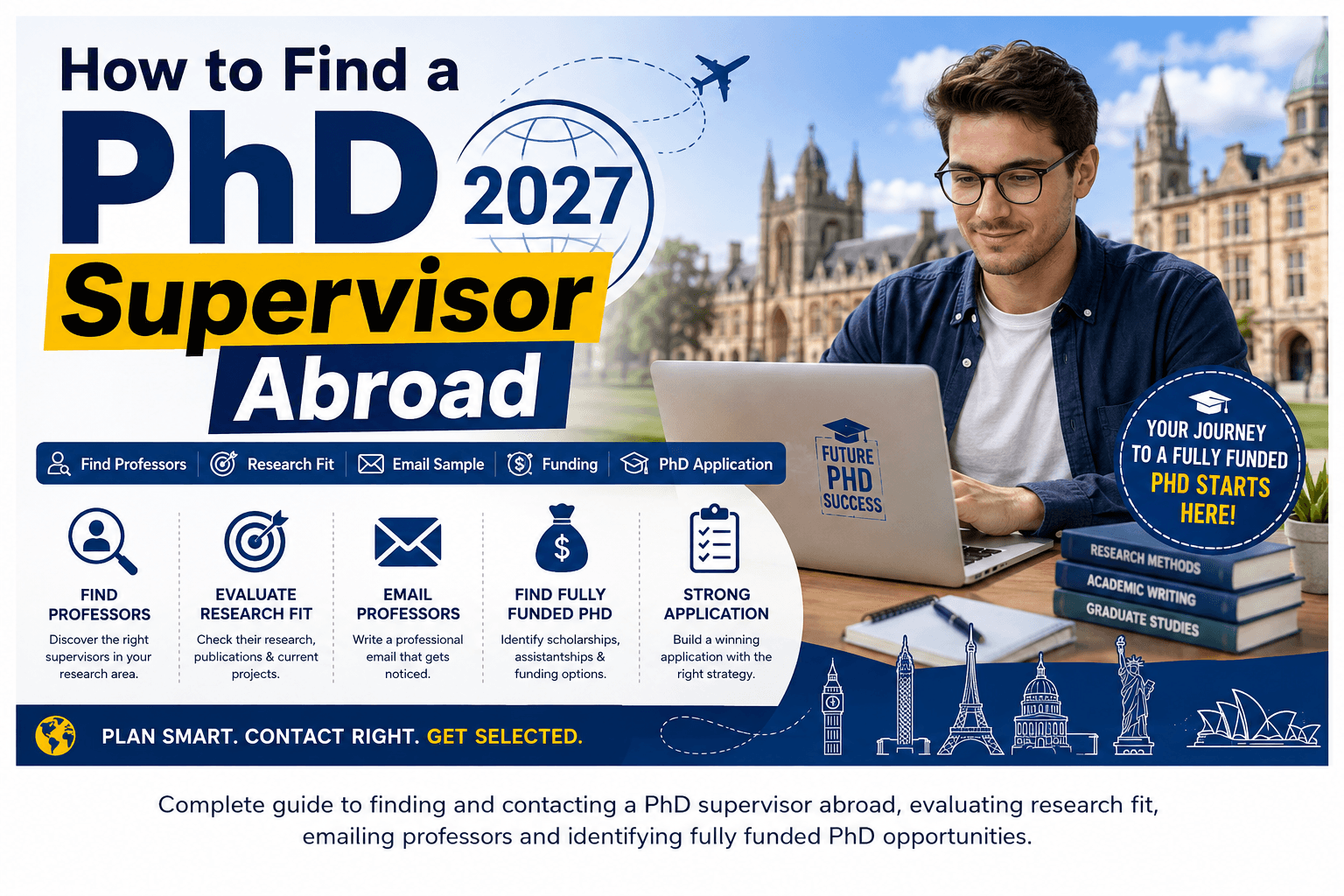
Finding the right PhD supervisor abroad is one of the most important steps in securing doctoral admission, identifying funding opportunities and building a successful research career.
If you are planning a PhD abroad in 2027, you may be wondering:
- How do I find a PhD supervisor abroad?
- How do I contact a professor for PhD supervision?
- What should I write in an email to a potential PhD supervisor?
- How do I know whether a professor is accepting PhD students?
- How can I find a fully funded PhD supervisor?
- Should I contact a professor before submitting my PhD application?
This complete EducationMESD guide explains how to find and contact a PhD supervisor abroad, shortlist suitable professors, evaluate research fit, prepare your academic CV, write a professional supervisor email and search for funded PhD opportunities.
For most research-focused doctoral applications, a strong strategy is:
Research Interest → Research Gap → Potential Supervisor → Research Fit → Funding → University → PhD Application
The goal is not to email hundreds of professors.
The goal is to identify academics whose current research closely matches the problem you want to investigate.
How to Find a PhD Supervisor Abroad: Quick Answer
To find a PhD supervisor abroad, first define your research area and identify specific research keywords. Search university faculty profiles, Google Scholar, research laboratories and advertised PhD projects. Read the professor’s recent publications, evaluate research alignment, check whether they are accepting doctoral researchers, prepare an academic CV and research concept, and then send a personalised PhD supervision enquiry.
10-Step PhD Supervisor Search Process
- Define your PhD research topic.
- Identify research keywords.
- Search university faculty profiles.
- Use Google Scholar to identify researchers.
- Read recent publications.
- Check research laboratories and projects.
- Investigate supervisor availability.
- Search for funded PhD opportunities.
- Create a supervisor shortlist.
- Send a personalised PhD supervisor email.
What Is a PhD Supervisor?
A PhD supervisor is an academic researcher who provides scholarly guidance to a doctoral candidate throughout the PhD.
Depending on the country and university, the role may also be called:
- Research Supervisor
- Doctoral Supervisor
- Primary Supervisor
- Principal Supervisor
- Research Advisor
- Academic Advisor
- Principal Investigator
- PI
Some universities appoint one primary supervisor, while others use a supervisory team consisting of:
Primary Supervisor + Co-Supervisor + Research Advisory Committee
The exact model depends on the institution and doctoral programme.
What Does a PhD Supervisor Do?
A PhD supervisor may support you with:
- Identifying a research gap
- Refining the research problem
- Developing research questions
- Setting research objectives
- Choosing a methodology
- Developing theoretical frameworks
- Planning experiments
- Selecting datasets
- Conducting data analysis
- Improving academic writing
- Preparing research publications
- Selecting journals
- Preparing conference papers
- Research ethics
- Thesis development
- Viva preparation
- Academic networking
- Career development
Because a PhD usually involves several years of intensive research, your supervisor can have a significant influence on your overall doctoral experience.
Why Is Finding the Right PhD Supervisor Important?
Many students begin their PhD search by asking:
Which university has the highest ranking?
For doctoral research, a better question may be:
Which professor is conducting research that closely matches my proposed PhD topic?
A highly ranked university may not necessarily be the best option if:
- No professor works in your research area.
- The research laboratory lacks appropriate facilities.
- Relevant datasets are unavailable.
- Funding is limited.
- The supervisor has no capacity for additional students.
- The professor’s current research has moved away from your topic.
A strong PhD decision should consider:
Supervisor Fit + Research Environment + Funding + Facilities + University Reputation
rather than university ranking alone.
Do You Need a PhD Supervisor Before Applying Abroad?
It depends on the university, country and doctoral programme.
There are generally three types of PhD admission structures.
1. Supervisor-First PhD Application
You identify a professor, discuss your research idea and potentially obtain supervisory interest before submitting the formal application.
2. Programme-First PhD Application
You apply directly to a doctoral programme or department. A supervisor may be selected or assigned later.
3. Advertised PhD Project
A professor, research laboratory or university advertises a predefined PhD project.
The advertisement may already include:
- Research topic
- Supervisor
- Scholarship
- Funding
- Eligibility
- Research methodology
- Application deadline
Important
Before contacting a professor, always check the official university page for:
- PhD admission requirements
- Graduate research application
- Supervisor requirements
- Funding information
- Research proposal requirements
- Application deadlines
Do not assume every university follows the same process.
University of Oxford’s official guidance on research projects and supervisors
How to Find a PhD Supervisor Abroad Step by Step
Step 1: Define Your PhD Research Area
Before searching for professors, clearly define your broad research interest.
Too Broad
Artificial Intelligence
Better
Artificial Intelligence for Healthcare
More Specific
Federated Deep Learning for Privacy-Preserving Medical Image Segmentation
Another example:
Too Broad
Marketing
Better
Consumer Behaviour
More Specific
Brand Activism and Consumer Behaviour in Tourism and Hospitality
A clearly defined research area makes it much easier to identify relevant professors.
You do not need to have your final PhD title ready.
However, you should be able to explain:
- What you want to investigate
- Why the problem matters
- What gap you have identified
- How you may investigate it
- What contribution the research could make
University of Cambridge’s official guide to finding a PhD supervisor
Step 2: Identify Research Keywords
Research keywords are essential when searching for a potential PhD supervisor abroad.
For example, if your research area is AI in healthcare:
Primary Keywords
- Artificial Intelligence
- Machine Learning
- Deep Learning
- Healthcare AI
- Medical Imaging
Specialised Keywords
- Federated Learning
- Explainable AI
- Privacy-Preserving AI
- Medical Image Segmentation
- Brain Tumour Segmentation
- Multimodal Learning
- Clinical AI
Use combinations of these keywords when searching university profiles, Google Scholar and research projects.
Step 3: Search University Faculty Profiles
University websites are among the most reliable places to search for PhD supervisors.
Use this navigation:
University → School → Department → Faculty → Research → People
Professor profiles often include:
- Research interests
- Recent publications
- Current projects
- Research grants
- Research laboratory
- Current PhD students
- Academic biography
- Contact information
Do not contact every professor in the department.
Only shortlist academics whose research genuinely overlaps with your proposed topic.
Step 4: Use Google Search to Find PhD Supervisors
Google can help you find relevant academics quickly.
Useful search queries include:
"PhD supervisor" "federated learning" Australia
"PhD supervisor" "medical imaging" UK
"professor" "brand activism" tourism
"doctoral researcher" "robotics" Germany
You can also use the site: search operator.
For the UK
site:ac.uk "federated learning" professor
For Australia
site:edu.au "medical imaging" professor
For New Zealand
site:ac.nz "machine learning" professor
This method can help you locate professor profiles, research laboratories and funded projects quickly.
Step 5: Use Google Scholar to Find Potential PhD Supervisors
Google Scholar is one of the best platforms for finding academics who actively publish in your research field.
Search your specific research topic.
Examples:
- Federated Learning Medical Imaging
- Explainable AI Healthcare
- Brand Activism Tourism
- Digital Twin Rehabilitation
- Sustainable Consumer Behaviour
- Robotics Reinforcement Learning
Look for researchers who repeatedly publish in your area.
Check:
- Recent publications
- University affiliation
- Research themes
- Co-authors
- Citation profile
- Current projects
Do not choose a supervisor purely because they have thousands of citations.
For PhD supervision:
Research Relevance > Citation Count
Step 6: Read the Professor’s Recent Research Papers
Never email a professor without understanding their research.
Read at least a few relevant recent publications.
Focus on:
Research Problem
What problem is the professor investigating?
Research Gap
What limitations are they trying to address?
Methodology
What methods, frameworks, models or theories are being used?
Dataset or Sample
What data or participants are involved?
Results
What are the major findings?
Limitations
What problems remain unresolved?
Future Research
What directions are suggested for future studies?
The future research section can sometimes help you identify potential PhD research opportunities.
Step 7: Check the Professor’s Research Laboratory
Many academics belong to specialised research groups.
Examples include:
- AI Research Laboratory
- Medical Imaging Laboratory
- Robotics Research Centre
- Cybersecurity Lab
- Consumer Behaviour Research Group
- Sustainability Research Centre
- Tourism Research Institute
Check whether the group has:
- Current PhD students
- Research assistants
- Research fellows
- Active projects
- Publications
- External collaborations
- Industry partners
- Funding
- Vacancies
A strong research group can significantly improve your PhD experience.
Step 8: Find Professors Accepting PhD Students
One of the most useful searches is:
professors accepting PhD students
Check professor pages for phrases such as:
- Accepting PhD students
- Recruiting PhD researchers
- Prospective doctoral students
- Open PhD positions
- PhD opportunities
- Graduate research opportunities
- Studentships available
You can also search Google:
"accepting PhD students" + your research topic
"PhD opportunities" + research field
"doctoral researcher" + research area
If the professor does not state whether they are recruiting, you can still send a professional enquiry.
Step 9: Search for Fully Funded PhD Opportunities
Students searching for a fully funded PhD abroad should explore both scholarships and professor-led research projects.
Potential funding sources include:
- University scholarships
- Government scholarships
- Research council grants
- Professor research grants
- Industry-funded projects
- Doctoral training programmes
- Research assistantships
- Graduate research scholarships
Useful search keywords include:
Fully Funded PhD + Research Area
PhD Studentship + Research Area
Doctoral Researcher + Country
PhD Scholarship + University
Funded PhD Position + Research Topic
How to Find a Fully Funded PhD Supervisor Abroad
A common mistake is searching only for:
Professor offering full scholarship
Instead, search:
Research Topic → Professor → Current Project → Funding → PhD Vacancy
A professor may have funding through an active research grant even if a scholarship is not prominently advertised on their personal page.
Therefore, investigate:
- Research projects
- University funding pages
- Laboratory websites
- Research council projects
- Doctoral vacancies
EURAXESS Jobs and Opportunities portal
Step 10: Create a PhD Supervisor Shortlist
Create a spreadsheet to manage your supervisor search.
| Supervisor | University | Country | Research Fit | Recent Papers | Funding | Contacted | Response |
|---|---|---|---|---|---|---|---|
| Professor A | University A | UK | Excellent | Highly Relevant | Possible | No | — |
| Professor B | University B | Australia | Excellent | Relevant | Available | Yes | Positive |
| Professor C | University C | Germany | High | Relevant | Funded Project | Yes | Waiting |
| Professor D | University D | New Zealand | Moderate | Partially Relevant | Unknown | No | — |
A practical approach is:
Initial List: 15–20 supervisors
Strong Research Matches: 8–12
Priority Contacts: Top research matches
Quality matters more than quantity.
How to Choose the Right PhD Supervisor
Once you identify potential professors, evaluate them using the following criteria.
1. Research Alignment
Ask:
Does this professor actively research the area I want to investigate?
This should be your first criterion.
2. Recent Publications
Look at recent publications rather than relying only on older work.
The professor’s current research direction should align with your proposed PhD.
3. Current Research Projects
Ongoing projects can indicate:
- Research priorities
- Available datasets
- Funding
- Laboratory capacity
- Potential research gaps
4. PhD Supervision Experience
Check for:
- Current doctoral researchers
- Former PhD students
- Completed doctoral theses
- Research group alumni
5. Funding
Investigate:
- Research grants
- Scholarships
- Studentships
- Research assistant positions
- Doctoral training grants
6. Research Infrastructure
For STEM research, check the availability of:
- Laboratories
- GPU infrastructure
- High-performance computing
- Research datasets
- Robotics facilities
- Medical facilities
- Experimental equipment
- Specialised software
7. Publications and Collaborations
Check whether the professor collaborates with:
- International universities
- Research institutes
- Hospitals
- Industry
- Government agencies
Collaborations can create valuable research and career opportunities.
8. Supervision Style
During later discussions, ask about:
- Meeting frequency
- Feedback style
- Student independence
- Publication expectations
- Research milestones
- Co-supervision
PhD Supervisor vs University Ranking: Which Is More Important?
For a research degree, your decision should not be based entirely on ranking.
Consider:
Supervisor Expertise
Research Fit
Research Facilities
Funding
Research Group
University Reputation
A professor at a slightly lower-ranked university may be a better choice if they provide stronger research alignment and better research opportunities.
How to Contact a PhD Supervisor Abroad
After identifying a suitable professor, contact them by email.
Your PhD supervisor email should be:
Professional + Personalised + Concise + Research-Focused
The professor should quickly understand:
- Who you are.
- What you want to research.
- Why you selected them.
- What relevant experience you have.
- What you are asking.
Best Subject Lines for PhD Supervisor Emails
Use a clear and research-specific subject line.
Example 1
Prospective PhD Applicant – Federated Learning for Medical Imaging
Example 2
PhD Supervision Enquiry – Explainable AI in Healthcare
Example 3
Prospective PhD Researcher – Brand Activism and Consumer Behaviour
Example 4
PhD Applicant 2027 – Robotics and Digital Twin Research
Example 5
Prospective Doctoral Student – Research Interest in [Topic]
Avoid:
- Need PhD
- Scholarship Required
- Urgent PhD Request
- Hello Professor
- Admission Help
How to Write an Email to a PhD Supervisor
A good email can follow six parts.
Paragraph 1: Introduce Yourself
Mention:
- Name
- Current qualification
- Institution
- Research area
Paragraph 2: Mention the Professor’s Research
Reference a specific:
- Publication
- Project
- Methodology
- Research theme
This demonstrates genuine interest.
Paragraph 3: Explain Your PhD Research Idea
Briefly describe:
- Research problem
- Research gap
- Proposed methodology
- Potential contribution
Paragraph 4: Explain Your Research Background
Mention relevant:
- Dissertation
- Research paper
- Conference
- Research project
- Technical skills
Paragraph 5: Ask About Supervision
Ask whether the professor:
- Is accepting PhD students.
- Sees research alignment.
- Would be available for a short discussion.
Paragraph 6: Mention Attachments
Attach:
Academic CV
and, where appropriate:
Short Research Concept Note
Sample Email to a PhD Supervisor Abroad
Subject: Prospective PhD Applicant – Federated Learning for Medical Imaging
Dear Professor [Surname],
I am [Full Name], currently completing/having completed my [Degree] in [Discipline] from [University, Country]. My research interests focus on federated learning, medical image analysis and explainable artificial intelligence.
I recently read your research on [specific paper/project], particularly your work related to [specific topic]. I found this closely aligned with my proposed doctoral research interests.
For my PhD, I am interested in investigating privacy-preserving federated deep-learning approaches for medical image segmentation, particularly focusing on model generalisation, explainability and heterogeneous clinical datasets.
My previous research has involved [briefly mention relevant dissertation, project, publication or technical experience].
I am planning to pursue doctoral research in this area and would be grateful to know whether you are currently considering new PhD researchers whose interests align with your research group.
If you see potential research alignment, I would appreciate the opportunity to discuss my proposed PhD research with you.
I have attached my academic CV and a short research summary for your consideration.
Thank you for your time.
Kind regards,
[Full Name]
[Institution]
[Country]
[Google Scholar / ORCID / LinkedIn – Optional]
Sample Email for a Fully Funded PhD Opportunity
Subject: Prospective PhD Applicant – [Research Area] and Funding Opportunities
Dear Professor [Surname],
I am [Name], currently [qualification/position] at [Institution]. My research interests focus on [research area].
I recently reviewed your work on [specific research project/paper] and found strong alignment with my proposed doctoral research on [topic].
My previous research experience includes [brief description].
I would be grateful to know whether you are currently accepting PhD researchers in this area and whether there may be any funded PhD projects, studentships or scholarships associated with your research group.
I have attached my academic CV and a brief research concept for your consideration.
Thank you for your time.
Kind regards,
[Full Name]
What Documents Should You Send to a PhD Supervisor?
Academic CV
Include:
- Education
- Research interests
- Dissertation
- Publications
- Conferences
- Research projects
- Research methods
- Technical skills
- Awards
- Relevant work experience
- Google Scholar
- ORCID
Keep the CV research-focused.
PhD Research Concept Note
Your concept note may include:
Proposed Research Title
Background
Research Problem
Research Gap
Research Questions
Research Objectives
Proposed Methodology
Expected Contribution
Key References
Avoid sending a very long proposal unless specifically requested.
How Long Should a PhD Supervisor Email Be?
Keep the first email short enough to scan quickly.
Your email should answer five questions:
Who are you?
What do you want to research?
Why are you contacting this professor?
What relevant experience do you have?
What do you want the professor to do next?
Avoid unnecessary personal background.
Can I Contact a PhD Supervisor Without Publications?
Yes.
Having publications can strengthen your profile, but they are not mandatory for every PhD applicant.
You can demonstrate research potential through:
- Master’s dissertation
- Research project
- Conference presentation
- Internship
- Research methodology
- Programming experience
- Laboratory work
- Strong research proposal
Should I Mention Publications in My PhD Email?
Yes, if they are relevant.
Example:
My recent research examined explainable deep-learning approaches for medical image classification, and a manuscript based on this work is currently under review.
Always represent your publication status accurately.
How to Ask a Professor for PhD Funding
Avoid:
Sir, I need full scholarship.
Use:
I would also appreciate any guidance regarding funded PhD positions, studentships or scholarships associated with your research group or department.
Your initial communication should emphasise research fit first and funding second.
How Many PhD Supervisors Should You Contact?
There is no fixed number.
A practical strategy is:
Stage 1
Identify 15–20 potential professors.
Stage 2
Evaluate their research.
Stage 3
Shortlist 8–12 strong matches.
Stage 4
Prioritise the best research fits.
Stage 5
Send individually personalised emails.
10 carefully researched emails are usually more valuable than 100 generic emails.
Can You Contact Multiple Professors at the Same University?
Yes, provided their research genuinely aligns with your topic.
However, avoid emailing the entire department with the same template.
Each email should demonstrate why that particular professor is relevant to your proposed research.
When Should You Contact a PhD Supervisor?
Start researching potential supervisors well before the intended application cycle.
Starting early gives you time for:
- Research topic development
- Supervisor identification
- Research proposal preparation
- Academic CV preparation
- Supervisor communication
- Proposal revisions
- Scholarship applications
- SOP preparation
- Recommendation letters
- English-language requirements
- Formal applications
Students seeking a fully funded PhD abroad should pay particular attention to scholarship deadlines.
What If a PhD Supervisor Does Not Reply?
A lack of response does not always mean rejection.
Professors may be busy with:
- Teaching
- Research
- Student supervision
- Conferences
- Journal reviews
- Grant applications
- Administrative work
Send one polite follow-up after a reasonable period.
PhD Supervisor Follow-Up Email Sample
Subject: Follow-Up – Prospective PhD Applicant in [Research Area]
Dear Professor [Surname],
I hope you are well.
I am writing to follow up on my previous email regarding potential PhD research in [research area].
I remain very interested in your research on [specific topic] and believe my proposed work may align with your current research interests.
I understand that you may have a busy schedule, but I would appreciate knowing whether you expect to consider new PhD researchers in this area.
I have attached my academic CV again for convenience.
Thank you for your time and consideration.
Kind regards,
[Full Name]
What If the Professor Still Does Not Respond?
After one professional follow-up, continue with other suitable supervisors.
Avoid:
- Daily emails
- Repeated follow-ups
- Messaging across multiple platforms immediately
- Sending identical messages
A lack of response may simply mean:
- No supervision capacity
- No funding
- Research mismatch
- Professor unavailable
- Position already filled
What Happens After a Professor Gives a Positive Response?
A positive response may lead to:
- Informal discussion
- Supervisor meeting
- Research interview
- Research proposal revision
- Scholarship discussion
- Formal PhD application
A positive response does not automatically guarantee admission.
Questions a Potential PhD Supervisor May Ask You
Be prepared to answer:
- Why do you want to pursue a PhD?
- Why did you select this topic?
- What research gap have you identified?
- Why did you contact me?
- Which of my papers have you read?
- What methodology do you propose?
- What previous research experience do you have?
- Why this university?
- What contribution could your research make?
- How do you plan to fund your PhD?
- What are your long-term career goals?
Questions You Should Ask a PhD Supervisor
Useful questions include:
- Do you think my proposed topic has sufficient PhD-level scope?
- How could I refine my research question?
- Are you accepting new PhD researchers?
- Are there related projects within your group?
- Are funded PhD positions available?
- Which scholarships should I consider?
- What methodology would you recommend?
- How frequently do you meet PhD students?
- What are your publication expectations?
- Are co-supervisors involved?
- Are there opportunities for international collaboration?
- How is research progress normally evaluated?
Common Mistakes When Contacting a PhD Supervisor
1. Sending Generic Emails
Avoid:
Dear Sir, I checked your prestigious profile and want to do PhD under you.
It demonstrates no research preparation.
2. Not Reading the Professor’s Research
Do not claim research alignment unless you can explain it.
3. Asking Only About Scholarships
Funding matters, but your first message should establish research relevance.
4. Sending a Very Long Email
Keep your initial communication concise.
5. Sending the Same Email to Every Professor
Personalise each message.
6. Selecting Professors Only by University Ranking
Research fit should remain central.
7. Sending Too Many Attachments
For initial communication, focus on:
Academic CV + Research Summary
8. Using the Wrong Professor Name
Always check:
- Name
- Academic title
- Department
- University
How to Find a PhD Supervisor in the UK
Students looking for a PhD supervisor in the UK should search:
- University research pages
- Faculty profiles
- Research centres
- Doctoral training programmes
- Funded PhD studentships
- Professor publications
Useful search keywords include:
PhD supervisor UK
fully funded PhD UK
PhD studentship UK
professor accepting PhD students UK
Always check the individual programme’s supervisor requirements before applying.
How to Find a PhD Supervisor in Australia
Students planning a PhD in Australia should investigate:
- Researcher profiles
- Graduate research pages
- Research centres
- Supervisor directories
- University scholarships
- Funded research projects
Search keywords:
PhD supervisor Australia
find research supervisor Australia
fully funded PhD Australia
graduate research scholarship Australia
How to Find a PhD Supervisor in New Zealand
Students planning a PhD in New Zealand can search:
- University researcher profiles
- Research institutes
- Faculty pages
- Scholarship pages
- Research projects
- Department research areas
Useful search queries:
PhD supervisor New Zealand
fully funded PhD New Zealand
PhD scholarship New Zealand
professor accepting PhD students New Zealand
How to Find a PhD Supervisor in Germany
For a PhD in Germany, search for:
- Individual doctoral supervision
- Structured doctoral programmes
- Doctoral researcher vacancies
- Research assistant positions
- Funded PhD projects
Search terms:
PhD position Germany
doctoral researcher Germany
fully funded PhD Germany
professor accepting PhD students Germany
How to Find a PhD Supervisor in Canada
Canadian PhD admission procedures vary between universities.
Search:
- Graduate faculty pages
- Research groups
- Laboratory websites
- Funded projects
- University PhD pages
Useful keywords:
PhD supervisor Canada
professor accepting graduate students Canada
fully funded PhD Canada
How to Find a PhD Supervisor in the USA
Some US PhD programmes admit candidates through a department rather than requiring formal supervisor approval before application.
However, faculty research compatibility remains important.
Check:
- Graduate programme requirements
- Faculty research pages
- Research laboratories
- Current projects
- Department admission guidance
Best Platforms to Find PhD Supervisors Abroad
University Websites
Best for official supervisor information.
Google Scholar
Best for identifying researchers through publications.
ORCID
Useful for researcher profiles and publication verification.
ResearchGate
Useful for exploring academic publications and research interests.
Useful for professional and academic background research.
Research Laboratory Websites
Excellent for identifying current projects and vacancies.
PhD Vacancy Platforms
Useful for advertised funded projects and doctoral positions.
Always verify important information on the official university website.
How to Find Professors Accepting PhD Students
Search phrases such as:
"accepting PhD students" + research topic
"prospective PhD students" + research field
"PhD opportunities" + university
"doctoral researcher" + topic
"funded PhD" + research field
Check:
- Professor homepages
- Research laboratory pages
- Department vacancies
- University research portals
- Funded project pages
PhD Supervisor Selection Checklist
Before contacting a professor, confirm:
- My research interests match the professor’s expertise.
- I have read recent publications.
- I understand the professor’s current research direction.
- I checked the university’s supervisor requirements.
- My academic CV is updated.
- My research concept is clear.
- I can explain the research gap.
- My email is personalised.
- My email subject clearly mentions my topic.
- I checked the professor’s correct name.
- I investigated funding options.
- I know the relevant PhD application deadline.
- My email contains a clear request.
Best PhD Supervisor Search Strategy
A strong PhD supervisor search can be divided into eight stages:
Phase 1: Define Research Interest
Identify your broad area.
Phase 2: Identify Research Gap
Determine what problem needs further investigation.
Phase 3: Discover Supervisors
Search university websites and academic databases.
Phase 4: Analyse Research Fit
Read publications and projects.
Phase 5: Shortlist Supervisors
Rank professors according to relevance.
Phase 6: Contact Supervisors
Send personalised emails.
Phase 7: Explore Funding
Investigate scholarships and funded projects.
Phase 8: Submit PhD Application
Follow the official university process.
Frequently Asked Questions About Finding a PhD Supervisor Abroad
How do I find a PhD supervisor abroad?
Define your research topic, identify relevant keywords, search university faculty profiles and Google Scholar, read recent publications and shortlist academics whose research closely matches your proposed PhD.
How do I contact a PhD supervisor?
Send a personalised professional email explaining your academic background, proposed research, connection with the professor’s work and request for potential supervision.
How do I email a professor for PhD supervision?
Use a clear subject line, introduce yourself briefly, mention a specific publication or project, explain your proposed research and ask whether the professor is accepting new PhD students.
What should I write in the subject line?
Example:
Prospective PhD Applicant – Research Interest in Explainable AI
How can I find professors accepting PhD students?
Search university faculty pages, research laboratory websites, professor homepages and terms such as accepting PhD students, PhD opportunities, doctoral researcher and funded PhD position.
Can I contact a PhD supervisor without publications?
Yes. Publications can help, but a strong dissertation, relevant research experience, technical skills and a well-developed proposal can also demonstrate doctoral potential.
Should I attach my CV when emailing a professor?
Yes. A concise academic CV makes it easier for the professor to evaluate your research background.
Should I send my research proposal in the first email?
A concise research concept can be useful. A full proposal should generally be sent when requested or when required by the programme.
Can I contact multiple PhD supervisors?
Yes, provided each professor is genuinely relevant and every email is personalised.
How many PhD supervisors should I contact?
There is no fixed number. Focus on a carefully selected group of highly relevant supervisors rather than mass emailing.
How do I ask a professor about a fully funded PhD?
First demonstrate research alignment. Then ask politely whether funded projects, PhD studentships or scholarships are available.
What should I do if a PhD supervisor does not reply?
Send one professional follow-up after a reasonable period. If there is still no response, continue with other potential supervisors.
Does supervisor approval guarantee PhD admission?
Not necessarily. Formal admission normally depends on the university’s application and selection procedures.
Is the PhD supervisor more important than university ranking?
For doctoral research, supervisor compatibility, research environment, facilities and funding can be extremely important. University ranking should be considered alongside these factors.
When should I start looking for a PhD supervisor?
Start several months before your target application cycle so that you have sufficient time to research supervisors, develop your proposal, apply for funding and complete formal admission requirements.
Final Thoughts: How to Find the Right PhD Supervisor Abroad
Finding the right PhD supervisor abroad is not about sending the highest number of emails.
It is about finding the strongest research match.
Your PhD search should follow:
Research Interest → Research Gap → Supervisor → Research Fit → Research Group → Funding → University → Application
Before contacting a professor:
Read their research.
Understand their current projects.
Prepare your academic CV.
Develop a clear research concept.
Write a personalised supervisor email.
A well-matched PhD supervisor can influence your research quality, publications, collaborations, academic network and future research career.
Therefore, do not choose your PhD university based only on ranking.
Choose an academic environment where your research topic, supervisor expertise, research facilities and funding opportunities align.
Planning a PhD Abroad in 2027?
Planning a PhD abroad but unsure how to identify the right universities, supervisors, research areas or fully funded opportunities?
EducationMESD can support prospective researchers with:
- PhD country selection
- University shortlisting
- PhD supervisor search strategy
- Research topic refinement
- Research gap identification
- Academic CV guidance
- PhD research proposal guidance
- Supervisor email strategy
- SOP guidance
- Scholarship search
- Fully funded PhD opportunity search
- PhD application planning
- PhD interview preparation
A successful PhD application does not begin with filling out an application form.
It begins with the right research problem, the right supervisor and the right strategy.