
How to Select the Right Medical College After NEET 2026: Complete MBBS College Selection Guide
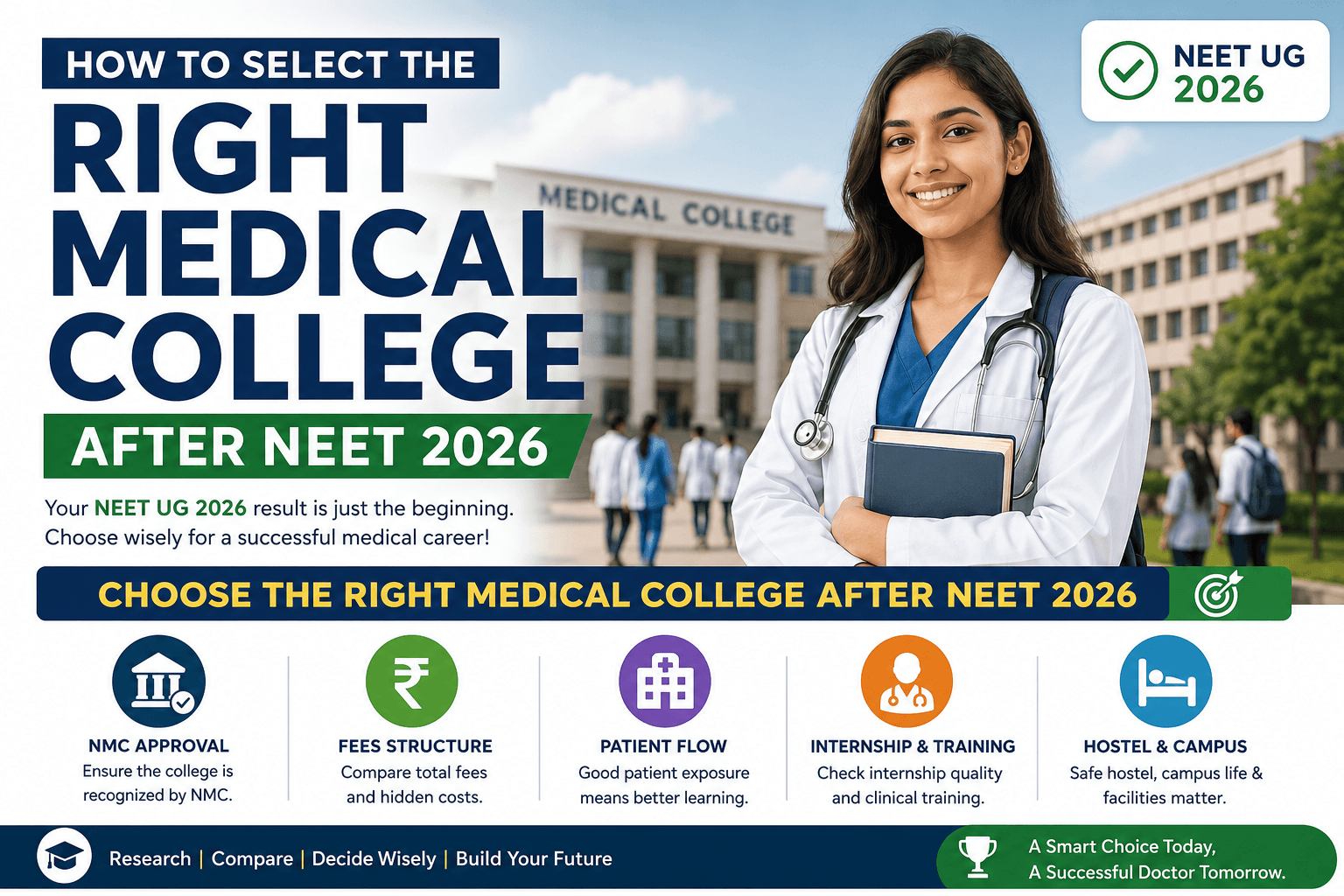
Clearing NEET is an important achievement, but your MBBS admission journey does not end with the result. The next major decision is understanding how to select the right medical college after NEET 2026.
The National Testing Agency has made the NEET UG 2026 scorecard available, and qualified candidates must now prepare for the appropriate central or state counselling process. NEET UG is the common entrance examination for admission to undergraduate medical education in Indian medical institutions.
Choosing an MBBS college should not be based only on its name, campus photographs, social media popularity or distance from home. The quality and suitability of a medical college depend on several factors, including:
- NMC approval and seat recognition
- Previous NEET closing ranks
- Hospital patient flow
- Clinical exposure
- Faculty and teaching quality
- Total MBBS fees
- Internship experience and stipend
- Service bond conditions
- Hostel and campus safety
- Location and local language
- Research opportunities
- Student feedback
The best medical college for one student may not be the best option for another. Your final choice should match your NEET rank, category, domicile, budget, preferred location and career goals.
This EducationMESD guide explains how to compare medical colleges and prepare a smart NEET UG counselling preference list.
Quick Answer: How Do You Select the Right Medical College After NEET?
To select the right medical college after NEET, follow these steps:
- Verify the college and MBBS course through the NMC.
- Check whether the seat appears in the official counselling seat matrix.
- Compare your NEET rank with previous closing ranks.
- Evaluate the attached hospital and actual patient flow.
- Check faculty availability and academic quality.
- Calculate the complete MBBS course cost.
- Review service bond and discontinuation penalties.
- Compare internship experience and stipend.
- Examine hostel, food, safety and location.
- Speak with current students.
- Visit the college where possible.
- Arrange choices according to genuine preference.
The safest approach is to compare every shortlisted college using the same fixed criteria instead of making an emotional or last-minute decision.
Why Is Choosing the Right Medical College Important?
MBBS is a long and demanding professional programme. Medical students learn through classroom instruction, practical laboratories, hospital postings, community exposure and compulsory internship.
Your medical college can influence your:
- Understanding of medical subjects
- Clinical examination skills
- Exposure to different diseases
- Confidence in handling patients
- Communication and professional behaviour
- Research experience
- Internship competence
- Preparation for postgraduate entrance examinations
- Professional network
- Long-term career development
An attractive campus cannot compensate for weak patient flow. Similarly, a popular college may not be financially suitable if its fees create an excessive burden on the family.
The right MBBS college should provide a reasonable combination of recognition, affordability, clinical exposure, academic support and personal suitability.
1. Verify NMC Approval and Recognition
The first step in medical college selection is checking whether the college and its MBBS course are approved or recognised by the National Medical Commission.
The official NMC College and Course Search allows users to search medical institutions by college name, state, university, management type, course and recognition status.
Before adding a college to your NEET preference list, verify:
- Exact name of the medical college
- State and city
- University affiliation
- Management type
- Year of establishment
- MBBS course status
- Approved annual intake
- Recognition or permission status
- Academic session for which permission applies
Why is NMC verification necessary?
A medical college may advertise MBBS admission, but students must independently confirm whether the institution has permission for the relevant course and number of seats.
Do not rely only on:
- Admission agents
- Promotional brochures
- Unofficial education portals
- Social media claims
- Old YouTube videos
- Previous-year seat information
The NMC has also cautioned candidates about institutions operating without the required approvals and directs students to verify colleges through its official search facility.
NMC verification checklist
Before admission, confirm that:
- The college appears in the official NMC database.
- The MBBS course is listed.
- The approved intake matches the seat offered.
- The university affiliation is correctly stated.
- The counselling allotment name matches the NMC-listed institution.
- The permission applies to the relevant academic year.
Never pay an admission fee before completing these checks.
2. Understand Your Counselling Eligibility
A high NEET score does not automatically make a candidate eligible for every medical college or every quota.
Your available options may depend on:
- NEET All India Rank
- Category rank
- Reservation category
- State domicile
- Institutional eligibility
- Minority status
- NRI eligibility
- PwBD eligibility
- All India Quota rules
- State quota rules
- University-specific conditions
The Medical Counselling Committee conducts online counselling for 15% All India Quota undergraduate seats and other participating central, institutional and specified categories. State counselling authorities manage seats covered under their respective state processes.
Before preparing your college preference list, identify:
- Which counselling authorities you must register with.
- Which quotas you are eligible for.
- Which documents are required.
- Whether domicile conditions apply.
- Whether separate registration fees must be paid.
- Whether private and government seats follow different fee rules.
Do not assume that registering for MCC counselling automatically registers you for state counselling.
3. Compare Your NEET Rank With Previous Cut-Offs
Previous opening and closing ranks can help you estimate your admission probability.
However, previous cut-offs are only indicators. They are not guaranteed admission thresholds.
Medical college cut-offs may change because of:
- Number of candidates
- Examination performance
- Number of available seats
- Addition of new medical colleges
- Changes in reservation rules
- Changes in tuition fees
- Candidate preferences
- Counselling round
- State domicile policies
- Seat conversion rules
When analysing a previous cut-off, make sure you compare the correct:
- College
- Course
- Category
- Quota
- Counselling authority
- Counselling round
- Opening rank
- Closing rank
For example, the closing rank for a government college under the All India Quota may differ significantly from its state quota closing rank.
Divide colleges into three groups
Aspirational colleges
These are colleges where your rank is weaker than the recent closing rank, but admission may still be possible if cut-offs shift.
Place them high in your preference list when you genuinely want to join them.
Realistic colleges
These are colleges where your rank is close to recent closing ranks.
These options should form the central part of your preference list.
Safer colleges
These are colleges where your rank appears stronger than the previous closing rank.
They help reduce the possibility of finishing a counselling round without a seat.
Recommended preference-list distribution
A practical initial list may contain approximately:
- 20% aspirational choices
- 50% realistic choices
- 30% safer choices
This is a planning framework, not an allotment guarantee. Adjust it according to the number of colleges available under your quota and budget.
4. Understand the Types of Medical Colleges
Students should understand the differences between government, private, deemed and central medical institutions before filling choices.
Government medical colleges
Government medical colleges are generally preferred because they may offer:
- Lower tuition fees
- High hospital patient flow
- Exposure to diverse cases
- Affordable hostel facilities
- Government hospital experience
- Lower overall financial burden
However, their NEET cut-offs are usually highly competitive.
Private medical colleges
Private medical colleges may provide:
- Modern infrastructure
- Organised campuses
- Simulation laboratories
- Better-maintained hostels
- Technology-enabled classrooms
- Additional student facilities
However, students must carefully verify clinical exposure and calculate the total cost of the course.
Deemed medical universities
Deemed universities may offer established campuses, specialist departments and research facilities. Their fees, deposits and hostel charges may be significantly higher than those of government institutions.
Candidates should verify:
- Annual tuition fee
- Complete course fee
- Hostel and mess charges
- Refundable security deposit
- Other compulsory fees
- Internship stipend
- Refund policy
- NRI seat conditions
Central institutions and institutes of national importance
Central institutions may provide strong academic, research and clinical environments. However, eligibility conditions, internal quotas and counselling requirements can vary.
Do not assume that one type of institution is automatically better than another. Compare the individual college, hospital and total financial commitment.
5. Evaluate the Attached Teaching Hospital
The attached teaching hospital is one of the most important factors in choosing an MBBS college.
Medical students develop practical skills through:
- Outpatient departments
- Inpatient wards
- Emergency departments
- Operation theatres
- Intensive care units
- Diagnostic laboratories
- Community health centres
- Rural health postings
What should you check in the teaching hospital?
Evaluate:
- Number of operational beds
- Average daily outpatient attendance
- Bed occupancy
- Emergency patient volume
- Trauma exposure
- Availability of major departments
- Number of operation theatres
- Intensive care facilities
- Blood bank
- Radiology services
- Pathology and microbiology facilities
- Labour room activity
- Paediatric exposure
- Community medicine postings
Why does patient flow matter?
Regular patient flow gives students opportunities to observe different conditions and practise:
- History-taking
- Physical examination
- Case presentation
- Differential diagnosis
- Patient communication
- Clinical decision-making
- Emergency response
- Procedural skills
A hospital may have a large sanctioned bed capacity but limited actual patient activity. Therefore, do not depend only on numbers displayed in a college brochure.
How to verify patient flow
Where possible:
- Visit the hospital on a normal working day.
- Observe the outpatient departments.
- Check whether wards are active.
- Speak with clinical-year students.
- Ask interns about hands-on experience.
- Examine whether major departments receive regular cases.
For MBBS education, a busy and functional teaching hospital is usually more valuable than a visually impressive but underutilised campus.
6. Examine Faculty and Academic Quality
Qualified, available and supportive faculty members can significantly improve the medical learning experience.
Check whether the college provides:
- Regular classroom teaching
- Clinical demonstrations
- Small-group discussions
- Case presentations
- Practical laboratory sessions
- Skills laboratory training
- Internal assessments
- Mentoring
- Remedial support
- Research supervision
- Academic counselling
Ask current students:
- Are lectures conducted regularly?
- Do faculty members attend clinical postings?
- Are students allowed to examine patients?
- Are doubts addressed?
- Are assessments conducted fairly?
- Are practical classes meaningful?
- Is attendance managed transparently?
- Does the college support academically weak students?
A complete faculty list on a website does not always indicate that every teacher is regularly available. Student feedback can help you understand the real academic environment.
7. Check Functional Infrastructure
Infrastructure is important, but functionality is more important than appearance.
A medical college should have adequate facilities such as:
- Anatomy dissection hall
- Physiology laboratory
- Biochemistry laboratory
- Pathology laboratory
- Microbiology laboratory
- Pharmacology laboratory
- Forensic medicine facilities
- Clinical skills laboratory
- Simulation centre
- Lecture theatres
- Demonstration rooms
- Central library
- Digital journal access
- Research laboratories
- Computer facilities
- Sports and recreation facilities
During a campus visit, check whether the laboratories and learning spaces are:
- Operational
- Properly equipped
- Regularly used
- Adequate for the number of students
- Maintained safely
Do not select a medical college only because it has modern buildings. Medical education depends on the combined quality of infrastructure, teachers, hospital exposure and student participation.
8. Calculate the Complete MBBS Course Cost
One of the most common mistakes during NEET counselling is comparing only the annual tuition fee.
The actual cost of MBBS education may include:
- Tuition fee
- Admission fee
- University fee
- Examination fee
- Security deposit
- Hostel charges
- Mess expenses
- Laboratory charges
- Library charges
- Transportation
- Books
- Medical instruments
- Aprons and clinical equipment
- Student activity charges
- Annual fee increases
- Miscellaneous compulsory expenses
Calculate the total cost, not the first-year cost
Prepare an estimate for the complete course period.
Use the following formula:
Total MBBS Cost = Total Tuition Fees + Hostel and Mess + Deposits + University Charges + Academic Expenses + Travel and Living Expenses
Questions to ask before admission
- Is the tuition fee fixed for the complete course?
- Can the fee increase annually?
- Is the security deposit refundable?
- Is hostel accommodation compulsory?
- Are mess charges included?
- Are examination charges separate?
- Are there development or administrative charges?
- What is the refund policy after resignation?
- Is the internship period charged separately?
- Are there penalties for delayed payments?
Request the fee structure in writing and compare it with the official counselling prospectus.
Never transfer admission money to an agent’s personal account.
9. Check Service Bond and Discontinuation Penalties
Some states and institutions require graduates to complete compulsory government or rural service.
Before selecting a medical college, understand:
- Service bond duration
- Bond amount
- Rural service requirement
- Government posting conditions
- Penalty for not completing service
- Course discontinuation penalty
- Seat resignation rules
- Rules for returning original documents
- Internship conditions
- Stipend conditions
Bond rules can differ by state, institution, quota and academic year.
A college with low tuition fees may become less suitable if its service bond conflicts with your future plans. Conversely, a reasonable service requirement may be acceptable to students who wish to gain government healthcare experience.
Always read the current counselling prospectus and bond document before locking the choice.
10. Compare Internship Quality and Stipend
The compulsory rotating medical internship is the phase in which students apply their academic knowledge in real clinical settings.
Internship rotations may include:
- General medicine
- General surgery
- Paediatrics
- Obstetrics and gynaecology
- Community medicine
- Emergency medicine
- Orthopaedics
- Psychiatry
- Dermatology
- Anaesthesiology
The NMC website provides a section for details of stipends paid by medical colleges for the undergraduate MBBS course.
Before choosing a college, ask:
- Do interns receive hands-on responsibilities?
- Are they supervised by residents and faculty?
- Is the workload educational?
- Are interns involved in emergency care?
- Are rural or community postings properly organised?
- Is the stipend paid regularly?
- What is the present stipend amount?
- Are duty rooms available?
- How many duty hours are normally assigned?
- Do interns receive procedural exposure?
A higher stipend is beneficial, but the quality of clinical learning should receive greater importance.
11. Consider Location and Local Language
Students often underestimate the importance of location.
You may spend several years in the city where your medical college is located. Consider:
- Distance from home
- Railway and airport connectivity
- Local transportation
- Climate
- Cost of living
- Food preferences
- Safety
- Language
- Cultural environment
- Access to essential services
Is the local language important?
Medical students communicate directly with patients during clinical postings.
Understanding the local language can help with:
- Taking medical history
- Understanding symptoms
- Explaining procedures
- Providing health advice
- Communicating with patients’ families
- Building patient trust
Language should not automatically prevent you from selecting a good medical college in another state. However, you should be prepared to learn basic patient-communication vocabulary.
12. Evaluate Hostel, Food and Campus Safety
A safe and manageable living environment can improve academic performance and student well-being.
Check:
- Hostel availability
- Room occupancy
- Hostel-to-hospital distance
- Washroom cleanliness
- Drinking water
- Electricity
- Power backup
- Internet connectivity
- Mess quality
- Campus security
- Hostel rules
- Medical support for students
- Grievance-redressal system
- Anti-ragging measures
Speak privately with current hostel residents and ask about:
- Food quality
- Water shortages
- Maintenance
- Hidden charges
- Curfew
- Study environment
- Ragging
- Safety
- Hostel administration
Official hostel photographs may not show daily living conditions.
13. Review Research and Postgraduate Opportunities
Many students plan to pursue MD, MS, DNB, public health, research or another advanced qualification after MBBS.
Check whether the college offers:
- Research mentorship
- Student research projects
- Medical conferences
- Workshops
- Journal access
- Scientific clubs
- Poster and paper presentation opportunities
- Postgraduate departments
- Clinical seminars
- Academic mentoring
- Postgraduate entrance preparation support
A college with postgraduate departments may offer wider specialist exposure. However, the presence of postgraduate programmes does not automatically guarantee good undergraduate teaching.
Ask students whether undergraduates are actively included in academic and research activities.
14. Use NIRF Rankings as a Supporting Factor
Medical college rankings can provide an additional comparison point.
The NIRF Medical ranking evaluates participating institutions through parameters that include teaching and learning resources, research and professional practice, graduation outcomes, outreach and perception. The NIRF 2025 Medical ranking lists institutions and their parameter-wise scores.
However, a ranking may not fully show:
- Current patient flow
- Department-wise teaching quality
- Hostel conditions
- Hidden fees
- Internship workload
- Faculty accessibility
- Recent administrative changes
- Personal suitability
Use NIRF rankings as a supporting factor, not as your only college-selection criterion.
15. Speak With Current Students and Interns
Current students can provide information that may not appear in official brochures.
Try to speak with:
- First-year students
- Clinical-year students
- Final-year students
- Interns
- Recent graduates
Ask specific questions such as:
- Are classes held regularly?
- How strong is the patient flow?
- Are clinical postings useful?
- Are faculty members available?
- Are students allowed to examine patients?
- Is the hostel well maintained?
- Are there unexpected fees?
- Is the internship stipend paid on time?
- Is ragging present?
- What is the biggest disadvantage of the college?
- Would you select the same college again?
- How responsive is the administration?
Do not depend on the experience of only one student. Compare responses from multiple people.
16. Visit the Medical College Before Final Admission
Where possible, visit your most important shortlisted colleges before reporting.
During the visit:
- Walk through the teaching hospital.
- Observe outpatient activity.
- Visit the emergency department.
- Inspect wards and laboratories.
- Check the library.
- Visit the hostel and mess.
- Speak privately with students.
- Confirm the written fee structure.
- Ask about bond conditions.
- Verify transport and safety.
- Check the surrounding area.
- Confirm the exact college and university name.
A physical visit can expose major differences between online promotion and actual facilities.
Government vs Private Medical College: Which Is Better?
| Selection factor | Government medical college | Private medical college |
|---|---|---|
| Tuition fees | Generally lower | Generally higher |
| NEET cut-off | Usually more competitive | Varies by quota and college |
| Patient flow | Often high | Must be individually verified |
| Infrastructure | Varies by institution | Often modern |
| Hostel fees | Usually more affordable | May be higher |
| Clinical exposure | Often extensive | Depends on attached hospital |
| Financial burden | Usually lower | Can be substantial |
| Seat availability | More limited | Comparatively more options |
| Bond requirement | May apply | Depends on state and institution |
| Internship stipend | Depends on state | Depends on institution |
Which option should you choose?
Choose a government medical college when it provides adequate clinical exposure and fits your rank and location preferences.
Consider a private medical college when:
- The college is NMC-approved.
- The hospital has strong patient flow.
- The total cost is affordable.
- The fee structure is transparent.
- The academic and internship environment is satisfactory.
Do not assume that every government college is excellent or every private college is unsuitable. Compare institutions individually.
How to Prepare a Medical College Preference List for NEET Counselling
Choice filling should reflect your genuine order of preference.
The allotment system generally considers the candidate’s eligible choices, preference order, rank, category and seat availability. Therefore, a college you prefer more should normally be placed above a college you prefer less.
Step 1: Prepare a master list
List all colleges that you are eligible and willing to join.
Step 2: Remove unacceptable colleges
Remove colleges that:
- Exceed your maximum budget
- Have unacceptable bond conditions
- Lack sufficient clinical exposure
- Are in locations you cannot manage
- Do not meet your essential academic criteria
- Have unresolved recognition concerns
Step 3: Divide colleges by probability
Classify them as:
- Aspirational
- Realistic
- Safer
Step 4: Score each college
Use a fixed scoring framework rather than depending on reputation alone.
Step 5: Arrange choices by genuine preference
Place your most preferred acceptable college first.
Do not place a lower-preference college above a better option simply because you think the lower college is easier to obtain.
Step 6: Verify every entry
Before locking choices, verify:
- College name
- College code
- Course
- Quota
- Category
- Fee
- Location
- Bond
- Preference order
Step 7: Save your final choice list
Download or print the locked-choice list and payment records.
EducationMESD 100-Point Medical College Selection Score
Use this framework to compare shortlisted MBBS colleges objectively.
| Selection criterion | Maximum score |
| NMC approval and recognition | Mandatory eligibility check |
| Hospital patient flow and clinical exposure | 25 |
| Total MBBS cost and affordability | 20 |
| Faculty and academic environment | 15 |
| Internship quality and stipend | 10 |
| Hostel, food and campus safety | 10 |
| Location, language and connectivity | 10 |
| Service bond and penalties | 5 |
| Research and postgraduate opportunities | 5 |
| Total | 100 |
Suggested interpretation
- 85–100: Excellent overall option
- 70–84: Strong option
- 55–69: Acceptable with some compromises
- Below 55: Review carefully before selecting
NMC approval should be treated as a mandatory condition, not merely as a scoring factor.
Medical College Comparison Table
| Comparison point | College A | College B | College C |
| NMC recognition | |||
| Approved MBBS intake | |||
| Previous closing rank | |||
| Quota eligibility | |||
| Annual tuition fee | |||
| Estimated complete cost | |||
| Daily patient flow | |||
| Clinical exposure | |||
| Faculty quality | |||
| Internship stipend | |||
| Hostel and mess | |||
| Service bond | |||
| Location | |||
| Student feedback | |||
| Final score | |||
| Preference order |
Red Flags to Avoid When Choosing a Medical College
Be cautious when:
- The college cannot provide clear NMC approval information.
- The approved seat intake is unclear.
- Representatives promise direct MBBS admission without counselling.
- Fees are requested through personal accounts.
- The written fee structure is unavailable.
- Students report low patient flow.
- Hospital departments appear inactive.
- Hostel facilities cannot be inspected.
- Bond and refund rules are not provided.
- The college pressures you to make immediate payments.
- Online reviews appear copied or promotional.
- Current students consistently report serious academic or administrative problems.
Never accept claims of a guaranteed MBBS seat outside the authorised counselling process.
Common Mistakes During Medical College Selection
Choosing a college only by reputation
A famous name cannot replace adequate patient flow, teaching quality and affordability.
Looking only at the first-year fee
Always calculate the complete MBBS cost.
Ignoring quota eligibility
A college may appear in a counselling portal even though a particular seat category has additional conditions.
Using outdated cut-offs
Compare recent ranks by quota, category and counselling round.
Ignoring service bonds
A bond can influence your plans after graduation.
Copying another candidate’s preference list
Every student has a different rank, category, budget and priority.
Filling too few choices
A narrow preference list may reduce your allotment opportunities.
Selecting infrastructure over clinical exposure
Modern buildings are useful, but medical competence requires real patient exposure.
Depending entirely on social media
Verify important information through official sources and current students.
Missing counselling deadlines
Registration, choice filling, locking, payment, reporting and document verification must be completed within the official schedule.
Final Checklist Before Accepting an MBBS Seat
Confirm all the following before completing admission:
- The college is listed in the NMC database.
- The MBBS course and intake are approved.
- The seat appears in the official counselling matrix.
- You meet the quota and category requirements.
- The complete fee structure is available in writing.
- Your family can afford the total course cost.
- Bond and penalty conditions are understood.
- Hospital patient flow is adequate.
- Clinical departments are functional.
- Faculty and academic feedback are satisfactory.
- Hostel and mess conditions are acceptable.
- Internship and stipend information has been checked.
- The location is manageable.
- Current students have provided credible feedback.
- All required documents are ready.
- Payment will be made only through an authorised channel.
Frequently Asked Questions About Medical College Selection After NEET
1. How do I select the right medical college after NEET?
Verify NMC approval, previous cut-offs, hospital patient flow, clinical exposure, total fees, faculty, internship, service bond, hostel, location and student feedback. Arrange colleges in your genuine order of preference.
2. Which is the most important factor when choosing an MBBS college?
NMC approval is the first mandatory requirement. After approval, hospital patient flow, clinical exposure, affordability and teaching quality should receive the greatest importance.
3. Is a government medical college better than a private college?
Government colleges are generally more affordable and often have busy hospitals. Private colleges may offer modern infrastructure, but their clinical exposure and complete fee structure must be carefully verified.
4. How can I check whether a medical college is NMC-approved?
Use the official NMC College and Course Search. Verify the college name, course, university, approved intake and recognition or permission status.
5. Is patient flow important when selecting a medical college?
Yes. Regular patient flow provides exposure to different diseases and improves history-taking, examination, diagnosis, communication and clinical decision-making skills.
6. Should I choose a new government medical college?
A new government college may offer affordable fees but could still be developing its faculty, hospital services and infrastructure. Visit the college and compare its actual patient flow with established alternatives.
7. Should I choose a medical college close to home?
A nearby college can reduce travel costs and provide family support. However, clinical exposure, approval, academic quality and affordability should remain the main considerations.
8. Does the local language matter for MBBS students?
Yes. Knowledge of the local language helps students communicate with patients during hospital and community postings. Basic communication skills can normally be learned after admission.
9. How many colleges should I add during NEET choice filling?
Add every eligible college that you would genuinely be willing to join. A broader, carefully ordered list usually provides more opportunities than a list containing only a few highly competitive colleges.
10. Should I use NIRF rankings to select a medical college?
Use NIRF rankings as a supporting indicator. Do not rely on rankings alone because they may not fully reflect present patient flow, hostel conditions, fees or undergraduate clinical experience.
11. Is internship stipend important?
Internship stipend is an important financial consideration, but hands-on experience, supervision and clinical responsibility are more important for professional development.
12. Can I trust online medical college reviews?
Online reviews may provide initial information but can be outdated, biased or promotional. Verify major claims through official sources, current students, interns and a campus visit.
13. What should I check in a private medical college?
Check NMC approval, total tuition fees, hidden charges, hospital patient flow, internship, stipend, hostel costs, annual fee increases, refund policy and student feedback.
14. What is a medical service bond?
A medical service bond is an undertaking that may require graduates to work in a government or rural healthcare setting for a specified period or pay a stated penalty.
15. Can an admission agent guarantee an MBBS seat?
No unauthorised agent can legitimately guarantee an MBBS seat outside the applicable counselling and admission rules. Use official counselling portals and authorised institutional channels only.
Conclusion
Understanding how to select the right medical college after NEET 2026 can help students avoid financial, academic and counselling-related mistakes.
Do not select an MBBS college only because of its brand name, ranking, campus appearance or location. Begin with NMC verification and then compare:
- Clinical exposure
- Hospital patient flow
- Total fees
- Faculty
- Internship
- Service bond
- Hostel
- Location
- Student feedback
- Long-term career opportunities
Prepare a balanced college preference list containing aspirational, realistic and safer options. Most importantly, arrange choices according to the order in which you would genuinely prefer to join them.
A carefully selected medical college can provide the academic knowledge, clinical competence and professional foundation required to become a confident and responsible doctor.
Need Help Selecting the Best Medical College After NEET?
EducationMESD supports students and parents with:
- NEET UG counselling guidance
- Government medical college selection
- Private and deemed university comparison
- College preference-list preparation
- Choice-filling strategy
- Fee and bond comparison
- MBBS admission planning
- Counselling document support
Connect with EducationMESD for personalised guidance based on your NEET rank, category, domicile, budget and preferred location.
Disclaimer: NEET counselling schedules, seat matrices, fees, cut-offs, recognition status, service bonds and institutional policies may change. Candidates must verify all information through the official NTA, MCC, NMC, state counselling and college portals before making an admission decision.