
MCC Counselling vs State Counselling 2026: Key Differences in Seats, Domicile, Fees and Registration
After qualifying for NEET UG, candidates must register for the appropriate counselling process to secure admission to MBBS, BDS and other eligible medical courses. At this stage, students frequently become confused about MCC counselling vs state counselling.
The difference can be understood in one sentence:
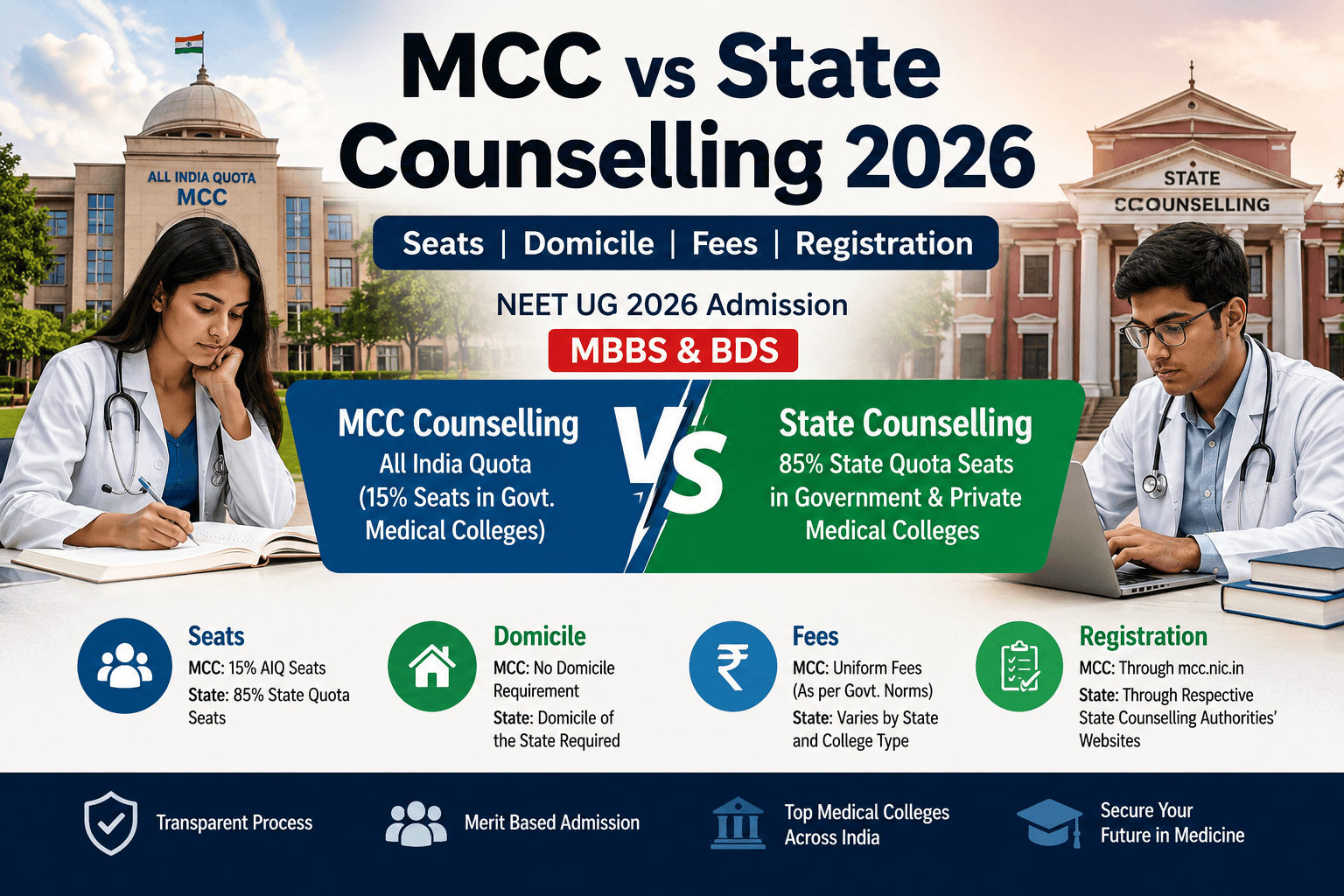
MCC counselling is conducted at the national level primarily for 15% All India Quota seats and specified institutions, whereas state counselling is conducted separately by each state or Union Territory for state quota seats and most private medical college seats within that state.
Candidates can generally participate in both counselling processes when eligible. However, MCC and state counselling require separate registration, fee payment, document submission, choice filling and seat allotment.
This comprehensive guide explains the difference between MCC counselling and state counselling in 2026, including:
- 15% All India Quota and state quota seats
- Government and private medical colleges
- Domicile requirements
- Reservation policies
- Registration procedures
- Counselling fees
- Choice-filling strategies
- Required documents
- Common counselling mistakes
NEET UG Counselling 2026 Latest Update
The National Testing Agency published the NEET UG 2026 scorecard on 16 July 2026.
As of 29 July 2026, the MCC website identifies the portal as the admission and e-counselling service for Session 2026. However, its UG schedule page does not yet display the detailed counselling schedule, and the Candidate Activity Board states that information will be updated soon.
Candidates should therefore monitor the official MCC website for the publication of:
- MCC counselling registration dates
- NEET UG 2026 counselling information bulletin
- Round-wise schedule
- Seat matrix
- Registration fee and security deposit
- Choice-filling dates
- Seat-allotment results
- Reporting and resignation rules
Important: Never rely exclusively on previous-year dates or counselling rules. Use the official 2026 information bulletin once it is released.
MCC Counselling vs State Counselling: Quick Answer
MCC counselling is conducted by the Medical Counselling Committee under the Directorate General of Health Services. MCC is responsible for online counselling for 15% All India Quota undergraduate seats and specified central or institutional seat categories.
State counselling is conducted by the authorised counselling authority of an individual state or Union Territory. It generally covers state quota seats in government colleges and seats in private medical and dental colleges located within that state.
MCC Counselling vs State Counselling: Quick Comparison
| Comparison Point | MCC Counselling | State Counselling |
|---|---|---|
| Counselling level | National level | State or Union Territory level |
| Conducting authority | Medical Counselling Committee under DGHS | Authorised counselling body of the respective state |
| Main government seat pool | 15% All India Quota seats | Generally the remaining state quota seats |
| Competition level | National competition | State-based or category-specific competition |
| Government colleges | AIQ seats in participating government colleges | State quota seats within the concerned state |
| AIIMS admission | Conducted through MCC | Not conducted through regular state counselling |
| JIPMER admission | Conducted through MCC | Not conducted through regular state counselling |
| Central institutions | Specified institutions and seat categories | Usually outside regular state counselling |
| Private medical colleges | Deemed and other institutions included in the applicable MCC matrix | Most non-deemed private colleges within the state |
| Domicile for regular seats | Generally not required for regular AIQ seats | Commonly required for government state quota seats |
| Reservation rules | Central rules for applicable categories | Respective state reservation rules |
| Registration | Through the MCC portal | Through the authorised state portal |
| Choice filling | MCC choice-filling portal | State choice-filling portal |
| Registration fee | Determined by MCC | Determined separately by each state |
| Merit consideration | NEET UG rank, category, eligibility and preferences | NEET UG score, state merit, category and state eligibility |
| Best suited for | Students seeking national-level college options | Students seeking seats within a particular state |
What Is MCC Counselling?
MCC counselling is the centralised online medical counselling process conducted by the Medical Counselling Committee, which operates under the Directorate General of Health Services, Ministry of Health and Family Welfare, Government of India.
The MCC is responsible for finalising counselling procedures and schedules, determining counselling fees and deposits, allocating applicable AIQ seats and coordinating with agencies involved in state and Union Territory counselling.
Which Seats Are Covered by MCC Counselling?
The MCC officially identifies the following UG counselling responsibilities:
- 15% All India Quota MBBS and BDS seats of participating states
- 100% MBBS and BDS seats of Banaras Hindu University
- 100% MBBS seats of AIIMS institutions across India
- 100% JIPMER seats in Puducherry and Karaikal
- 100% seats of Aligarh Muslim University, subject to applicable eligibility
- Specified state and institutional quota seats under Delhi University and IP University
- Faculty of Dentistry seats at Jamia Millia Islamia, including the applicable internal quota
- Specified ESIC IP quota seats
These categories are listed by MCC, although candidates must confirm the precise 2026 institutions and seat categories in the official seat matrix.
Who Should Apply for MCC Counselling?
MCC counselling is particularly important for candidates who want to:
- Compete for government medical colleges outside their home state
- Apply for 15% All India Quota MBBS or BDS seats
- Apply for AIIMS MBBS admission
- Apply for JIPMER MBBS admission
- Explore specified central universities
- Consider deemed medical universities included in the current matrix
- Access a wider national college choice
- Avoid relying only on home-state counselling
Qualifying for NEET UG does not automatically register a candidate for MCC counselling. A separate application must be completed when MCC registration opens.
What Is State Counselling?
State counselling is the NEET UG admission process conducted by the designated counselling authority of a state or Union Territory.
Depending on the state, the authority may be a:
- Directorate of Medical Education
- State admission committee
- State examination authority
- Government medical university
- State counselling board
Each state publishes its own counselling rules and schedule.
Which Seats Are Covered by State Counselling?
State counselling generally covers:
- State quota MBBS seats in government medical colleges
- State quota BDS seats in government dental colleges
- Seats in state government universities
- Government quota seats in private medical colleges
- Private medical college seats
- Private dental college seats
- Management quota seats
- Minority quota seats
- Institutional quota seats
- NRI quota seats, where applicable
The precise classification is different in every state. Candidates must read the official state prospectus before registering or filling choices.
Who Should Apply for State Counselling?
State counselling is essential for students who:
- Have valid domicile or residence eligibility
- Want government medical colleges in their home state
- Prefer a college closer to home
- Qualify for state-specific reservation benefits
- Want admission to private medical colleges in a particular state
- Want government quota seats in private institutions
- Are considering management, minority or NRI quota seats
What Is the Main Difference Between MCC and State Counselling?
The biggest difference between MCC counselling and state counselling is the seat pool.
MCC Seat Pool
MCC primarily manages seats available under the All India Quota and seats of specified national, central and institutional categories.
Candidates from across India generally compete for regular AIQ seats based on:
- NEET UG rank
- Candidate category
- Eligibility
- Reservation rules
- Seat availability
- Submitted preference order
State Counselling Seat Pool
A state counselling authority primarily manages seats allocated to that state and private medical or dental colleges under its jurisdiction.
Admission may depend on:
- NEET UG score
- State merit rank
- Domicile
- Residence or schooling conditions
- Candidate category
- State reservation rules
- Seat type
- Submitted preferences
The same candidate can therefore have different admission possibilities in MCC counselling and state counselling.
15% All India Quota vs 85% State Quota
The difference between 15% AIQ and 85% state quota is central to understanding NEET UG counselling.
What Is the 15% All India Quota?
Approximately 15% of eligible MBBS and BDS seats in participating state government colleges are made available under the All India Quota.
The Medical Counselling Committee conducts online counselling for these seats.
Candidates generally compete nationally for AIQ seats, subject to:
- NEET UG qualification
- All India Rank
- Category
- Reservation policy
- Eligibility conditions
- Choice preference
- Seat availability
What Is the 85% State Quota?
The remaining eligible government-college seats are generally placed under the state quota and allotted by the concerned state counselling authority.
Candidates may need to fulfil conditions related to:
- Domicile
- Permanent residence
- Schooling in the state
- Parents’ residence or employment
- State category certification
- Local or regional eligibility
Simple Example
Suppose a participating government medical college has 100 eligible MBBS seats.
A simplified seat division may be:
| Seat Category | Approximate Seats | Counselling Authority |
| All India Quota | 15 | MCC |
| State quota | 85 | State counselling authority |
This example is only for understanding the general system. Actual seat distribution may differ because of institutional status, special quotas, court orders, reservation rules, seat additions or other applicable conditions.
MCC Counselling vs State Counselling: Domicile Rules
Domicile is one of the most important differences between MCC and state counselling.
Is Domicile Required for MCC Counselling?
Domicile is generally not required for regular 15% All India Quota seats.
However, candidates must not assume that every seat appearing on the MCC portal is completely open. MCC also manages certain:
- Institutional quota seats
- Internal quota seats
- Domicile-linked central university seats
- ESIC quota seats
- University-specific categories
- NRI categories
The MCC portal specifically refers to institutional, internal, central university, ESIC and other categories in addition to regular AIQ seats.
Candidates must check the eligibility code attached to every choice.
Is Domicile Required for State Counselling?
Domicile or residence eligibility is commonly required for government state quota seats.
A state may ask for:
- Domicile certificate
- Permanent resident certificate
- Residence certificate
- Birth certificate
- Class 10 or Class 12 schooling certificate
- Parents’ domicile documents
- Parents’ employment certificate
- State-issued category certificate
Some states allow outside-state candidates to apply for selected private, management or NRI quota seats. The eligibility conditions vary by state and must be checked separately.
MCC vs State Counselling for Government Medical Colleges
Government medical college seats can be available through both MCC and state counselling.
Government Seats Through MCC
MCC provides access to:
- AIQ seats in participating state government colleges
- AIIMS institutions
- JIPMER campuses
- Specified central universities
- Other eligible institutions listed in the MCC seat matrix
Government Seats Through State Counselling
State counselling provides access to:
- State quota seats in government medical colleges
- Government dental colleges
- State government universities
- Government quota seats in participating private colleges, where applicable
Candidates with a strong domicile advantage should not ignore state counselling, even when they also have a competitive All India Rank.
MCC vs State Counselling for Private Medical Colleges
Private medical college counselling is a major source of confusion.
Private Colleges Under State Counselling
Most non-deemed private medical colleges are included in the counselling process of the state in which they are located.
Their seats may be divided into:
- Government quota seats
- State quota seats
- Management quota seats
- Minority quota seats
- Institutional quota seats
- NRI quota seats
Deemed Universities Through MCC
Deemed medical university seats have traditionally been handled through MCC counselling. Candidates must nevertheless verify the participating colleges, seat numbers and categories in the official MCC 2026 seat matrix before submitting choices.
Never assume that every private medical college is included in MCC counselling.
MCC vs State Counselling: Reservation Rules
Reservation policies may be different in the two counselling systems.
Reservation in MCC Counselling
Central reservation rules apply to relevant All India Quota and central seat categories.
Applicable categories can include:
- Scheduled Caste
- Scheduled Tribe
- OBC-NCL
- Economically Weaker Section
- Persons with Benchmark Disabilities
MCC states that 27% OBC and 10% EWS reservation has applied to AIQ seats prospectively since 2021.
Reservation in State Counselling
State counselling follows the reservation policy of the concerned state.
Depending on the state, categories may include:
- State OBC categories
- Scheduled Castes
- Scheduled Tribes
- EWS
- PwD
- Women candidates
- Defence quota
- Freedom-fighter quota
- Rural or regional quota
- Government-school quota
- Other state-specific reservations
A certificate valid for state OBC reservation may not establish eligibility under the central OBC-NCL category. Candidates should check the prescribed certificate format, issuing authority and validity date.
Is Separate Registration Required for MCC and State Counselling?
Yes. Separate registration is required.
Registering on the MCC website does not automatically register a candidate for state counselling. Similarly, completing state registration does not make the candidate eligible for MCC allotment.
A student participating in both processes must generally complete:
| Activity | MCC | State |
| Registration | Separate | Separate |
| Application fee | Separate | Separate |
| Security deposit | As prescribed | As prescribed |
| Document upload | Separate | Separate |
| Choice filling | Separate | Separate |
| Choice locking | Separate | Separate |
| Allotment result | Separate | Separate |
| College reporting | As per MCC schedule | As per state schedule |
Candidates should maintain a calendar containing all MCC and state deadlines.
Can You Participate in MCC and State Counselling Together?
Yes. Eligible candidates can generally participate in MCC and state counselling during the same admission cycle.
Participating in both may provide access to:
- AIQ government seats
- Home-state government seats
- AIIMS
- JIPMER
- Central institutions
- Deemed universities
- Private medical colleges
- Management quota seats
- NRI quota seats
However, candidates must carefully monitor:
- Seat-joining rules
- Free-exit provisions
- Resignation deadlines
- Security-deposit forfeiture
- Upgradation conditions
- Round 3 eligibility
- Stray vacancy eligibility
- Restrictions on already joined candidates
The current information bulletin should be treated as the final authority for round-wise rules.
Which Is Better: MCC or State Counselling?
Neither process is automatically better for every candidate.
The best option depends on:
- NEET UG rank
- Category
- State domicile
- Preferred location
- Government or private college preference
- Family budget
- Bond conditions
- College quality
- Hospital exposure
- Previous closing-rank trends
MCC Counselling May Be Better When
MCC may be more suitable when the candidate:
- Wants colleges outside the home state
- Has a competitive All India Rank
- Is targeting AIQ government seats
- Wants AIIMS or JIPMER
- Is considering central institutions
- Wants a wider national choice list
- Is considering deemed universities
State Counselling May Be Better When
State counselling may be more suitable when the candidate:
- Has valid domicile
- Wants a government college in the home state
- Is eligible for state reservation
- Prefers studying near home
- Wants a non-deemed private college
- Is exploring management or minority seats
- Has a favourable state merit position
Recommended Approach
For most eligible candidates, the strongest strategy is to register for both MCC and state counselling.
This expands the number of available colleges and reduces dependence on a single seat pool.
MCC Counselling Process 2026
The exact process should be verified after publication of the MCC 2026 information bulletin. The usual stages include:
Step 1: Online Registration
Create an account on the official MCC portal and enter the required NEET UG and personal details.
Step 2: Fee Payment
Pay the prescribed registration fee and security deposit. MCC determines the counselling fees and deposits applicable to its process.
Step 3: Choice Filling
Select preferred courses and colleges from the available seat matrix.
Step 4: Choice Locking
Review the sequence carefully and lock the choices before the deadline.
Step 5: Seat Allotment
The system considers rank, category, eligibility, reservation, seat availability and preference order.
Step 6: Downloading the Allotment Letter
Successful candidates download their allotment result and reporting instructions.
Step 7: College Reporting
Candidates report to the allotted college, complete document verification and pay the applicable institutional fee.
Step 8: Subsequent Rounds
Candidates may participate in subsequent rounds according to the applicable upgradation, resignation and eligibility rules.
State Counselling Process 2026
The usual state counselling process includes:
- State portal registration
- Payment of the state counselling fee
- Submission of NEET UG information
- Submission of domicile and category information
- Document upload or verification
- Publication of the state merit list
- Publication of the seat matrix
- Choice filling and locking
- Seat allotment
- Admission fee payment
- Reporting to the allotted college
- Participation in subsequent rounds, if eligible
Some states may require physical document verification. Others may complete most stages online.
Candidates should not assume that registration will reopen before later rounds.
MCC Counselling vs State Counselling Fees
MCC and state counselling have different fee structures.
MCC Counselling Costs
Candidates may need to pay:
- Non-refundable registration fee
- Refundable security deposit
- Different deposits for different institutional categories
- College admission fee after allotment
The final amount must be checked in the official MCC 2026 bulletin.
State Counselling Costs
State authorities may charge:
- Registration fee
- Counselling fee
- Security deposit
- Seat-confirmation fee
- University fee
- Admission fee
The amount may vary according to the candidate category and seat type.
College Costs to Compare
Before selecting a private or deemed medical college, check:
- Annual tuition fee
- Total course fee
- Hostel fee
- Mess charges
- Refundable and non-refundable deposits
- University fee
- Examination fee
- Miscellaneous charges
- Service bond
- Rural-service obligation
- Discontinuation penalty
- Internship stipend
- Fee-refund policy
Do not add an unaffordable college to the choice list merely to test the allotment system.
Documents Required for MCC and State Counselling
Candidates should prepare original documents, photocopies and clear scanned copies.
Commonly required documents include:
- NEET UG 2026 admit card
- NEET UG 2026 scorecard
- Class 10 marksheet and certificate
- Class 12 marksheet and passing certificate
- Date-of-birth proof
- Government-issued photo identity proof
- Recent passport-size photographs
- Category certificate, where applicable
- Central OBC-NCL certificate, where applicable
- State OBC certificate, where applicable
- EWS certificate
- PwD certificate
- Domicile or residence certificate
- Schooling certificates
- Migration certificate
- Transfer certificate
- Character certificate
- Medical fitness certificate
- Gap certificate, where required
- NRI documents, where applicable
- Allotment letter
- Counselling payment receipt
- College fee receipt
- Required affidavits or undertakings
The final document checklist must be verified from the official MCC bulletin, state prospectus and allotted college instructions.
How to Create the Best NEET UG Choice List
Candidates should arrange colleges according to their genuine preference, not simply according to previous closing ranks.
Factors to Compare
Compare each college using:
- Government, private or deemed status
- Total course cost
- Hospital patient load
- Clinical exposure
- Infrastructure
- Faculty and departments
- Hostel facilities
- Internship stipend
- Service bond
- Discontinuation penalty
- Distance from home
- Language and local environment
- Previous closing ranks
Three-Level Choice Strategy
Aspirational Choices
Colleges whose previous closing ranks were more competitive than the candidate’s current position.
Realistic Choices
Colleges where the candidate has a reasonable admission possibility based on rank, category and previous trends.
Safe Choices
Acceptable colleges whose previous closing ranks indicate a comparatively stronger possibility of admission.
Previous closing ranks are indicators, not guarantees.
Common MCC and State Counselling Mistakes
Registering Only for MCC
MCC registration does not provide access to state counselling seats.
Waiting for the MCC Result Before State Registration
State registration may close before the MCC process is completed.
Assuming State Quota Is Open to Everyone
Government state quota seats commonly have domicile or residence conditions.
Assuming Every Private College Is Under MCC
Most non-deemed private colleges are allotted through the relevant state authority.
Ignoring the Complete Fee Structure
Candidates should calculate the full course cost, not only first-year tuition.
Filling Choices in Cut-Off Order
Choices should reflect the candidate’s actual preference.
Using the Wrong Category Certificate
Central and state certificate requirements may differ.
Ignoring Bond Conditions
A low-fee government seat may have a compulsory service obligation.
Missing Choice Locking or Reporting Deadlines
A missed deadline can result in loss of the allotted seat.
Depending on Unofficial Messages
Schedules, seat matrices and exit rules should be verified only through official counselling portals.
MCC Counselling vs State Counselling: Final Verdict
The main difference between MCC counselling and state counselling lies in the conducting authority, seat quota, domicile rules, reservation policy, participating colleges and registration process.
MCC counselling primarily covers:
- 15% All India Quota seats
- AIIMS seats
- JIPMER seats
- Specified central institutions
- Institutional or internal categories notified by MCC
- Deemed university seats included in the applicable seat matrix
State counselling primarily covers:
- State quota government seats
- Government dental college seats
- Most non-deemed private medical college seats
- Government quota seats in private colleges
- Management quota seats
- Minority quota seats
- NRI quota seats, where applicable
For most eligible students, registering for both MCC counselling and state counselling creates the widest range of admission opportunities.
A competitive NEET UG rank is important, but careful registration, documentation, financial planning and choice filling are equally necessary to convert the rank into a suitable MBBS or BDS seat.
Disclaimer: Counselling dates, fees, eligibility conditions, seat matrices, reservation rules and round-wise exit conditions may change. Candidates should verify every admission decision through the official MCC website and the authorised state counselling portal.
Frequently Asked Questions
1. What is the difference between MCC counselling and state counselling?
MCC counselling is conducted nationally for 15% All India Quota seats and specified institutions. State counselling is conducted separately by each state for state quota seats and most private medical colleges.
2. Is MCC counselling compulsory for MBBS admission?
MCC registration is required for seats allotted through MCC. Candidates targeting only eligible state counselling seats must register with the relevant state authority.
3. Can I participate in MCC and state counselling together?
Yes. Eligible candidates can generally participate in both. Separate registration, fee payment and choice filling are required.
4. Does MCC counselling cover 85% state quota seats?
Generally, no. State quota seats are normally allotted by the respective state counselling authority, except for certain central or institutional categories handled by MCC.
5. Is domicile required for MCC counselling?
Domicile is generally not required for regular 15% AIQ seats. Certain institutional, internal or university-specific categories may have separate conditions.
6. Is domicile required for state counselling?
Domicile is commonly required for government state quota seats. Private and management quota rules differ by state.
7. Is AIIMS counselling conducted by MCC?
Yes. MCC lists 100% MBBS seats in AIIMS institutions among its UG counselling responsibilities.
8. Is JIPMER counselling conducted by MCC?
Yes. MCC handles JIPMER Puducherry and JIPMER Karaikal seats.
9. Are private medical colleges included in MCC counselling?
Deemed university seats and other notified institutions may be included through MCC. Most non-deemed private colleges are handled through state counselling.
10. Can candidates from another state apply for private MBBS seats?
Some states allow outside-state candidates to apply for selected private, management or NRI quota seats. Eligibility varies by state.
11. Is separate registration required for MCC and state counselling?
Yes. Candidates must register separately for both processes.
12. Which counselling has lower MBBS fees?
Government seats under either AIQ or state quota generally cost less than private or deemed university seats. Actual fees depend on the institution and quota.
13. Is the state quota always exactly 85%?
No. The 85% state quota is a general structure for participating government colleges. Central institutions, special categories and other institutions may follow different seat distributions.
14. Which rank is used in state counselling?
State authorities use NEET UG performance along with state merit, domicile, category and other applicable eligibility conditions.
15. Can I leave an MCC seat after getting a state seat?
This depends on the counselling round, joining status, resignation deadline and forfeiture rules applicable at that time.
16. What happens if I miss state counselling registration?
The candidate may lose access to that state’s seats unless the authority officially reopens registration.
17. Should I register for both MCC and state counselling?
For most eligible candidates, registering for both is beneficial because it provides access to more colleges and seat categories.
18. Where should I check NEET UG counselling updates?
Check the official MCC website for MCC counselling and the authorised medical counselling portal of the concerned state for state-level admissions.
Education MESD Counselling Support
Need Help With NEET UG 2026 Counselling?
Managing MCC registration, state counselling, domicile rules, private medical college fees and multiple choice lists can be difficult for students and parents.
Education MESD supports medical aspirants with:
- MCC and state counselling guidance
- Eligibility and domicile assessment
- Document preparation
- College and fee comparison
- Government, private and deemed university options
- Choice-filling strategy
- Round-wise counselling support
Make informed decisions before locking your medical college choices