
MS in Australia vs New Zealand vs UK in 2027: Fees, Eligibility, Jobs & Post-Study Work
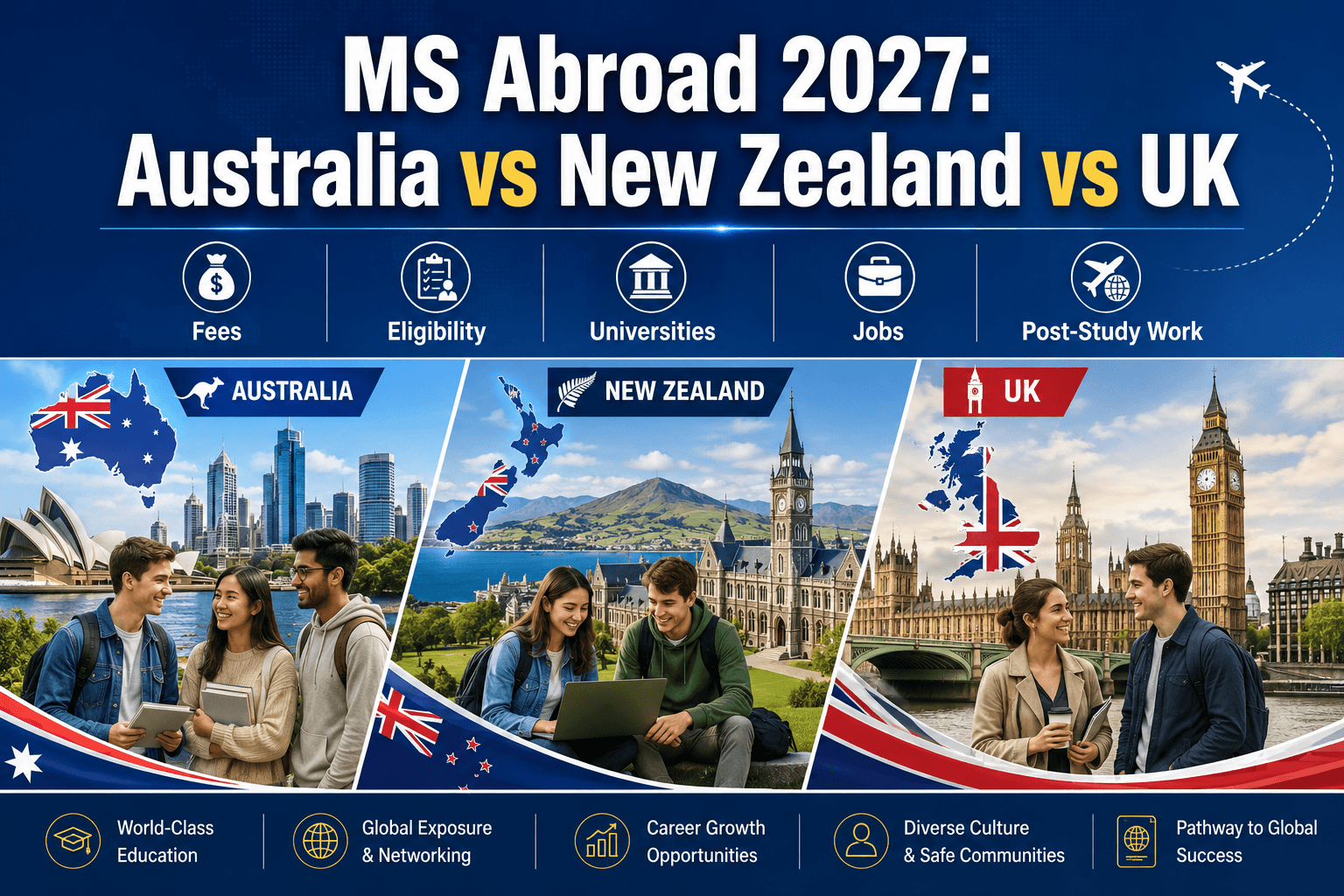
MS in Australia vs New Zealand vs UK in 2027 is one of the most important study-abroad comparisons for Indian students planning a master’s degree overseas. Australia, New Zealand and the United Kingdom all offer internationally recognised universities, specialised master’s programmes and opportunities to work after graduation—but they differ significantly in tuition fees, eligibility, course duration, part-time work rights, job opportunities and post-study work visas.
For students targeting the 2027 intake, post-study work rules deserve particular attention. Eligible Indian master’s graduates in Australia can currently receive up to three years of post-study stay under Australia–India ECTA arrangements. New Zealand can provide a three-year Post Study Work Visa after an eligible master’s completed with the required study duration. In the UK, however, the Graduate visa will be reduced to 18 months for applications made on or after 1 January 2027; doctoral graduates retain a three-year period.
So, which country is best for MS in 2027—Australia, New Zealand or the UK?
This complete EducationMESD guide compares all three destinations for Indian students based on MS fees, eligibility, IELTS requirements, course duration, part-time jobs, employment prospects, post-study work rights and long-term career considerations.
MS in Australia vs New Zealand vs UK in 2027: Quick Comparison
| Factor | Australia | New Zealand | UK |
|---|---|---|---|
| Typical Master’s Duration | 1–2 years depending on programme | 1 year, 18 months or 2 years | Many master’s programmes are 1 year |
| Indicative Tuition | Around AUD 38,000–61,000+ annually in representative 2027 technology master’s programmes | Around NZD 20,000–45,000+ for postgraduate study; programme-specific fees may be higher | Around £9,000–£30,000 for international postgraduate study |
| Common IELTS Benchmark | Around 6.5* | Around 6.5* | Around 6.0–7.0* |
| Work While Studying | Up to 48 hours per fortnight during study periods | Up to 25 hours per week for eligible students | Usually up to 20 hours per week during term time at degree level |
| Post-Study Work After Master’s | Up to 3 years for eligible Indian master’s graduates | Up to 3 years after qualifying master’s study | 18 months for applications from 1 January 2027 |
| Doctoral Graduate Route | Up to 4 years for eligible Indian doctoral graduates under current ECTA provisions | Up to 3 years | 3 years |
| Key Advantage | Strong balance of jobs and post-study time | Long post-study work period | Many one-year master’s programmes |
| Main Limitation | High total cost for longer programmes | Smaller employment market | Shorter Graduate visa from 2027 |
| Best For | Students prioritising jobs + longer PSW | Students prioritising PSW + targeted career planning | Students prioritising fast master’s + broad university choice |
*English requirements vary by university and programme.
Australia currently permits eligible Student visa holders to work up to 48 hours per fortnight while studying. New Zealand permits eligible tertiary students to work up to 25 hours per week, while UK degree-level students sponsored by qualifying higher education providers can generally work up to 20 hours per week during term time.
Which Is Best: Australia, New Zealand or UK for MS in 2027?
For students looking for the fastest answer:
Australia may be best for Indian students seeking a combination of a relatively large graduate employment market and a longer post-study work period.
New Zealand may be best for students prioritising up to three years of post-study work after a qualifying master’s and who are comfortable targeting a smaller employment market.
The UK may be best for students wanting a one-year master’s, extensive university choice and faster completion, but its Graduate visa will be only 18 months for most applications made from 1 January 2027.
However, the best country depends on your academic profile, budget, specialisation, age, previous work experience and long-term career goal.
MS in Australia in 2027 for Indian Students
Australia remains an important destination for Indian students pursuing postgraduate education.
Popular master’s specialisations include:
- Artificial Intelligence
- Data Science
- Computer Science
- Cybersecurity
- Information Technology
- Engineering
- Business Analytics
- Finance
- Biotechnology
- Public Health
- Renewable Energy
- Construction Management
- Project Management
- Supply Chain Management
Australian master’s degrees can have different durations depending on the university, qualification and student’s previous academic background.
For example, the University of Queensland’s 2027 Master of Data Science offers 1.5-year and two-year pathways, illustrating why students should compare programme duration rather than assuming every Australian master’s lasts exactly two years.
MS in Australia Fees in 2027
How much does an MS in Australia cost in 2027?
There is no single Australian master’s tuition fee. Study Australia states that tuition depends on the education provider, study level, programme and location.
Published 2027 examples demonstrate the range.
RMIT lists an indicative AUD 38,400 annual fee for its Master of Artificial Intelligence in 2027. The University of Queensland lists AUD 60,952 for its 2027 Master of Data Science and Master of Computer Science programmes.
Therefore, students considering technology-related master’s programmes at major Australian universities may encounter fees in the region of:
AUD 38,000–61,000+ per year
This should be treated only as a planning range, not an Australia-wide fee structure.
Students must also budget for:
- Accommodation
- Food
- Transportation
- Overseas Student Health Cover
- Study materials
- Visa-related costs
- Airfare
- Personal expenses
A programme lasting two years can therefore have a significantly greater total cost than a one-year master’s, even where annual tuition looks competitive.
MS in Australia Eligibility for Indian Students
Admission requirements differ by university and course.
Indian students generally need a recognised bachelor’s degree for admission to an Australian master’s programme.
Technical master’s degrees may require prior study in areas such as:
- Computer Science
- Information Technology
- Engineering
- Mathematics
- Statistics
- Science
Some universities also offer conversion-style programmes suitable for applicants from different academic backgrounds.
Academic Percentage
There is no universal national percentage required for admission to an Australian master’s degree.
For shortlisting purposes, applicants with approximately 60% or above may find a broader range of opportunities, but admission can vary substantially by:
- University
- Course competitiveness
- Undergraduate institution
- Relevant subjects
- Backlogs
- Work experience
- Academic progression
Students with lower marks should therefore evaluate universities individually instead of assuming they are automatically ineligible.
IELTS Requirement for MS in Australia
A common postgraduate planning benchmark is:
IELTS 6.5 overall
Some universities may require specific minimum section scores or higher English proficiency.
Depending on the institution, students may also be able to use:
- PTE Academic
- TOEFL iBT
- Other approved English tests
Always check the exact programme requirement.
Can International Students Work While Studying in Australia?
Yes, subject to Student visa conditions.
Australia currently permits Student visa holders to work up to:
48 Hours Per Fortnight
during study terms and semesters.
Students can generally work unrestricted hours during scheduled course breaks, while master’s-by-research and doctoral students may have different work provisions after commencing their programme.
Part-time employment can help students:
- Gain local work experience
- Develop communication skills
- Build professional connections
- Offset some living expenses
However, students should not depend on part-time employment to finance their entire tuition fee.
Australia Post-Study Work Visa After MS in 2027
Post-study work rights are one of Australia’s strongest advantages for Indian applicants.
Under the current Australia–India Economic Cooperation and Trade Agreement (AI-ECTA) arrangements, stay periods for eligible Indian graduates remain:
| Qualification | Post-Study Stay for Eligible Indian Nationals |
| Bachelor’s degree | Up to 2 years |
| Master’s coursework | Up to 3 years |
| Master’s extended | Up to 3 years |
| Master’s research | Up to 3 years |
| Doctoral degree | Up to 4 years |
Australia’s Department of Home Affairs specifically confirms that the ECTA stay periods for Indian nationals remain in place despite wider changes to the Temporary Graduate visa programme.
Why Is This Important?
A three-year post-study period can give an eligible Indian master’s graduate more time to:
- Search for relevant graduate employment
- Gain Australian work experience
- Build professional networks
- Improve employability
- Explore an eligible longer-term work or skilled migration pathway
However:
A Temporary Graduate visa is not permanent residency, and an Australian master’s degree does not guarantee PR.
Longer-term migration depends on the rules and individual eligibility applicable at that time.
Jobs After MS in Australia
Students completing an MS in Australia may target roles depending on their qualification and experience.
Technology and AI
Potential roles include:
- Software Developer
- Data Analyst
- Data Scientist
- Machine Learning Engineer
- AI Engineer
- Cybersecurity Analyst
- Cloud Engineer
- Business Analyst
Engineering
Potential careers include:
- Civil Engineer
- Mechanical Engineer
- Electrical Engineer
- Project Engineer
- Renewable Energy Engineer
Business and Management
Graduates may target:
- Business Analyst
- Financial Analyst
- Marketing Analyst
- Supply Chain Analyst
- Project Coordinator
- Management Consultant
Students should not choose a course simply because it is promoted as a “PR course”. Skilled occupation rules and workforce demand change over time.
A more sustainable strategy is to choose a course that builds strong, transferable employability skills.
Advantages of MS in Australia in 2027
Australia may be particularly attractive because of:
Longer PSW for Eligible Indian Students
Indian master’s graduates can currently receive up to three years under the applicable ECTA arrangements.
Extensive Master’s Options
Australian universities offer coursework, extended and research master’s degrees across many disciplines.
Strong Industry Exposure
Depending on the programme, students may encounter capstone projects, research projects, industry engagement and work-integrated learning.
Multiple Major Employment Centres
Students can evaluate opportunities across cities such as Sydney, Melbourne, Brisbane, Perth, Adelaide and Canberra rather than focusing on only one labour market.
Disadvantages of MS in Australia
Students should also consider:
- Higher tuition at many universities
- Higher total expenditure for longer courses
- Competitive graduate employment
- Visa eligibility conditions
- Changing skilled migration rules
- Post-study work age requirements
Australia therefore works best when students choose the course, city and career pathway together.
MS in New Zealand in 2027 for Indian Students
New Zealand offers another strong study-abroad option for Indian master’s applicants.
According to Education New Zealand, master’s programmes can take one year, 18 months or two years, depending on the programme and applicant’s previous qualifications.
Popular study areas include:
- Data Science
- Information Technology
- Computer Science
- Engineering
- Business Analytics
- Agriculture Technology
- Environmental Science
- Construction
- Finance
- Healthcare
- Supply Chain
- Sustainability
MS in New Zealand Fees in 2027
Education New Zealand states that international postgraduate tuition can range from approximately:
NZD 20,000–45,000
with higher fees possible for particular subjects and programmes.
Students should use this only as a general starting point.
Actual master’s tuition can vary based on:
- University
- Subject
- Number of credits
- Course duration
- Professional or laboratory requirements
Therefore, before comparing New Zealand with Australia or the UK, calculate the total fee for the complete qualification, not only the advertised annual fee.
MS in New Zealand Eligibility for Indian Students
Applicants generally need a recognised bachelor’s degree appropriate to the programme.
Universities may assess:
- Previous qualification
- Academic performance
- Relevant subjects
- Research background
- Work experience
- English proficiency
IELTS Requirement for New Zealand Master’s
A common planning benchmark for postgraduate programmes is approximately:
IELTS 6.5
Some specialist courses may require a higher level.
Universities may also recognise alternative approved English-language tests.
Can International Students Work While Studying in New Zealand?
Yes, if their Student visa includes work rights.
Eligible tertiary students can currently work up to:
25 Hours Per Week
during study periods.
Some eligible students can also work full-time during specified study breaks and holiday periods, depending on visa conditions.
New Zealand increased the standard eligible in-study work allowance from 20 to 25 hours per week from 3 November 2025.
New Zealand Post-Study Work Visa After MS in 2027
Post-study work is one of the strongest reasons students consider New Zealand.
Immigration New Zealand states that graduates who complete a master’s or doctoral qualification and study in New Zealand for at least 30 weeks can receive a:
3-Year Post Study Work Visa
subject to meeting the visa conditions.
This provides graduates with time to:
- Seek relevant employment
- Gain professional experience
- Establish local employer relationships
- Develop industry networks
- Consider longer-term immigration options where eligible
Immigration New Zealand also confirms that the exact Post Study Work Visa duration depends on the qualification completed.
Jobs After MS in New Zealand
Depending on qualifications and experience, master’s graduates may target areas such as:
Technology
- Software Development
- Data Analytics
- Cybersecurity
- Cloud Computing
- Information Systems
Engineering and Infrastructure
- Civil Engineering
- Construction
- Electrical Engineering
- Environmental Engineering
Other Professional Areas
- Healthcare
- Finance
- Business Analytics
- Agriculture Technology
- Supply Chain
- Sustainability
The major consideration is market size.
New Zealand has a smaller overall employment market than Australia or the UK, so students should pay particular attention to the demand for their chosen profession and location before selecting a programme.
Advantages of MS in New Zealand in 2027
Three-Year Post-Study Work Potential
A qualifying master’s graduate meeting the required New Zealand study period can currently obtain three years of post-study work rights.
Flexible Master’s Duration
Programmes may take one year, 18 months or two years depending on the qualification.
Student Work Rights
Eligible tertiary students can work up to 25 hours weekly while studying.
Good Option for Targeted Career Planning
New Zealand may suit students who identify a strong match between their qualification and local employer demand before applying.
Disadvantages of MS in New Zealand
Potential disadvantages include:
- Smaller employment market
- Fewer universities than Australia or UK
- Lower volume of vacancies in some specialised sectors
- High tuition for certain programmes
- Limited opportunities in some smaller locations
For New Zealand, course-to-career alignment is especially important.
MS in UK in 2027 for Indian Students
The United Kingdom remains one of the most recognisable international postgraduate destinations.
One of its strongest advantages is course duration.
Study UK states that many postgraduate degrees can be completed in one year of full-time study, which can reduce total accommodation and living expenditure and allow graduates to return to full-time employment faster.
Popular master’s programmes include:
- MSc Artificial Intelligence
- MSc Data Science
- MSc Computer Science
- MSc Cyber Security
- MSc Business Analytics
- MSc Finance
- MSc International Business
- MSc Marketing
- MSc Engineering
- MSc Biotechnology
- MSc Public Health
- MSc Supply Chain Management
MS in UK Fees in 2027
According to official Study UK guidance, international postgraduate tuition typically ranges from approximately:
£9,000–£30,000
although specialist programmes and particular universities can cost more.
The UK’s biggest cost advantage is not necessarily a lower annual tuition fee.
It is the fact that:
Many UK Master’s Degrees Can Be Completed in One Year
A shorter programme may reduce:
- Total accommodation costs
- Food costs
- Transportation
- Other living expenses
- Time outside full-time employment
Therefore, always compare total programme cost, not annual tuition alone.
MS in UK Eligibility for Indian Students
UK universities typically assess an Indian bachelor’s degree against their own postgraduate entry requirements.
Applicants frequently encounter requirements expressed as:
- UK 2:1 equivalent
- UK 2:2 equivalent
The corresponding Indian percentage or CGPA varies by university.
Documents Commonly Required
Students may need:
- Bachelor’s transcripts
- Degree certificate
- Statement of Purpose or personal statement
- Academic/professional references
- CV
- English-language evidence
- Passport
- Work-experience documentation where applicable
IELTS Requirement for UK Master’s
A typical planning range is:
IELTS 6.0–7.0
Requirements can be higher for particular universities and programmes.
Can International Students Work During MS in the UK?
Eligible full-time degree-level students sponsored by a qualifying higher education provider can generally work:
Up to 20 Hours Per Week During Term Time
and may work full-time outside term time, subject to applicable visa conditions.
Students should always verify the conditions attached to their own Student visa.
UK Post-Study Work Visa 2027: Major Change
Students targeting an MS in the UK in 2027 need to understand this rule before selecting their destination.
The UK Government confirms that the Graduate visa lasts:
| Application Date | Graduate Visa Duration |
| On or before 31 December 2026 | 2 years |
| On or after 1 January 2027 | 18 months |
| PhD/doctoral graduates | 3 years |
Therefore, a student beginning a typical one-year master’s in the UK during 2027 should currently plan for an:
18-Month Graduate Visa
after successful completion, assuming the rules remain unchanged at the time of application.
Is the UK Graduate Visa Worth It in 2027?
Yes, the UK can still be attractive—but students need a more proactive employment strategy.
With an 18-month post-study window, career preparation should begin during the master’s degree, not after graduation.
Students should work on:
- UK-style CV
- LinkedIn optimisation
- Career fairs
- Employer networking
- Graduate schemes
- Internship applications
- Professional certifications
- Portfolio development
- Interview preparation
A shorter post-study window makes early career planning increasingly important.
Jobs After MS in UK
Depending on qualification and experience, graduates may target opportunities across:
Technology
- AI Engineering
- Software Development
- Data Science
- Cybersecurity
- Cloud Computing
- Business Analysis
Business and Finance
- Financial Analysis
- Consulting
- Business Analytics
- Marketing Analytics
- Risk
- Operations
Engineering and Research
- Mechanical Engineering
- Electrical Engineering
- Automotive
- Electronics
- Biotechnology
- Research
Students who intend to remain in the UK after the Graduate visa should investigate applicable longer-term immigration routes early rather than waiting until the Graduate visa is close to expiry.
Advantages of MS in UK in 2027
One-Year Master’s
This can substantially shorten the study period compared with many overseas master’s programmes.
Extensive University Choice
The UK offers a very broad selection of universities and specialist master’s programmes.
Strong Choice for Fast Career Progression
A student can complete a one-year qualification and re-enter full-time employment sooner than with many two-year programmes.
Diverse Specialisations
Students can choose from highly specialised postgraduate programmes across AI, Finance, Engineering, Healthcare, Business and other fields.
Disadvantages of MS in UK in 2027
The main considerations are:
- Graduate visa reduced to 18 months from 2027
- High living expenses in some cities
- Competitive graduate recruitment
- Expensive tuition at some universities
- Less time after graduation to establish employment
The UK therefore rewards students who begin employability preparation early.
MS Fees in Australia vs New Zealand vs UK in 2027
Cost is one of the most searched questions among Indian students.
| Country | Indicative Master’s Tuition |
| Australia | Approx. AUD 38,000–61,000+ annually in representative 2027 tech master’s programmes |
| New Zealand | Approx. NZD 20,000–45,000+ for postgraduate study; some programmes may cost more |
| UK | Approx. £9,000–£30,000 for international postgraduate tuition |
Australia does not publish one universal tuition band because fees vary by provider and course. Representative 2027 examples include RMIT’s AI master’s at AUD 38,400 annually and UQ’s Data Science programme at AUD 60,952. Education New Zealand provides an indicative postgraduate range of NZD 20,000–45,000, while Study UK places international postgraduate tuition at £9,000–£30,000.
Which Country Is Cheapest for MS?
There is no universal cheapest country.
Calculate:
Total Tuition + Living Expenses + Visa Costs + Insurance + Travel + Course Duration
A one-year UK master’s may have a higher annual fee but a lower total living-cost burden than a two-year programme.
Always compare the entire degree cost.
MS Eligibility: Australia vs New Zealand vs UK in 2027
| Requirement | Australia | New Zealand | UK |
| Recognised Bachelor’s | Yes | Yes | Yes |
| Relevant Undergraduate Background | Course-dependent | Course-dependent | Course-dependent |
| Common English Planning Benchmark | IELTS ~6.5 | IELTS ~6.5 | IELTS ~6.0–7.0 |
| GRE | Usually programme-specific | Usually programme-specific | Usually programme-specific |
| SOP/Personal Statement | Often required | Programme-specific | Common |
| References | Programme-specific | Programme-specific | Common for many universities |
| Work Experience | Required for selected courses | Programme-specific | Important for selected professional programmes |
Do not treat these as universal admission criteria. The university’s 2027 official course page is always the final authority.
Post-Study Work Visa: Australia vs New Zealand vs UK in 2027
For Indian students, this is one of the biggest differentiators.
| Country | Post-Study Work After Eligible Master’s |
| Australia – Indian nationals | Up to 3 years |
| New Zealand | Up to 3 years |
| UK from 1 January 2027 | 18 months |
Best Country for Post-Study Work in 2027
Based only on current post-study duration for a qualifying Indian master’s graduate:
Australia ≈ New Zealand > UK
However, a longer visa does not automatically produce better career outcomes.
Students must compare:
Post-Study Time + Job Availability + Skills + Location + Employer Demand
Australia vs UK for MS in 2027: Which Is Better?
Choose Australia if you prioritise:
- Up to three years of post-study stay as an eligible Indian master’s graduate
- More time to build local work experience
- Australian career opportunities
- Longer study formats with greater scope for projects
Choose the UK if you prioritise:
- One-year master’s
- Faster graduation
- A broad range of postgraduate programmes
- Reduced total study duration
- Access to the UK professional market
The key trade-off is clear:
Australia = Longer Post-Study Window
UK = Faster Master’s Degree
The current post-study difference is significant: eligible Indian master’s graduates in Australia can receive up to three years, while most UK Graduate visa applicants from January 2027 receive 18 months.
Australia vs New Zealand for MS in 2027
Both countries currently offer strong post-study work opportunities for qualifying master’s graduates.
Australia May Be Better If You Want
- A larger university ecosystem
- More major employment centres
- Extensive programme choice
- Up to three years of PSW as an eligible Indian master’s graduate
New Zealand May Be Better If You Want
- Up to three years of post-study work
- Smaller study environment
- A clearly targeted qualification-to-employment pathway
For this comparison, students should pay close attention to job availability in their exact field.
UK vs New Zealand for MS in 2027
The comparison can be summarised as:
UK
Shorter Study Duration + Broad University Choice + 18-Month Graduate Visa
New Zealand
Potentially Longer Study Duration + Smaller Job Market + Up to 3-Year Post Study Work Visa
A student prioritising speed may favour the UK.
A student prioritising more time after graduation may favour New Zealand.
Best Country for MS in Artificial Intelligence and Data Science in 2027
Students targeting MS in AI, Machine Learning, Data Science or Computer Science abroad should evaluate more than university rankings.
Check whether the programme includes:
- Machine Learning
- Deep Learning
- Generative AI
- Natural Language Processing
- Computer Vision
- Data Engineering
- Cloud Computing
- MLOps
- Industry Projects
- Research Projects
- Internship Opportunities
Australia
Attractive for Indian students who want more time after graduation to establish their career.
UK
Attractive for students who want a specialised master’s that can often be completed in one year.
New Zealand
Worth considering where the course aligns strongly with local technology-sector demand and the student values the longer post-study work period.
Best Country for MS in Engineering in 2027
Australia
Strong options can be found across:
- Civil Engineering
- Mechanical Engineering
- Electrical Engineering
- Renewable Energy
- Construction
- Infrastructure
UK
Popular options include:
- Automotive Engineering
- Aerospace Engineering
- Robotics
- Electronics
- Mechanical Engineering
- Manufacturing
New Zealand
Students frequently explore:
- Civil Engineering
- Construction
- Environmental Engineering
- Electrical Engineering
- Renewable Energy
Engineering students should also check professional accreditation before accepting an offer.
Best Country for MS in Business Analytics, Finance and Management
UK
Particularly attractive where students value:
- One-year master’s
- Finance
- Consulting
- International Business
- Marketing
- Business Analytics
Australia
Strong options include:
- Business Analytics
- Finance
- Information Systems
- Supply Chain
- Project Management
New Zealand
Can be suitable for students with a clearly defined local employment strategy.
Which Country Offers the Best ROI for MS in 2027?
Return on investment should not be calculated from tuition alone.
A better formula is:
ROI = Career Outcome ÷ Total Education Investment
Your education investment includes:
- Tuition
- Living costs
- Visa expenses
- Insurance
- Travel
- Opportunity cost
- Time spent outside full-time employment
A one-year UK master’s can reduce total study time.
Australia may involve a larger total investment but can provide eligible Indian master’s graduates with up to three years of post-study work.
New Zealand may offer a long post-study period, but students must account for the smaller employment market.
The best ROI therefore depends on your course and career outcome—not merely the cheapest fee.
Scholarships for MS Abroad in 2027
Students should investigate scholarships before accepting an offer.
Australia
Study Australia confirms that international students can access scholarships, grants and bursaries offered by government bodies, universities and other organisations.
New Zealand
Universities and education providers offer institution-specific scholarships for international students. Availability, value and eligibility should be checked for the 2027 intake.
UK
Students may explore university scholarships and schemes such as GREAT Scholarships, Chevening and Commonwealth funding where eligibility applies.
Scholarship deadlines can be earlier than ordinary university application deadlines, so students should begin research early.
MS Abroad 2027 Application Timeline
12–15 Months Before Intake
Research:
- Country
- Specialisation
- University
- Career outcomes
- Budget
- Scholarships
10–12 Months Before Intake
Prepare:
- IELTS/PTE/TOEFL
- Initial university shortlist
- CV
- Passport
- Financial plan
8–10 Months Before Intake
Complete:
- SOP
- Recommendation letters
- Academic transcripts
- Applications
- Scholarship applications
6–8 Months Before Intake
Compare offers based on:
- Course curriculum
- University reputation
- Tuition
- Scholarship
- Course duration
- Location
- Career opportunities
4–6 Months Before Intake
Arrange:
- Offer acceptance
- Education loan
- Financial documentation
- University deposits
2–4 Months Before Intake
Prepare:
- Student visa
- Accommodation
- Insurance
- Travel
- Pre-departure documents
Students should recheck immigration rules before committing significant non-refundable funds because study and post-study visa policies can change.
Common Mistakes When Choosing an MS Abroad Destination
Choosing a Country Only for PR
No master’s degree automatically guarantees permanent residence.
Comparing Annual Tuition Instead of Total Cost
A one-year and two-year master’s should not be compared only on annual tuition.
Choosing Only by University Ranking
Programme content, internship opportunities and employability may be more relevant than small differences in ranking.
Assuming Part-Time Jobs Will Pay Tuition
Student work can support living expenses, but it should not replace adequate financial planning.
Ignoring Post-Study Work Rules
Students should understand what happens after graduation before selecting a country.
Starting the Job Search Too Late
Career preparation should begin during the master’s programme.
MS in Australia vs New Zealand vs UK in 2027: Which Should You Choose?
Choose Australia if your priority is:
Longer PSW + Larger Career Market + More Time After Graduation
Eligible Indian master’s graduates can currently receive up to three years of post-study stay.
Choose New Zealand if your priority is:
Three-Year Post-Study Work + Targeted Career Planning
Eligible master’s graduates meeting the required study conditions can receive a three-year Post Study Work Visa.
Choose the UK if your priority is:
One-Year Master’s + Fast Graduation + Broad Programme Choice
Many postgraduate degrees can be completed in one year, but the Graduate visa becomes 18 months for applications made from 1 January 2027.
Final Verdict: MS in Australia vs New Zealand vs UK in 2027
The MS in Australia vs New Zealand vs UK in 2027 decision should not be based only on university rankings or tuition fees.
For many Indian students, Australia can offer one of the strongest overall combinations of post-study work duration and career-building time, particularly because eligible Indian master’s graduates currently receive up to three years under Australia–India ECTA provisions.
New Zealand is highly competitive for post-study work, with qualifying master’s graduates able to receive three years after completing the required period of study. The main trade-off is a smaller employment market.
The UK remains highly attractive for one-year master’s degrees and extensive programme choice, but students entering in 2027 need to plan around the new 18-month Graduate visa rather than the previous two-year period.
In simple terms:
Australia: Best for a strong study-to-work balance
New Zealand: Best for longer PSW with targeted career planning
UK: Best for fast master’s completion and broad university choice
The right destination depends on your:
Academic Profile + Budget + Course + Career Goal + Post-Study Plan
Before finalising an overseas master’s, compare the complete education-to-employment pathway.
Frequently Asked Questions About MS Abroad in 2027
1. Which country is best for MS in 2027 for Indian students?
Australia may be particularly attractive for Indian students wanting a combination of longer post-study work rights and a broad employment environment. New Zealand also offers up to three years after qualifying master’s study, while the UK offers many one-year master’s programmes but has an 18-month Graduate visa for applications from January 2027.
2. Is Australia or UK better for MS in 2027?
Australia may be better if post-study work duration is your priority. The UK may be better if you prioritise completing a master’s in one year and entering the workforce faster.
3. Is New Zealand good for MS in 2027?
Yes. New Zealand can be particularly attractive because eligible master’s graduates who meet the required study duration can receive a three-year Post Study Work Visa.
4. What is the UK post-study work visa duration in 2027?
The UK Graduate visa lasts 18 months for applications made on or after 1 January 2027. PhD and other doctoral graduates remain eligible for three years.
5. How long can Indian students stay in Australia after MS?
Under current Australia–India ECTA provisions, eligible Indian master’s graduates can receive up to three years of post-study stay.
6. How long can students stay in New Zealand after a master’s?
A student completing a qualifying master’s and studying in New Zealand for at least 30 weeks can currently receive a three-year Post Study Work Visa.
7. Can international students work while studying in Australia?
Yes. Australia currently permits Student visa holders to work up to 48 hours per fortnight during study periods, subject to their visa conditions.
8. Can international students work in New Zealand during MS?
Eligible tertiary students can currently work up to 25 hours per week, subject to their Student visa conditions.
9. Can international students work in the UK during a master’s?
Eligible full-time degree-level students can generally work up to 20 hours per week during term time, subject to their Student visa conditions.
10. Which country has the longest post-study work visa after MS?
For the destinations compared here, eligible Indian master’s graduates in Australia and qualifying master’s graduates in New Zealand can currently receive up to three years, compared with 18 months under the UK Graduate visa for applications made from January 2027.
11. Which country is cheapest for MS: Australia, New Zealand or UK?
There is no universal cheapest option. The UK can have an advantage because many master’s degrees last only one year, while Australia and New Zealand may offer longer programmes. Students should compare total tuition and living costs rather than annual tuition alone.
12. Is a one-year master’s in the UK worth it in 2027?
It can be worthwhile for students prioritising fast completion and reduced total study duration. However, students should begin employment preparation early because the Graduate visa will generally be 18 months for applications submitted from January 2027.
13. Does MS abroad guarantee permanent residency?
No. Studying in Australia, New Zealand or the UK does not automatically provide permanent residency. Students must separately satisfy whichever work or immigration pathway applies at that time.
14. When should I start applying for MS abroad for 2027?
Ideally, students should start researching countries, universities, scholarships and English-language requirements approximately 10–15 months before their intended intake, particularly where education loans and extensive documentation are required.
Plan Your MS Abroad 2027 with EducationMESD
Choosing between Australia, New Zealand and the UK for MS in 2027 is a major academic and financial decision.
A university should not be selected only because it is cheaper.
A country should not be selected only because it currently provides a longer post-study work visa.
And a course should not be selected only because someone claims it offers an easy migration pathway.
At EducationMESD, the study-abroad planning process can focus on the complete pathway:
Profile Evaluation → Country Selection → Course Selection → University Shortlisting → Application Strategy → SOP & Documentation → Scholarship Planning → Visa Preparation → Pre-Departure Guidance
Planning for MS in Australia, New Zealand or the UK in 2027? Get your academic profile evaluated before finalising your country, course and university shortlist.