
NEET Counselling Choice Filling 2026: 17 Common Mistakes to Avoid
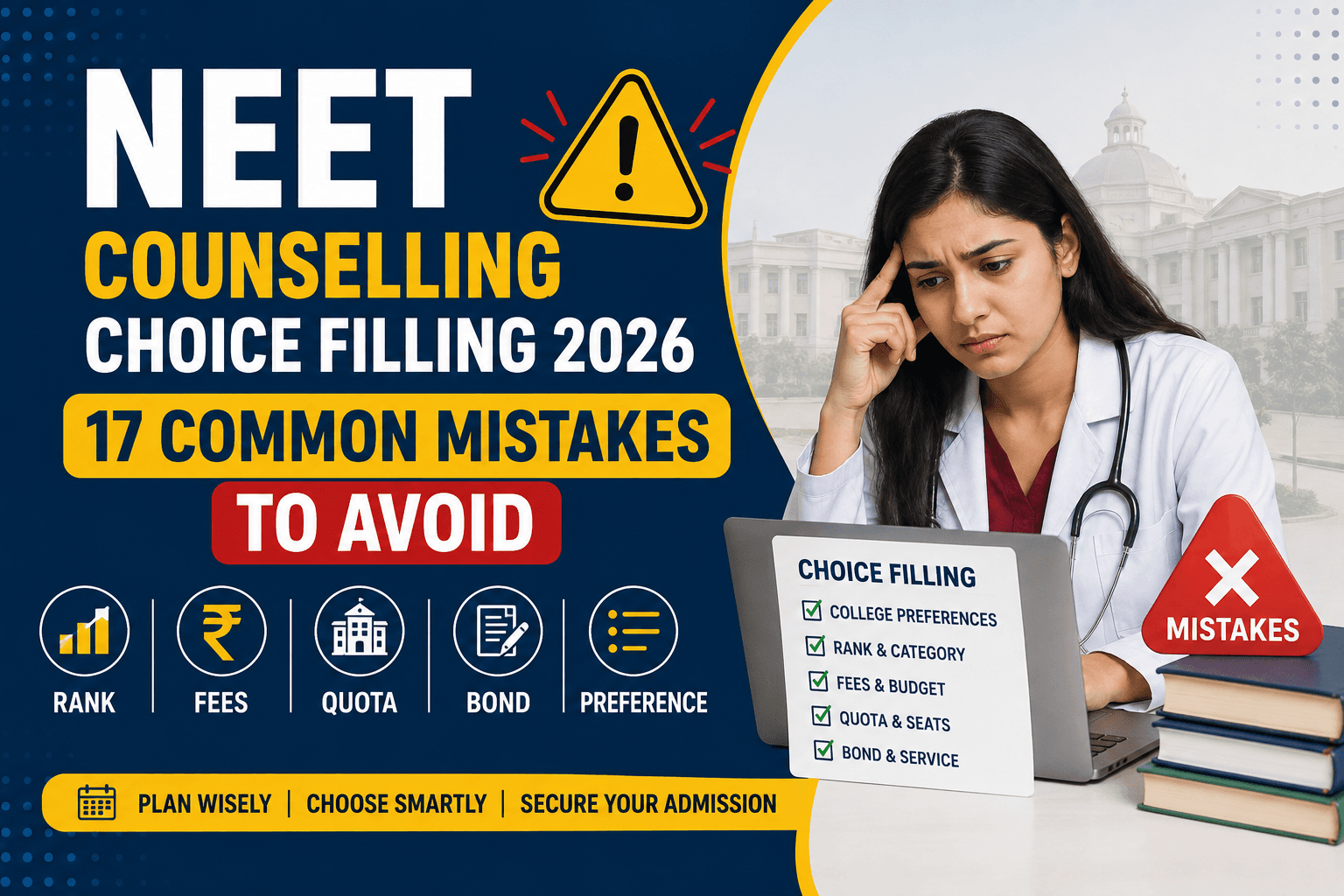
NEET counselling choice filling 2026 is one of the most important stages of the MBBS and BDS admission process. A candidate may have a competitive NEET rank and valid documents, but an incorrect college preference order can still lead to an unsuitable seat allotment—or no allotment at all.
During choice filling, candidates select medical colleges, dental colleges and courses and arrange them in their preferred order. The allotment system then considers the candidate’s NEET UG merit, category, eligibility, submitted preferences and available seats.
A minor mistake during NEET choice filling 2026 can result in:
- Missing a preferred medical college
- Receiving an unaffordable private or deemed university seat
- Selecting a college with a high service bond
- Losing the refundable security deposit
- Becoming ineligible for a subsequent counselling round
- Being allotted a college the candidate does not want to join
This guide explains the most common NEET counselling choice filling mistakes, how to prepare the right MBBS college preference list and what candidates should verify before locking their choices.
NEET UG 2026 Choice-Filling Dates
According to the MCC Round 1 schedule dated 1 August 2026:
- Choice filling: 6 August to 13 August 2026, up to 11:00 AM
- Choice locking: 12 August 2026 from 4:00 PM to 13 August 2026 at 11:00 AM
- Round 1 seat-allotment result: 17 August 2026
- Reporting and joining: 18 August to 22 August 2026
Candidates must follow the server time displayed on the MCC portal and regularly check for revised schedules or notices.
Quick answer: Arrange colleges according to your genuine preference—not according to predicted admission probability. Include all acceptable options, verify fees and bonds, remove colleges you would never join and lock the final list before the deadline.
What Is Choice Filling in NEET Counselling?
Choice filling is the online process in which NEET-qualified candidates select their preferred:
- Medical colleges
- Dental colleges
- MBBS, BDS or other participating courses
- Government, private and deemed institutions
- Eligible quota and institution combinations
MCC conducts counselling for 15% All India Quota seats and specified seats in deemed universities, central universities, AIIMS, JIPMER and other participating institutions. Candidates must register on the official counselling portal and submit their college-course preferences online.
The official 2026 counselling process states that candidates select their preferred courses and institutions, save and lock the choices and then receive allotment based on merit and submitted preferences.
Simple choice-filling example
Suppose a student enters the following order:
- College A – MBBS
- College B – MBBS
- College C – MBBS
- College D – BDS
The counselling system considers the higher preference first. When College A is unavailable according to the candidate’s merit, category and seat availability, the system considers College B and then the remaining choices.
Therefore, the NEET counselling preference order directly affects the final allotment.
Why Is the Choice-Filling Order Important?
Many students believe that NEET rank alone determines the allotted medical college. Rank is crucial, but candidates can only be considered for the colleges and courses they submit in their choice list.
The preference order is important because:
- The system attempts to allot the highest available eligible choice.
- A college placed lower in the list receives lower priority.
- A college omitted from the list cannot normally be allotted.
- An unwanted college may be allotted when it has been added as a casual backup.
- Upgradation can cancel the previously held seat when a higher submitted preference is allotted.
The MCC bulletin advises candidates participating in subsequent rounds to submit only those choices they prefer over their existing allotted seat because, after upgradation, the earlier seat is automatically cancelled and cannot be reclaimed.
17 Common NEET Counselling Choice Filling Mistakes
1. Starting Choice Filling Without Researching Colleges
One of the biggest NEET counselling choice filling mistakes is opening the portal and selecting colleges without preparing an offline list.
The portal may contain hundreds of college-course combinations. Without prior research, students may:
- Add colleges randomly
- Overlook better institutions
- Confuse similarly named colleges
- Select the wrong course or quota
- Arrange preferences incorrectly
Before beginning online choice filling, prepare a college comparison sheet containing:
- College name and location
- Government, private or deemed status
- Complete fee structure
- Hostel and mess charges
- Service bond
- Discontinuation penalty
- Previous closing rank
- Hospital and patient exposure
- Internship stipend
- Connectivity and distance from home
- NMC course and seat status
Online choice filling should be the final submission stage—not the beginning of college research.
2. Arranging Colleges According to Cut-Off Probability
Many students put a less-preferred college first because they think it is easier to obtain.
This is the wrong strategy.
Suppose you prefer College A over College B, but College A had a higher previous-year cut-off. You should still place College A above College B.
A suitable order would be:
- College A
- College B
- College C
If College A is unavailable, the allotment process can consider College B. However, placing College B first may result in its allotment even when College A could have been available.
Correct approach
Arrange colleges according to where you genuinely want to study, considering:
- Academic and clinical quality
- Affordability
- Hospital exposure
- Bond conditions
- Location
- Hostel facilities
- Internship experience
- Personal willingness to join
Do not arrange your list merely according to expected cut-offs.
3. Filling Too Few Choices
Some candidates select only a few highly competitive government medical colleges.
This significantly reduces the possibility of receiving an allotment.
MCC’s 2026 Information Bulletin states that there is no prescribed restriction on the number of choices a candidate may submit. Candidates may enter as many choices as they wish, provided the colleges and courses are arranged in their actual order of preference.
A balanced preference list may include:
- Aspirational colleges
- Target colleges
- Realistic colleges
- Safer colleges
- Affordable private colleges
- Suitable deemed universities
- BDS options, when genuinely acceptable
Adding acceptable lower choices does not reduce the priority of higher choices because the preferences are considered in the submitted order.
4. Adding a College You Would Never Join
Some candidates select every available college because they believe more choices always improve admission chances.
However, adding an unacceptable institution can create serious problems.
If such a college is allotted, the candidate may face:
- Security-deposit forfeiture
- Restricted resignation
- Loss of eligibility for another round
- Financial pressure
- An unwanted relocation
- Loss of an earlier seat after upgradation
Under the 2026 MCC scheme, the security deposit may be forfeited when a candidate is allotted a seat in Round 2 or a subsequent round and fails to join. Round 3 seats also carry stricter exit conditions.
Before selecting any college, ask:
- Can my family afford the complete course?
- Am I willing to live in that city?
- Is the bond acceptable?
- Is the course genuinely acceptable?
- Would I join this institution if it became my final seat?
Never add a college that you are completely unwilling or unable to join.
5. Checking Only the Annual Tuition Fee
The advertised annual tuition fee may not represent the actual cost of medical education.
The total MBBS or BDS expenditure may include:
- Tuition fee
- Admission fee
- University fee
- Hostel fee
- Mess charges
- Examination fee
- Laboratory charges
- Development charges
- Security deposit
- Clinical or hospital charges
- Annual fee escalation
- Bond penalty
- Course-discontinuation penalty
This mistake is particularly common while selecting private medical colleges and deemed universities.
The MCC bulletin advises candidates to verify fees, stipend, bond amount, service conditions and payment requirements directly with the college before filling choices. MCC does not accept responsibility for inaccurate institution-provided fee or bond information.
Better strategy
Calculate the approximate total course cost, not merely the first-year fee.
6. Ignoring the Service Bond and Discontinuation Penalty
Many government and private medical colleges impose service-related or course-leaving conditions.
These may include:
- Compulsory rural service
- State government service
- A fixed service duration
- A penalty for refusing service
- A penalty for leaving MBBS midway
- Restrictions on returning original documents
Before placing a college in your NEET preference list, check:
| Factor | What to verify |
|---|---|
| Service duration | Number of compulsory service years |
| Service location | Rural, district or state posting |
| Bond amount | Penalty for avoiding service |
| Discontinuation penalty | Amount payable for leaving MBBS |
| Internship condition | Any compulsory service linkage |
| Document policy | Rules for original certificates |
A low-fee government college may still carry a significant service obligation.
7. Ignoring Domicile, Category and Quota Eligibility
A college appearing on the counselling portal does not automatically mean every candidate is eligible for every available seat.
Eligibility may depend on:
- State domicile
- Category certificate
- Institutional quota
- Internal university quota
- Minority status
- NRI eligibility
- ESIC eligibility
- Defence or CW quota
- PwBD certification
- University-specific requirements
MCC advises candidates to confirm their eligibility and domicile status before selecting institutional or domicile quota seats.
Selecting an ineligible quota may lead to cancellation during document verification.
Always match your documents with the exact eligibility requirements of the selected seat.
8. Depending Only on Previous-Year Closing Ranks
Previous-year NEET cut-offs are valuable, but they cannot guarantee the current year’s allotment.
Closing ranks may change because of:
- Addition of new medical colleges
- Increase or decrease in seats
- Fee revisions
- Changes in candidate preferences
- Category-wise seat availability
- Revised reservation distribution
- College reputation
- Round-wise resignations and upgrades
- Changes in the number of qualified candidates
The MCC bulletin states that previous opening and closing ranks provide only an indicative idea and do not guarantee the current year’s allotment.
Recommended approach
Study at least two or three years of:
- Category-wise closing ranks
- Quota-wise closing ranks
- Round-wise allotment trends
- College fee changes
- Seat-matrix changes
Use cut-offs as a planning reference, not as a fixed prediction.
9. Comparing Your Rank With the Wrong Category or Quota
A candidate may compare an OBC-NCL state quota rank with the All India Quota general closing rank and reach an incorrect conclusion.
Closing ranks can vary across:
- General or open category
- OBC-NCL
- EWS
- SC
- ST
- PwBD
- All India Quota
- State quota
- Institutional quota
- Deemed university seats
- NRI quota
Always verify that the cut-off data matches your:
- Category
- Quota
- Course
- College
- Counselling authority
- Counselling round
Using the wrong data can make your college preference list either unnecessarily narrow or unrealistically ambitious.
10. Ignoring NMC College and Course Status
Candidates should verify the college, course and seat-intake information before placing an institution high in their preference list.
Check:
- Official college name
- College location
- University affiliation
- MBBS course status
- Permitted seat intake
- Current remarks or restrictions
- Appearance in the official counselling seat matrix
The National Medical Commission provides an official College and Course Search facility for checking medical institutions and course information.
Do not depend solely on:
- Advertisements
- Admission agents
- Social-media posts
- Old brochures
- Unofficial college-ranking websites
11. Selecting a College Only Because of Its Campus
An attractive campus does not automatically indicate strong medical education.
Medical training depends heavily on:
- Hospital bed occupancy
- Daily patient inflow
- Emergency cases
- Availability of clinical departments
- Diagnostic facilities
- Operation theatre exposure
- Faculty availability
- Internship responsibilities
- Diversity of clinical cases
A new college may have excellent infrastructure but limited patient exposure. An older government college may have modest buildings but a larger patient load and stronger clinical training.
Candidates should compare both infrastructure and clinical exposure.
12. Ignoring Internship Stipend and Working Conditions
The internship year is a major part of MBBS training.
Candidates should compare:
- Monthly stipend
- Regularity of stipend payment
- Emergency duty exposure
- Patient diversity
- Internship workload
- Rural or community postings
- Availability of postgraduate departments
- Hands-on clinical responsibilities
A higher stipend is attractive, but it should not be the only factor. Quality of clinical learning, patient exposure and supervision are equally important.
13. Ignoring Location, Language and Hostel Conditions
MBBS involves several years of study, hospital postings and internship.
Before selecting a distant college, evaluate:
- Distance from home
- Railway and airport connectivity
- Local language
- Climate
- Food availability
- Safety
- Hostel availability
- Hostel rules
- Cost of living
- Local transport
The local language may also become important when communicating with patients during clinical postings and internship.
Location should not be the only selection criterion, but it should be considered realistically.
14. Confusing Saved Choices With Locked Choices
Saving choices and locking choices are different stages.
Saved choices may be edited during the permitted choice-filling window. Candidates can add, delete or rearrange them before locking. Once choices are locked, no changes can be made. MCC states that even MCC cannot unlock or modify a candidate’s locked choices.
Before locking, verify:
- College name
- Course name
- Quota
- College code
- Preference number
- Complete fee structure
- Bond conditions
- Eligibility
- Willingness to join
After locking, download and save the submitted preference list.
15. Waiting Until the Final Hour
Waiting until the last day creates avoidable risks.
Candidates may experience:
- Heavy website traffic
- Slow portal response
- Session expiry
- Internet interruption
- OTP delays
- Browser problems
- Power failure
- Insufficient time for final review
The MCC bulletin specifically advises candidates not to wait until the last minute to register, lock choices or obtain the choice-list printout.
Complete the initial list early. Use the final day only to:
- Check revised seat matrices
- Review official notices
- Add newly available seats
- Remove withdrawn seats
- Verify the final order
- Lock the choices
16. Sharing Passwords and OTPs With Agents
Candidates should not allow agents, cybercafé operators or unrelated persons to control their counselling account.
Sharing login credentials can lead to:
- Unauthorised choice changes
- Removal of preferred colleges
- Addition of unsuitable colleges
- Incorrect locking
- Account-access problems
- Misuse of personal information
MCC advises candidates to fill the application themselves and keep the password and OTP confidential.
Parents or counsellors may assist with research, but the candidate should personally verify the final preference list.
17. Assuming Round 1 Choices Continue Automatically
Candidates should not assume that their first-round list will automatically remain active in later rounds.
The MCC 2026 counselling process requires fresh choices for Round 2 and Round 3. A candidate who does not submit fresh choices in an applicable round may not be considered for a new allotment in that round.
Before each counselling round:
- Check eligibility
- Review the latest vacancy list
- Study the revised seat matrix
- Submit fresh choices
- Remove unwanted colleges
- Reorder preferences
- Lock the new choice list
- Download the submitted list
For subsequent-round upgradation, include only those colleges you genuinely prefer over the seat already held.
Best NEET Counselling Choice Filling Strategy for 2026
Step 1: Fix Your Total Budget
Calculate the maximum amount your family can realistically spend for the complete course.
Include:
- Tuition
- Hostel
- Mess
- University charges
- Travel
- Personal expenditure
- Fee escalation
- Security deposits
- Bond-related risks
Do not depend solely on the possibility of obtaining an education loan.
Step 2: Identify Eligible Counselling Categories
Prepare separate lists for:
- MCC All India Quota
- State quota
- Central universities
- AIIMS and JIPMER
- Deemed universities
- Private medical colleges
- Institutional quotas
- Minority seats
- NRI seats
This reduces confusion between colleges with different eligibility and fee requirements.
Step 3: Prepare a Medical College Comparison Sheet
Use the following columns:
| College-comparison criterion | Information to record |
|---|---|
| College name | Official institution name |
| State and city | Location |
| College type | Government, private or deemed |
| Tuition fee | Annual and total estimate |
| Hostel and mess | Annual estimate |
| Service bond | Duration and penalty |
| Discontinuation bond | Course-leaving penalty |
| Closing rank | Correct category and quota |
| Clinical exposure | Patient flow and hospital departments |
| Internship stipend | Monthly amount |
| Connectivity | Travel time from home |
| NMC status | College, course and seat details |
| Final preference | Your ranking |
Step 4: Divide Colleges Into Four Groups
Dream colleges
Highly preferred colleges where admission may be difficult based on previous trends.
Target colleges
Colleges whose closing ranks are reasonably close to your rank.
Safer colleges
Acceptable institutions where your rank may be comparatively competitive.
Backup colleges
Affordable private colleges, deemed universities or BDS options that you are genuinely prepared to join.
Step 5: Combine the Groups by Genuine Preference
Do not automatically put every private college below every government college.
For example, an affordable and clinically strong private college may be preferable to a distant government college with an unacceptable service bond.
Your final order should reflect:
- Genuine preference
- Affordability
- Clinical quality
- Bond conditions
- Location
- College type
- Career priorities
Step 6: Check the Current Seat Matrix
Before locking, check for:
- Newly added colleges
- Increased seat intake
- Withdrawn seats
- Revised college codes
- Category conversions
- Newly available deemed seats
- Changes in quota distribution
Use the latest official seat matrix for the specific counselling round.
Step 7: Conduct a Final Preference Audit
For every selected college, answer:
- Am I eligible?
- Can I afford it?
- Do I accept the bond?
- Would I genuinely join?
- Is it placed above or below the correct colleges?
- Have I selected the right course and quota?
Remove any option for which the answer is uncertain or negative.
NEET Choice Filling Example
Assume a candidate has shortlisted five colleges:
- College A: Excellent government college with a difficult cut-off
- College B: Good government college with a realistic cut-off
- College C: Government college located far from home
- College D: Affordable private medical college
- College E: Expensive deemed university
A possible preference order is:
- College A
- College B
- College C
- College D
- College E
College A should remain first even when its previous cut-off appears difficult.
However, College E should be removed completely when the family cannot afford its total fees. It should not be added merely as a backup.
NEET Counselling Choice Filling Checklist
Before locking your preferences, confirm that:
- I have researched every selected college.
- My colleges are arranged in genuine preference order.
- I have included enough acceptable choices.
- I have not included any college I would refuse to join.
- I have checked the current seat matrix.
- I meet the quota and domicile conditions.
- My category certificates are valid.
- I have checked the complete course cost.
- I have verified hostel and mess charges.
- I understand the service bond.
- I understand the discontinuation penalty.
- I have checked NMC course and seat information.
- I have assessed clinical exposure.
- I have checked location and connectivity.
- I have used the correct category-wise closing ranks.
- I have verified the college and course codes.
- I have read the current round’s rules.
- I have not shared my password or OTP.
- I have locked my choices before the deadline.
- I have downloaded the final submitted list.
Frequently Asked Questions About NEET Choice Filling 2026
How many choices can I fill in NEET counselling?
MCC does not prescribe a fixed maximum number of choices. Candidates may enter as many available choices as they wish, but they should arrange them in their genuine preference order.
Should I place my dream medical college first?
Yes. A genuinely preferred college should be placed above a less-preferred college, even when its previous closing rank appears difficult.
Does filling more choices reduce my chance of receiving my first choice?
No. Lower choices do not replace higher preferences. They are considered when higher choices are unavailable according to merit, eligibility and seat availability.
Can I edit choices after locking?
No. Candidates may add, delete or rearrange choices before locking. Once locked, the choices cannot be changed or unlocked.
What happens when I save but do not manually lock choices?
The MCC bulletin states that submitted choices may be automatically locked according to the schedule. However, candidates should manually review, lock and download their preference list instead of depending on automatic locking.
Is fresh choice filling required for Round 2?
Yes. Eligible candidates must submit fresh choices for Round 2. Earlier Round 1 choices are not sufficient for a new Round 2 allotment.
Can I participate in both MCC and state counselling?
Eligible candidates may participate in both processes, but they must carefully monitor joining, resignation, upgradation and forfeiture rules before accepting or surrendering a seat.
Are previous-year NEET cut-offs reliable?
Previous closing ranks are useful for estimating possibilities, but they are only indicative and do not guarantee the current year’s allotment.
Should I add private medical colleges?
Add a private medical college only after checking the complete tuition fee, hostel expenses, additional charges, bond conditions and your family’s financial capacity.
Is clinical exposure important when selecting an MBBS college?
Yes. Hospital patient flow, emergency exposure, clinical departments and internship responsibilities directly influence practical medical training.
Conclusion
NEET counselling choice filling 2026 is not merely an online formality. It is a strategic decision that can determine the college a candidate joins, the amount the family spends and the service or bond obligations accepted for the coming years.
The most common mistakes include:
- Selecting too few colleges
- Arranging choices according to cut-off probability
- Ignoring complete fees
- Overlooking service bonds
- Choosing ineligible quotas
- Depending only on previous ranks
- Locking choices without reviewing them
The best strategy is to research every institution, prepare a broad but acceptable choice list and arrange colleges in genuine preference order.
A good NEET rank creates the admission opportunity. A carefully prepared preference list helps convert that opportunity into the best available medical seat.
Get NEET Counselling Support From Education MESD
Preparing the correct MBBS college preference order can be difficult because students must compare ranks, quotas, fees, bonds, clinical exposure and multiple counselling rounds.
Education MESD provides personalised NEET UG counselling guidance to help students and parents make informed admission decisions.
Counselling support may include:
- Rank-based medical college shortlisting
- MCC and state counselling guidance
- Government medical college comparison
- Private and deemed university comparison
- Fee and bond analysis
- Category and quota-based planning
- Choice-filling preference preparation
- Round-wise counselling support
Disclaimer: Admission depends on NEET merit, category, eligibility, seat availability, submitted choices and the rules of the respective counselling authority. No counsellor, institution or admission service can guarantee a particular medical college.