
PhD in UK for Indian Students 2027: Ultimate Guide to Universities, Fully Funded Scholarships, Fees, Stipend & Applications
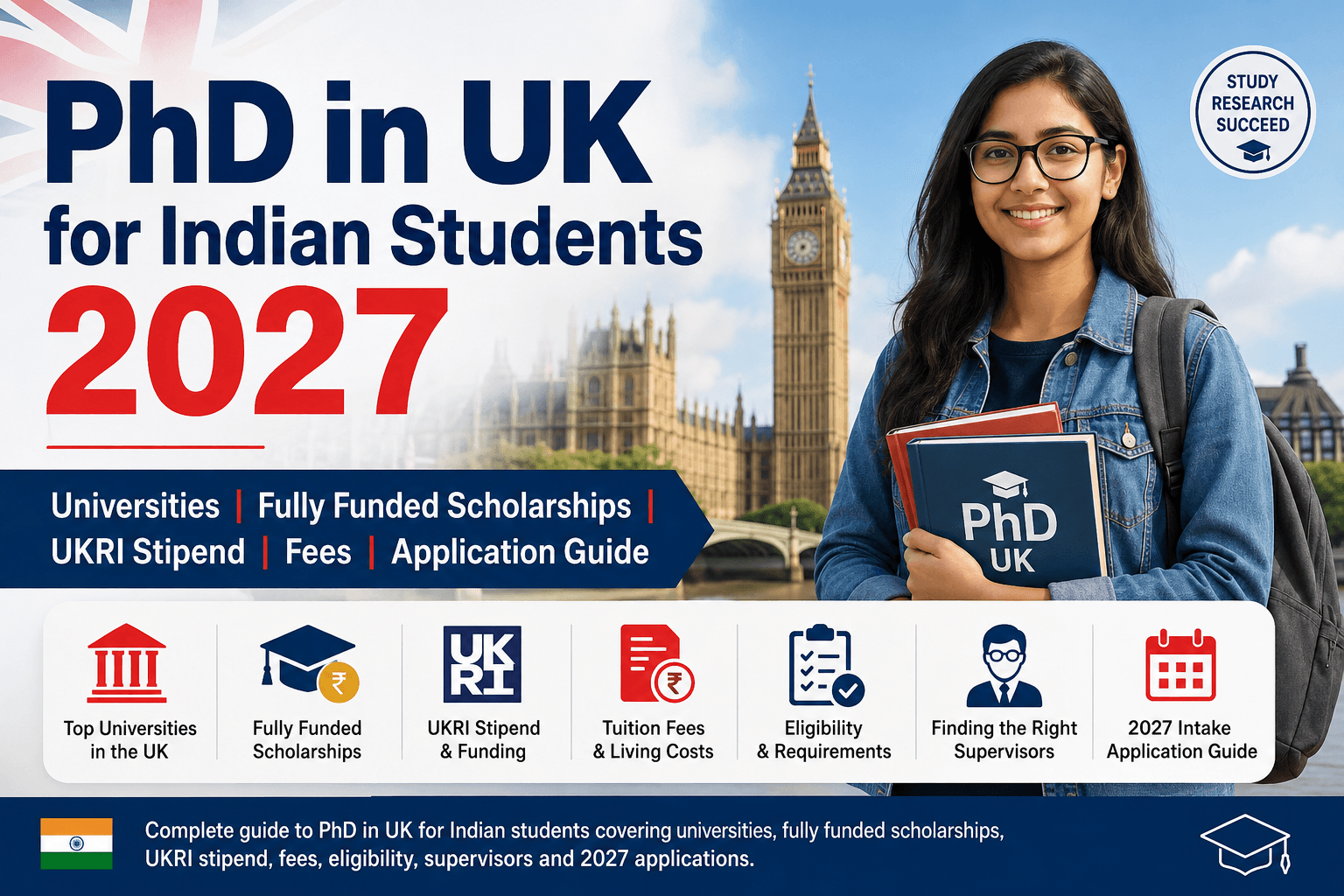
Planning a PhD in UK for Indian students in 2027? The United Kingdom remains one of the most attractive destinations for Indian research scholars because of its globally recognised universities, intensive research environment, competitive doctoral funding, UKRI studentships, internationally respected supervisors and comparatively shorter PhD duration.
A PhD in the UK for Indian students generally takes around 3–4 years of full-time research, depending on the university, discipline and project. Indian applicants can also compete for fully funded PhD scholarships in UK, including university scholarships, UKRI-funded studentships, doctoral training programmes, research-project funding and prestigious awards offered by universities such as Oxford, Cambridge, Imperial College London, UCL and Edinburgh.
But getting a fully funded PhD in UK for Indian students is not simply about applying to highly ranked universities.
A successful UK PhD strategy should follow:
Research Interest → Research Gap → Supervisor → Research Group → University → Funding → Application
In this complete PhD in UK for Indian students 2027 guide, EducationMESD explains the best universities, fully funded scholarships, UKRI stipend, tuition fees, eligibility, research proposal, supervisor selection, application process, documents, visa requirements, dependants and post-PhD career opportunities.
PhD in UK for Indian Students 2027: Quick Answer
Indian students can pursue a PhD in the UK after meeting the academic and research requirements of the selected university. A full-time UK PhD commonly takes around 3–4 years. Fully funded opportunities are available through UKRI studentships, university scholarships, doctoral training programmes and funded research projects. Students targeting September or October 2027 admission should ideally begin supervisor identification and scholarship preparation during 2026.
PhD in UK for Indian Students: Key Highlights
| Particular | Details |
|---|---|
| Degree | PhD / DPhil |
| Typical Duration | 3–4 years |
| Main Intake | September–October |
| Other Intakes | January or flexible starts at selected universities |
| Eligibility | Relevant Bachelor’s/Master’s depending on programme |
| Research Proposal | Required for many programmes |
| Supervisor | Usually very important |
| English Requirement | IELTS/PTE/TOEFL or accepted equivalent |
| International Tuition | Depends on university and subject |
| Major Funding | UKRI, university scholarships, funded PhD projects |
| UKRI Minimum Stipend 2026–27 | £21,805 per year |
| Graduate Route After Doctorate | Up to 3 years under current rules |
| Dependants | Permitted for qualifying doctoral/research programmes |
| Popular Fields | AI, Engineering, Medicine, Business, Data Science, Biosciences, Social Sciences |
Why Study PhD in UK for Indian Students?
The UK is a major destination for doctoral research because many universities combine strong academic supervision with advanced research infrastructure, international collaborations and industry partnerships.
1. Shorter PhD Duration
One of the biggest advantages of a PhD in UK for Indian students is the duration.
Most full-time doctoral programmes are designed to be completed in approximately:
3 to 4 Years
This can be attractive compared with doctoral systems where substantial coursework may extend the overall duration.
2. Strong Research-Focused PhD Structure
A UK PhD is generally highly research oriented.
Students typically spend most of their doctoral period on:
- Literature review
- Research design
- Data collection
- Experiments
- Analysis
- Publications
- Conference presentations
- Thesis preparation
- Viva examination
This structure can be suitable for applicants who already have a relatively clear research direction.
3. Globally Recognised UK Universities
UK universities conduct internationally recognised research in areas such as:
- Artificial Intelligence
- Machine Learning
- Data Science
- Computer Science
- Cybersecurity
- Robotics
- Electronics
- Engineering
- Medicine
- Biotechnology
- Public Health
- Pharmaceutical Sciences
- Business
- Management
- Finance
- Economics
- Psychology
- Education
- Law
- Environmental Science
- Humanities
- Social Sciences
However, PhD students should choose universities according to research fit, not ranking alone.
4. Fully Funded PhD Opportunities
Indian students can apply for several forms of fully funded PhD in UK.
Funding may include:
- Full tuition fees
- Annual stipend
- Research expenses
- Laboratory costs
- Conference funding
- Travel support
- Fieldwork
- Research training
- Consumables
Students must carefully check whether the scholarship covers the full international tuition fee.
5. UKRI PhD Funding
UK Research and Innovation, or UKRI, supports a large number of doctoral studentships through universities, research councils and doctoral training structures.
For the 2026–27 academic year, the minimum UKRI doctoral stipend is:
£21,805 Per Year
Students should note that UKRI-funded opportunities are generally applied for through participating universities or research organisations rather than through a direct individual application to UKRI.
Best Universities for PhD in UK for Indian Students
There is no single best university for every PhD applicant.
For doctoral research, students should prioritise:
Supervisor + Research Group + Research Facilities + Funding + Research Fit
Some universities frequently considered by Indian PhD applicants include:
| University | Popular Research Areas | Major Funding Routes |
| University of Oxford | Medicine, AI, Science, Law, Humanities | Clarendon, Rhodes, UKRI |
| University of Cambridge | Engineering, Computer Science, Medicine, Biosciences | Gates Cambridge, Cambridge Trust |
| Imperial College London | AI, Computing, Engineering, Medicine | President’s PhD Scholarship |
| University College London | AI, Engineering, Health, Education | UCL doctoral scholarships |
| University of Edinburgh | AI, Informatics, Medicine, Engineering | Doctoral College funding |
| University of Manchester | Engineering, Business, Science, Healthcare | UKRI and university funding |
| King’s College London | Medicine, Law, AI, Social Sciences | Research studentships |
| University of Bristol | Engineering, AI, Health, Science | Doctoral Training funding |
| University of Warwick | Business, Economics, Computing, Engineering | University scholarships |
| University of Southampton | Computing, Electronics, Engineering | Research studentships |
Top 10 UK Universities for PhD for Indian Students
Indian applicants often search for the top universities in UK for PhD.
A practical shortlist can include:
- University of Oxford
- University of Cambridge
- Imperial College London
- University College London
- University of Edinburgh
- University of Manchester
- King’s College London
- University of Bristol
- University of Warwick
- University of Southampton
This should not be treated as a ranking.
The correct university depends on your research topic.
University of Oxford PhD for Indian Students
Oxford generally uses the term DPhil instead of PhD.
Indian students can explore doctoral research across:
- Computer Science
- Medicine
- Engineering
- Economics
- Law
- Biological Sciences
- Humanities
- Social Sciences
Clarendon Scholarship
The Clarendon Fund is one of Oxford’s best-known graduate funding schemes.
It generally provides:
- Course-fee support
- Living-cost funding
- Access across many academic disciplines
- Eligibility for international applicants
Indian students interested in a fully funded PhD at Oxford should check both Clarendon and departmental funding opportunities.
University of Cambridge PhD for Indian Students
Cambridge offers PhD programmes across a wide range of research areas.
Popular options include:
- Artificial Intelligence
- Computer Science
- Engineering
- Biotechnology
- Medicine
- Economics
- Business
- Environmental Science
- Social Sciences
Gates Cambridge Scholarship
The Gates Cambridge Scholarship is among the most prestigious funding schemes available to international postgraduate applicants.
Indian students should also investigate:
- Cambridge Trust
- Departmental scholarships
- UKRI studentships
- College funding
- Research-project funding
Imperial College London PhD for Indian Students
Imperial College London is especially attractive for STEM researchers.
Popular areas include:
- Artificial Intelligence
- Machine Learning
- Robotics
- Computing
- Engineering
- Biotechnology
- Healthcare
- Medicine
- Data Science
President’s PhD Scholarship
The President’s PhD Scholarship is one of Imperial’s major doctoral funding opportunities.
Recent funding rounds have included:
- Tuition-fee support
- Annual stipend
- Research consumables funding
Students targeting Imperial PhD scholarships 2027 should start monitoring opportunities during 2026.
UCL PhD for Indian Students
University College London offers doctoral programmes in:
- Artificial Intelligence
- Engineering
- Neuroscience
- Education
- Population Health
- Psychology
- Medicine
- Social Sciences
Indian applicants should explore:
- UCL Research Excellence Scholarship
- Departmental scholarships
- UKRI studentships
- Funded PhD vacancies
- Research-project funding
University of Edinburgh PhD for Indian Students
Edinburgh is particularly strong in:
- Artificial Intelligence
- Informatics
- Robotics
- Data Science
- Engineering
- Medicine
- Cognitive Science
- Social Sciences
Students should explore university, school and research-project funding opportunities.
PhD Fees in UK for Indian Students
One of the most common questions is:
How Much Does PhD in UK Cost for Indian Students?
There is no fixed tuition fee across all UK universities.
PhD fees depend on:
- University
- Subject
- Department
- Laboratory requirements
- Research facilities
- Project type
- Full-time or part-time study
For many international PhD programmes, tuition may broadly fall around:
£20,000–£40,000+ Per Year
However, laboratory-intensive, medical, engineering and specialist programmes may cost more.
Students should always verify the exact international research fee before applying.
Cost of Living in UK for PhD Students
Apart from tuition, Indian students should budget for:
- Accommodation
- Food
- Transportation
- Electricity and utilities
- Mobile and internet
- Books
- Research expenses
- Health-related costs
- Personal expenses
- Travel
- Visa and immigration charges
The actual cost depends heavily on location.
London is usually more expensive than cities such as:
- Sheffield
- Nottingham
- Leicester
- Newcastle
- Cardiff
- Coventry
This makes the scholarship stipend an important factor when comparing offers.
Fully Funded PhD in UK for Indian Students 2027
A fully funded PhD in UK can significantly reduce the financial burden on international researchers.
Popular funding routes include:
| Scholarship/Funding | Institution | Typical Coverage |
| Clarendon Scholarship | Oxford | Fees + living support |
| Gates Cambridge Scholarship | Cambridge | Full-cost funding |
| Cambridge Trust | Cambridge | Full or partial funding |
| President’s PhD Scholarship | Imperial | Tuition + stipend + research support |
| UCL Research Excellence Scholarship | UCL | Doctoral funding |
| Edinburgh Doctoral Funding | Edinburgh | Fees/stipend depending on scheme |
| UKRI Studentships | Participating universities | Stipend + fee contribution |
| Rhodes Scholarship | Oxford | Fees + stipend |
| Departmental Studentships | Various universities | Full/partial |
| Funded Research Projects | Universities | Often fully funded |
Best PhD Scholarships in UK for Indian Students
Students should not search only for the phrase UK PhD scholarship.
Funding can appear under several names.
Look for:
- PhD Scholarship
- PhD Studentship
- Funded PhD
- Doctoral Studentship
- Doctoral Training Partnership
- Centre for Doctoral Training
- Research Assistantship
- Project-Funded PhD
- Doctoral Scholarship
- Graduate Research Scholarship
Using these search terms can help students discover more funding opportunities.
UKRI PhD Studentship for Indian Students
What Is UKRI?
UKRI is a major public research funding organisation in the United Kingdom.
It supports doctoral research through several funding structures and research councils.
Relevant fields include:
- Engineering
- Physical Sciences
- Medicine
- Biotechnology
- Environmental Research
- Economics
- Social Sciences
- Arts
- Humanities
Can Indian Students Get UKRI PhD Funding?
International applicants can compete for many UKRI-funded doctoral opportunities.
However:
- International places may be limited.
- Competition can be high.
- Overseas tuition coverage should be checked carefully.
- Funding conditions vary by university.
Important Question to Ask
Does the studentship cover the full international tuition fee?
Do not assume that every UKRI-funded position automatically covers all overseas fees.
PhD Stipend in UK for Indian Students
The PhD stipend in UK depends on the scholarship or studentship.
For UKRI-funded doctoral students, the minimum stipend for 2026–27 is:
£21,805 Per Year
Some scholarships may provide a higher amount.
Students comparing offers should consider:
Tuition Fee Coverage + Stipend + Research Funding + Funding Duration
A higher stipend does not always mean a better overall package if international tuition is only partially covered.
Eligibility for PhD in UK for Indian Students
PhD eligibility differs by university and subject.
Common accepted qualifications include:
- BTech
- BE
- Four-year Bachelor’s degree
- MSc
- MTech
- MA
- MPhil
- MBA for relevant fields
- Other recognised postgraduate qualifications
Some universities may consider outstanding Bachelor’s graduates directly.
Others may require a Master’s degree.
Minimum Percentage Required for PhD in UK
Indian students commonly ask:
What Percentage Is Required for PhD in UK?
There is no universal percentage.
Universities may consider:
- Percentage
- CGPA
- Institution attended
- Bachelor’s degree
- Master’s degree
- Dissertation
- Research experience
- Publications
- Academic references
Many programmes requiring an equivalent UK 2:1 may expect approximately:
60%–65% or Higher
depending on the university and the applicant’s Indian institution.
Competitive programmes may expect substantially stronger academic performance.
PhD in UK After BTech
Can I Do PhD in UK After BTech?
Yes, some UK universities may consider applicants with a strong four-year BTech or equivalent Bachelor’s degree.
However, eligibility depends on:
- Academic record
- Research experience
- University policy
- Departmental requirements
- Proposed research field
A Master’s qualification can strengthen the application where competition is high.
PhD in UK After MTech
MTech graduates are well positioned to apply for research programmes in fields such as:
- Artificial Intelligence
- Computer Science
- Data Science
- Electronics
- Mechanical Engineering
- Civil Engineering
- Robotics
- Cybersecurity
- Renewable Energy
Your Master’s dissertation can become an important part of your PhD application.
PhD in UK After MSc
Indian MSc graduates can apply to doctoral programmes related to their academic background.
Examples:
MSc Data Science → PhD in AI or Data Science
MSc Biotechnology → PhD in Bioscience
MSc Psychology → PhD in Psychology
MSc Economics → PhD in Economics
MSc Physics → PhD in Physics or Applied Science
Is IELTS Required for PhD in UK?
English-language requirements vary between universities.
Commonly accepted tests may include:
- IELTS Academic
- TOEFL iBT
- Pearson PTE
- Cambridge English
- Other approved qualifications
Some universities may waive standardised English tests where applicants satisfy specific academic or language requirements.
However:
An Indian Medium of Instruction Certificate Does Not Automatically Guarantee an IELTS Waiver.
Check the exact university policy.
Research Proposal for PhD in UK
A strong PhD research proposal for UK universities should clearly demonstrate originality, relevance and feasibility.
Your proposal should answer four core questions:
What are you researching?
Why is the research important?
What gap exists?
How will you investigate it?
PhD Research Proposal Format
A typical proposal may contain:
1. Research Title
Keep it specific.
2. Introduction
Explain the background.
3. Research Problem
Define the problem clearly.
4. Literature Review
Discuss current academic knowledge.
5. Research Gap
Identify what existing studies have not solved.
6. Research Questions
Create focused research questions.
7. Research Objectives
State measurable objectives.
8. Methodology
Explain:
- Research design
- Data
- Participants
- Experimental methods
- Statistical methods
- Analytical techniques
- Software/tools
9. Expected Contribution
Explain theoretical, methodological or practical contributions.
10. Timeline
Show that the project is achievable.
11. References
Use current and relevant scholarly literature.
How to Find PhD Supervisor in UK
For many UK PhD programmes, supervisor selection is extremely important.
Step 1: Define Your Research Area
Do not search for:
PhD in Artificial Intelligence
Search more specifically.
For example:
Federated Learning for Privacy-Preserving Medical Image Analysis
Specific topics help you identify relevant faculty members.
Step 2: Search Research Groups
Check:
- University faculty pages
- Research laboratories
- Centres of excellence
- Research projects
- Academic publications
- Doctoral vacancies
Step 3: Read Recent Supervisor Publications
Review a professor’s recent work before contacting them.
Your aim is to identify:
Their Current Research + Your Proposed Research Gap
Step 4: Contact Potential Supervisors
A professional supervisor email should briefly include:
- Your qualification
- Research background
- Proposed research topic
- Research gap
- Why you selected that professor
- Funding interest
Attach a concise academic CV where appropriate.
Documents Required for PhD in UK
Indian students may be asked to submit:
- Passport
- Bachelor’s transcripts
- Bachelor’s degree certificate
- Master’s transcripts
- Master’s certificate
- Academic CV
- Research proposal
- Statement of Purpose
- Personal statement
- Academic references
- IELTS/English score
- Publications
- Writing sample
- Portfolio where relevant
- Supervisor details
Requirements differ by programme.
PhD SOP for UK Universities
A PhD Statement of Purpose should explain:
- Academic background
- Research journey
- Research interests
- Previous projects
- Why you want a PhD
- Why the university
- Why the supervisor
- Long-term goals
Avoid repeating your CV.
The SOP should tell a coherent research story.
Academic CV for UK PhD Application
Recommended sections include:
- Contact Details
- Research Interests
- Education
- Research Experience
- Dissertation
- Publications
- Conference Papers
- Technical Skills
- Research Methods
- Teaching Experience
- Awards
- Academic Memberships
For PhD applications, research should appear before unrelated work experience.
How to Apply for PhD in UK for Indian Students
Step 1: Define Your Research Interest
Identify a specific field and problem.
Step 2: Conduct a Literature Review
Understand recent research.
Step 3: Identify the Research Gap
Find what existing studies have not adequately addressed.
Step 4: Search for Supervisors
Look for strong academic alignment.
Step 5: Shortlist Universities
Compare research strength and funding.
Step 6: Prepare Your Research Proposal
Customise it for the programme.
Step 7: Prepare Academic CV and SOP
Highlight research potential.
Step 8: Arrange Academic References
Select referees who know your academic work.
Step 9: Apply for Admission
Follow the departmental process.
Step 10: Apply for Funding
Do not wait until admission is confirmed if scholarships have earlier deadlines.
Step 11: Attend the PhD Interview
Prepare to defend your research.
Step 12: Complete Visa Formalities
After receiving the required university documentation, proceed with visa preparation.
UK PhD Interview Questions
Indian students should prepare for questions such as:
- Why do you want to pursue a PhD?
- Why did you choose this research topic?
- What is your research gap?
- Why is the research important?
- What is novel about your proposal?
- Why did you choose this supervisor?
- Why this university?
- What methodology will you use?
- What data will you require?
- What limitations do you expect?
- What contribution will your research make?
- How will you complete the research within the available timeframe?
PhD in UK 2027 Application Timeline for Indian Students
Students targeting September or October 2027 should ideally follow this timeline:
| Period | Activity |
| August–September 2026 | Select research area |
| September–October 2026 | Identify universities and supervisors |
| October–November 2026 | Contact supervisors |
| November–December 2026 | Prepare proposal, CV and references |
| December 2026–January 2027 | Apply for major scholarships |
| January–March 2027 | Interviews and funding applications |
| March–June 2027 | Receive decisions |
| June–August 2027 | CAS, visa and accommodation |
| September–October 2027 | Begin PhD |
When Should I Apply for a Fully Funded PhD in UK 2027?
Start searching from:
September–October 2026
Many competitive scholarships and studentships can close before the general university admission deadline.
UK Student Visa for Indian PhD Students
After receiving the required university offer and Confirmation of Acceptance for Studies, students can proceed with the UK Student Visa process.
Documents may include:
- Passport
- CAS
- Financial evidence
- English-language evidence
- TB certificate
- ATAS where applicable
- Academic documents
- Visa application documents
Always verify the latest immigration rules before applying.
ATAS Requirement for UK PhD
Some postgraduate researchers in selected science, engineering and technology subjects may require an Academic Technology Approval Scheme certificate.
This can apply to particular areas of:
- Engineering
- Physics
- Materials Science
- Chemistry
- Advanced Technology
- Computing-related research
Applicants should check ATAS requirements early.
Can PhD Students Bring Dependants to UK?
Under current rules, qualifying students enrolled in:
- PhD programmes
- Doctoral programmes
- Research-based higher degrees
may be eligible to bring qualifying dependants.
This can be important for Indian students planning to travel with:
- Spouse
- Partner
- Children
Applicants must meet the relevant immigration and financial requirements.
Post-Study Work After PhD in UK
Eligible doctoral graduates can currently access a longer Graduate Route than students completing non-doctoral degrees.
A UK PhD can lead to opportunities in:
- Postdoctoral research
- Universities
- Research institutions
- Technology companies
- Healthcare
- Engineering
- Biotechnology
- Consulting
- Policy research
- Government
- Innovation centres
Jobs After PhD in UK for Indian Students
Academic Careers
Possible roles include:
- Postdoctoral Researcher
- Research Fellow
- Lecturer
- Academic Researcher
- Research Scientist
Industry Careers
Possible roles include:
- AI Research Scientist
- Machine Learning Engineer
- Data Scientist
- R&D Engineer
- Biotechnology Researcher
- Pharmaceutical Scientist
- Quantitative Researcher
- Research Consultant
- Policy Researcher
- Innovation Specialist
High-Demand PhD Fields in UK
Artificial Intelligence
Popular topics include:
- Generative AI
- Explainable AI
- Federated Learning
- Multimodal AI
- AI for Healthcare
- Responsible AI
Data Science
Research areas include:
- Predictive Analytics
- Big Data
- Statistical Learning
- Data Engineering
Cybersecurity
Research includes:
- Privacy
- Secure AI
- Cryptography
- Digital Forensics
Healthcare and Medicine
Popular areas include:
- Medical Imaging
- Bioinformatics
- Digital Health
- Precision Medicine
- Public Health
Engineering
Research areas include:
- Robotics
- Autonomous Systems
- Smart Manufacturing
- Renewable Energy
- Sustainable Engineering
Business and Management
Popular PhD topics include:
- Digital Transformation
- Artificial Intelligence in Business
- Marketing Analytics
- FinTech
- Sustainability
- Consumer Behaviour
How to Get Fully Funded PhD in UK for Indian Students
Students targeting a fully funded PhD in UK 2027 should focus on these seven factors:
1. Strong Academic Profile
Good academic performance remains important.
2. Research Experience
Research dissertations and projects demonstrate capability.
3. Publications
Quality publications can strengthen competitive applications.
4. Strong Research Proposal
Demonstrate a meaningful gap and realistic methodology.
5. Supervisor Alignment
Find a professor whose research closely matches your topic.
6. Academic References
Choose referees who can assess your research ability.
7. Early Application
Funding deadlines may close months before programme commencement.
The ideal formula is:
Research Fit + Academic Profile + Proposal + Research Experience + Supervisor Alignment + Funding Eligibility
Common Mistakes Indian Students Make in UK PhD Applications
Choosing Ranking Instead of Research Fit
A famous university does not guarantee the right supervisor.
Applying Too Late
Funding deadlines often occur early.
Sending Generic Supervisor Emails
Personalise every message.
Using the Same Proposal Everywhere
Adapt your proposal to the programme.
Ignoring Tuition-Fee Coverage
Check whether international fees are fully funded.
Applying Only to Oxford and Cambridge
Excellent research exists across many UK universities.
Focusing Only on Percentage
Research experience and supervisor fit can also be crucial.
PhD in UK vs Australia vs New Zealand
| Factor | UK | Australia | New Zealand |
| Typical Duration | 3–4 years | 3–4 years | 3–4 years |
| Research Focus | Very High | Very High | Very High |
| Funding Availability | Strong | Strong | Strong |
| Supervisor Importance | Very High | Very High | Very High |
| Research Infrastructure | Excellent | Excellent | Strong |
| International Reputation | Excellent | Excellent | Strong |
| Scholarship Competition | High | High | Moderate–High |
The best country depends on:
Research Topic + Supervisor + Scholarship + Career Goal + Cost
Is PhD in UK Worth It for Indian Students?
A PhD in UK can be worth it for Indian students when there is:
- Clear research interest
- Strong supervisor alignment
- Appropriate funding
- Good research infrastructure
- Long-term research or academic ambition
A UK PhD may be particularly suitable for careers in:
- Academia
- Postdoctoral research
- R&D
- Artificial Intelligence
- Technology
- Scientific research
- Corporate innovation
- Public policy
However, a PhD should not be selected simply as an immigration route.
It is primarily a serious research commitment.
Frequently Asked Questions About PhD in UK for Indian Students
Can Indian Students Do PhD in UK?
Yes. Indian applicants can pursue doctoral programmes in the UK if they meet the academic, English-language and research requirements of the selected programme.
Is PhD in UK Free for Indian Students?
No. A UK PhD is not automatically free. However, fully funded studentships and scholarships can cover tuition fees and living expenses.
Can Indian Students Get Fully Funded PhD in UK?
Yes. Indian students can compete for UKRI studentships, university scholarships, doctoral training funding and funded PhD projects.
How Much Is PhD Stipend in UK?
The minimum UKRI doctoral stipend for 2026–27 is £21,805 per year. Other schemes may offer more.
How Long Is PhD in UK?
Most full-time UK PhDs take approximately 3–4 years.
Is Master’s Required for PhD in UK?
Not always. Some programmes accept suitable Bachelor’s graduates, while others require or strongly prefer a Master’s degree.
Can I Do PhD in UK After BTech?
Yes, depending on the university, academic record and research profile.
Can I Do PhD in UK After MTech?
Yes. MTech graduates can apply for relevant engineering, AI, computing and technology PhDs.
Can I Do PhD in UK After MSc?
Yes. MSc graduates can apply to related research areas.
Can I Do PhD in UK Without IELTS?
Possibly. Some universities accept alternative English evidence or exemptions. Requirements vary.
Is GRE Required for PhD in UK?
GRE is not a universal requirement for UK PhD admission. Individual programmes may set their own requirements.
Can PhD Students Work in UK?
Students may be permitted to work subject to their visa conditions and university regulations.
Can PhD Students Take Spouse to UK?
Eligible students on qualifying doctoral or research-based programmes may currently bring qualifying dependants.
When Should I Apply for PhD in UK 2027?
Begin preparation during August–October 2026 and prioritise major scholarship deadlines from late 2026 onward.
How Do I Find Fully Funded PhD Positions in UK?
Search university vacancy pages, departmental websites, doctoral training programmes, UKRI-funded opportunities and research-group project advertisements.
Which UK University Is Best for PhD?
The best university is the one offering the strongest combination of research fit, supervisor expertise, facilities and funding for your specific topic.
Final Verdict: PhD in UK for Indian Students 2027
A PhD in UK for Indian students 2027 can provide strong research exposure, international academic experience, access to respected research groups and competitive fully funded scholarship opportunities.
But successful PhD applicants do not begin with university rankings.
They begin with a research problem.
The correct sequence is:
Research Interest → Research Gap → Supervisor → Research Group → University → Funding → Application
Students planning for UK PhD admission in 2027 should therefore start early, build a strong research profile, contact suitable supervisors and apply for funding before scholarship deadlines close.
Planning a PhD in UK? EducationMESD Can Help
Applying for a PhD abroad involves much more than filling out an online form.
EducationMESD can help aspiring research scholars with:
- UK university shortlisting
- PhD supervisor identification
- Research-topic refinement
- Research-gap identification
- Research proposal guidance
- Academic CV preparation
- Statement of Purpose guidance
- Scholarship identification
- Funding strategy
- PhD application planning
- Interview preparation
Planning for a Fully Funded UK PhD in 2027?
Start early. Build your research profile. Find the right supervisor. Apply strategically for funding.
Connect with EducationMESD for structured PhD admission and scholarship guidance.
Relevant official links to: