
PhD Abroad with a Low CGPA: Admission Possibilities, Best Countries, Scholarships & Strategies for Indian Students 2027
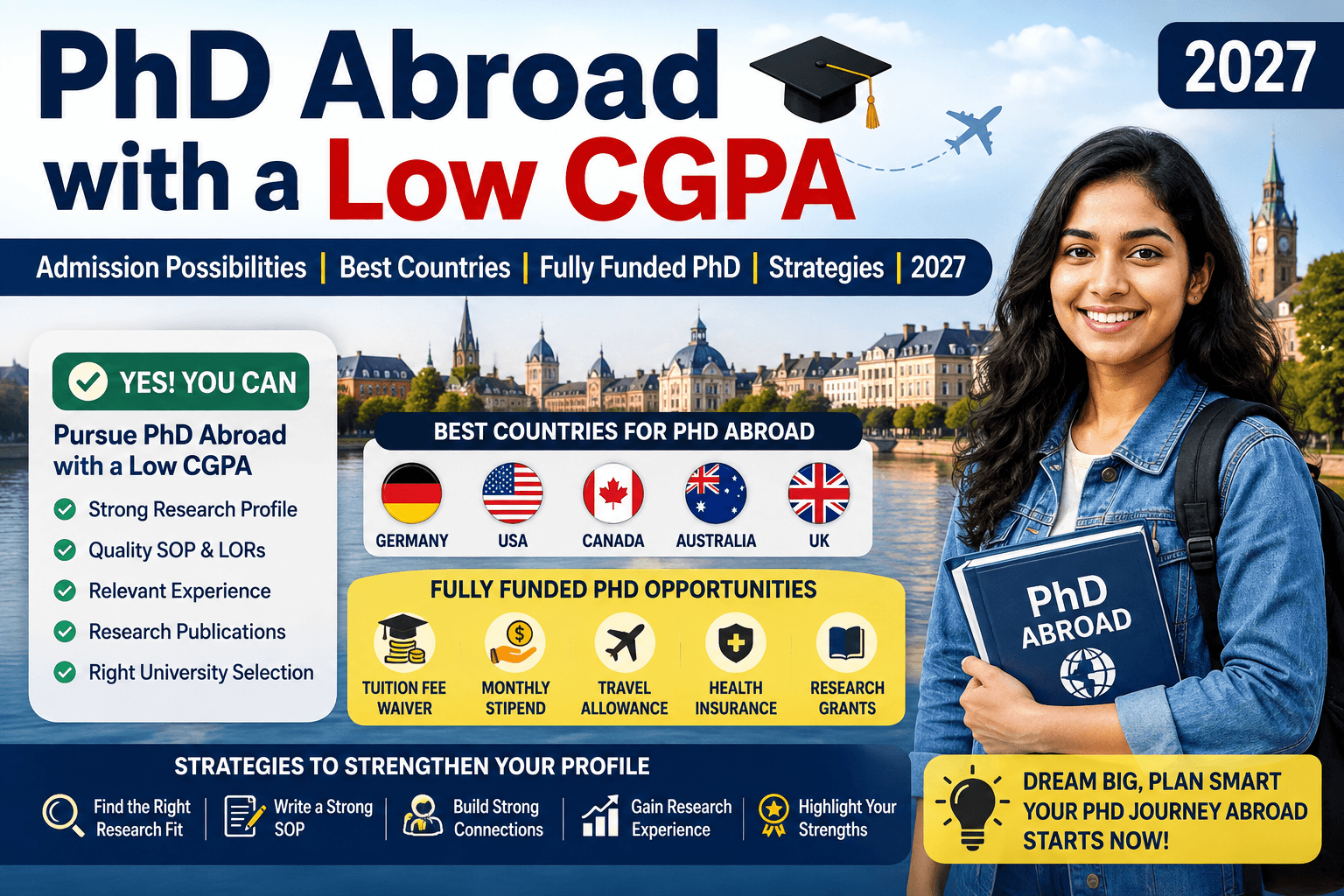
Are you worried that a low CGPA will stop you from pursuing a PhD abroad?
The good news is that a PhD abroad with a low CGPA may still be possible, depending on the university, country, doctoral program, research experience and overall strength of your profile.
Many Indian students believe that having a CGPA below 7.0 means they cannot apply for PhD programs in countries such as the UK, Australia, New Zealand, USA, Germany or other European destinations.
That is not always correct.
PhD admission is different from admission to many taught undergraduate or postgraduate programs because a doctorate is primarily a research degree. Universities may therefore examine your academic grades alongside your:
- research experience
- master’s dissertation
- journal publications
- conference papers
- research proposal
- Statement of Purpose
- Letters of Recommendation
- professional experience
- technical expertise
- academic improvement
- supervisor compatibility
- research-project fit
A lower CGPA may certainly make admission and scholarship competition more difficult, particularly at highly selective universities.
However, a strong research profile can sometimes make your application considerably more competitive.
The right question is therefore not:
“Can I do a PhD abroad with a low CGPA?”
Instead, ask:
“How can I build enough evidence of research ability to overcome a weaker academic record?”
This comprehensive PhD abroad with a low CGPA guide for Indian students in 2027 explains admission possibilities, CGPA ranges, country-wise opportunities, scholarship strategies and practical ways to strengthen your PhD profile.
PhD abroad for Indian students
Quick Answer: Can I Pursue a PhD Abroad with a Low CGPA?
Yes, pursuing a PhD abroad with a low CGPA can be possible if you meet the university’s minimum eligibility requirements and demonstrate strong research potential.
Your chances can improve when your application includes:
- strong postgraduate performance
- a research-intensive master’s degree
- a high-quality dissertation
- research publications
- relevant research experience
- strong academic recommendations
- an excellent research proposal
- a focused SOP
- relevant professional or R&D experience
- strong alignment with a potential supervisor
However, remember:
PhD admission eligibility and fully funded PhD scholarship competitiveness are not the same thing.
You may qualify for admission but still face intense competition for funding.
What Is Considered a Low CGPA for PhD Abroad?
There is no universal CGPA requirement for PhD admission abroad.
Indian universities commonly use a 10-point CGPA system, while overseas institutions may use:
- 4.0 GPA scales
- percentage systems
- UK degree classifications
- honours classifications
- institution-specific international equivalency systems
For planning purposes, Indian applicants can use the following broad framework.
| Indian CGPA | General Position | Suggested PhD Strategy |
|---|---|---|
| 8.0–10.0 | Strong | Target competitive universities and scholarships |
| 7.0–7.9 | Generally competitive | Focus on research quality and supervisor fit |
| 6.5–6.9 | Moderate | Strengthen publications and research experience |
| 6.0–6.4 | Challenging | Target flexible programs and research-heavy pathways |
| 5.5–5.9 | Difficult | Consider MRes, MPhil or strong research experience |
| Below 5.5 | Very challenging | Build a stronger postgraduate/research record first |
These ranges are not official admission criteria.
Universities evaluate international qualifications differently, so always check the exact PhD entry requirements on the official university website.
Can I Do a PhD Abroad with 5.5 CGPA?
A PhD abroad with 5.5 CGPA can be difficult, particularly if the university has a strict academic cut-off.
However, this does not necessarily mean the end of your PhD plans.
A better pathway may be:
Low Bachelor’s CGPA → Research Master’s/MRes/MPhil → Strong Dissertation → Publications → PhD
You can also strengthen your profile through:
- research assistant positions
- university research projects
- peer-reviewed publications
- industry R&D experience
- technical research projects
- conference presentations
- strong postgraduate academic performance
Applicants below standard eligibility thresholds should avoid spending money on applications before confirming formal eligibility.
Can I Do a PhD Abroad with 6 CGPA?
Yes, a PhD abroad with 6 CGPA may be possible at some universities, but university selection becomes extremely important.
Compare these two profiles:
Candidate A
CGPA: 6.0
Publications: None
Research Experience: None
Master’s Thesis: Average
Candidate B
CGPA: 6.0
Master’s CGPA: 8.3
Publications: 3
Research Experience: 3 years
Master’s Thesis: Strong
Supervisor Match: Excellent
Although both applicants have the same undergraduate CGPA, Candidate B presents much stronger evidence of doctoral readiness.
That is why research performance after your bachelor’s degree matters.
Can I Get a PhD Abroad with 6.5 CGPA?
A 6.5 CGPA can potentially be sufficient for some PhD programs abroad, depending on:
- the university
- degree equivalency
- postgraduate performance
- research experience
- publications
- supervisor support
- research proposal
- funding requirements
Students with a CGPA between 6.5 and 7.0 should concentrate strongly on research fit rather than applying randomly based on university rankings.
Can I Get a PhD Abroad with 7 CGPA?
Yes. A 7 CGPA may satisfy the academic requirements of some international PhD programs, although requirements differ.
Applicants around this range can improve their chances by developing:
- peer-reviewed publications
- a strong dissertation
- relevant research projects
- international conference exposure
- a high-quality research proposal
- strong recommendations
- a carefully targeted supervisor list
A 7 CGPA alone does not guarantee admission, but it can provide a workable foundation when combined with a strong research profile.
Does CGPA Matter for PhD Admission Abroad?
Yes, CGPA matters for PhD admission abroad, but it is not always the only selection criterion.
Doctoral admissions committees are trying to determine whether you can:
- identify an original research problem,
- review existing academic literature,
- formulate research questions,
- design an appropriate methodology,
- analyse complex evidence,
- conduct independent research,
- publish scholarly work, and
- complete a doctoral thesis.
Your CGPA provides evidence of academic performance.
Your research portfolio provides evidence of research readiness.
For PhD admission, both can matter.
What Can Compensate for a Low CGPA in PhD Admission?
Several factors can strengthen a weak-CGPA PhD application.
1. Strong Master’s Degree
Strong postgraduate performance can demonstrate academic improvement.
For example:
B.Tech CGPA: 6.2
followed by:
M.Tech CGPA: 8.6
shows a significant upward academic trend.
2. Research Publications
Peer-reviewed publications can demonstrate:
- academic writing ability
- methodology skills
- literature knowledge
- data-analysis capability
- research independence
- familiarity with peer review
Quality is more important than quantity.
3. Strong Master’s Thesis
Your master’s dissertation may become one of the strongest pieces of evidence showing your research potential.
Highlight:
- research problem
- methodology
- findings
- publications generated
- technical contribution
4. Research Experience
Experience as a:
- Research Assistant
- Junior Research Fellow
- project researcher
- laboratory researcher
- industry R&D professional
can significantly strengthen your profile.
5. Strong Research Proposal
A well-developed proposal demonstrates that you understand:
- research gaps
- research questions
- methodology
- theoretical foundations
- feasibility
- potential contribution
6. Strong PhD Supervisor Fit
A potential supervisor may be more interested in your profile if your technical or research expertise aligns closely with their current research.
Research fit can therefore become strategically important for lower-CGPA applicants.
find and contact a PhD supervisor abroad
Best Countries for PhD Abroad with a Low CGPA
Students often search for countries accepting low CGPA for PhD admission.
There is no country where low grades automatically guarantee admission.
However, differences in doctoral systems create different opportunities.
1. PhD in USA with Low GPA
The USA can be worth considering for applicants with strong research profiles because doctoral admission practices vary between universities and departments.
Some programs impose minimum GPA requirements.
Others use broader holistic assessment.
Students targeting a PhD in USA with low GPA should strengthen:
- Statement of Purpose
- research experience
- publications
- Letters of Recommendation
- faculty alignment
- quantitative skills
- technical research expertise
SEO Tip for Students
Do not search only:
“Universities accepting low GPA for PhD USA.”
Also search:
“PhD faculty working in [your research field] USA.”
Research fit often provides a better application strategy than GPA filtering alone.
2. PhD in UK with Low CGPA
The UK remains a popular destination for Indian PhD applicants.
UK doctoral opportunities generally fall into two broad categories:
Student-Proposed PhD
You develop your research proposal and identify a supervisor.
Advertised PhD Project
You apply for an existing research project, often with predefined funding.
For lower-CGPA applicants, advertised projects can sometimes be attractive when your technical expertise closely matches the project requirements.
Strengthen your application through:
- strong master’s performance
- MRes or MPhil experience
- publications
- research assistantships
- dissertation quality
- relevant industry experience
- supervisor alignment
3. PhD in Australia with Low CGPA
Australia can be particularly attractive for candidates with a strong postgraduate research background.
Australian PhD applications may place considerable emphasis on:
- research components in previous degrees
- honours research
- master’s thesis
- publications
- research proposal
- supervisor availability
An applicant with a weaker undergraduate record but a strong research master’s degree may therefore have a more competitive profile.
However, fully funded PhD scholarships in Australia can be significantly more competitive than basic admission.
Australian Government Department of Education
4. PhD in New Zealand with Low CGPA
Students can also explore a PhD in New Zealand with low CGPA, particularly when their postgraduate research and proposed doctoral project are strong.
Popular areas include:
- Artificial Intelligence
- Computer Science
- Engineering
- Management
- Business
- Agriculture
- Sustainability
- Environmental Science
- Education
- Healthcare
A strong supervisor match can be especially important.
5. PhD in Germany with Low CGPA
Germany offers several doctoral pathways:
- individual PhD supervision
- structured doctoral programs
- funded university projects
- research institute positions
- doctoral researcher vacancies
For project-specific doctoral positions, employers and research teams may pay close attention to:
- relevant research experience
- technical skills
- publications
- programming knowledge
- methodological expertise
- project fit
This can benefit applicants whose professional and research capabilities are stronger than their historical grades.
6. PhD in Europe with Low CGPA
Other European destinations worth exploring include:
- Netherlands
- Sweden
- Norway
- Denmark
- Finland
- France
- Belgium
- Austria
- Switzerland
In some European systems, doctoral positions operate similarly to research jobs.
Applicants are selected for a particular funded research project.
This means specialised knowledge can become particularly valuable.
Which Country Is Best for PhD with Low CGPA?
There is no single best country for PhD applicants with low CGPA.
Your best destination depends on:
- academic eligibility
- master’s performance
- research experience
- publications
- subject area
- funding needs
- research proposal
- supervisor availability
- technical skills
A student with strong AI research experience may find an excellent funded project in Germany or the Netherlands, while another candidate in management may find stronger supervisor-led opportunities in the UK or Australia.
Choose based on research fit—not just country rankings.
How to Get PhD Admission Abroad with Low CGPA: 15 Effective Strategies
1. Build a Strong Research Profile
Research experience is one of the best ways to reduce the emphasis on old grades.
Gain experience through:
- research assistantships
- master’s projects
- research laboratories
- academic collaborations
- research internships
- industry R&D
2. Publish High-Quality Research Papers
Aim for credible publications in your research area.
Relevant outputs include:
- journal articles
- conference papers
- systematic reviews
- methodological papers
- reputable book chapters
Never publish solely to increase paper count.
3. Develop a Strong PhD Research Proposal
A high-quality proposal should answer:
What is the research problem?
Clearly define the problem.
What is the research gap?
Explain what existing studies have not addressed.
Why does the research matter?
Show academic and practical significance.
What are your research questions?
Define measurable or investigable questions.
What methodology will you use?
Explain data, experiments, models, participants or analytical techniques.
What is the expected contribution?
Demonstrate potential originality.
how to write a PhD research proposal
4. Find the Right PhD Supervisor
Supervisor matching can be particularly important for students pursuing a PhD abroad with a low CGPA.
Identify professors based on:
- recent publications
- research interests
- funded projects
- laboratory focus
- research methodology
- current PhD opportunities
Do not send the same email to 100 professors.
Personalised outreach is much more effective.
5. Write a Powerful Statement of Purpose
Your SOP should focus primarily on your research journey and future potential.
Use this structure:
Academic Background → Research Experience → Research Gap → Proposed Research → Supervisor Fit → Long-Term Goal
If your CGPA needs explanation, keep it short.
Then emphasise your subsequent achievements.
6. Demonstrate Academic Improvement
An upward trajectory can strengthen your narrative.
For example:
Bachelor’s: 6.1 CGPA
Master’s: 8.5 CGPA
Dissertation: Excellent
Research Papers: 4
Research Experience: 3 Years
This demonstrates that your current research ability is not accurately represented by your earlier academic performance.
7. Get Strong Letters of Recommendation
A strong LOR should provide specific examples of your:
- research aptitude
- analytical ability
- technical competence
- independence
- writing ability
- academic maturity
- persistence
- doctoral potential
Choose referees who actually know your research.
8. Build an Academic Research CV
Your PhD CV should include:
- research interests
- education
- thesis/dissertation
- publications
- conference presentations
- research projects
- research experience
- technical skills
- awards
- patents
- professional experience
A PhD CV should present you as a researcher, not simply as a job applicant.
9. Use Your Master’s Degree Strategically
A strong master’s degree can help reposition an applicant with weaker undergraduate grades.
Highlight:
- master’s CGPA
- dissertation
- research methods
- technical contribution
- papers generated from the project
10. Gain Relevant Professional Experience
Industry experience can be valuable when directly related to your proposed PhD.
Examples:
AI Engineer → PhD in Artificial Intelligence
Data Scientist → PhD in Machine Learning
Marketing Manager → PhD in Marketing
Teacher → PhD in Education
Biomedical Engineer → PhD in Medical Imaging
11. Apply for Research Assistant Positions
A research assistant role can help you develop:
- publications
- laboratory experience
- methodologies
- academic references
- international collaboration
It can be an excellent bridge between a weak academic record and a competitive PhD application.
12. Target Advertised Funded PhD Projects
Search for projects where your skills directly match the research requirements.
For example:
“Federated Learning + Medical Imaging + PyTorch”
will be more valuable for a project requiring those exact capabilities than for a generic computer science PhD.
13. Create an Ambitious–Target–Realistic University List
A strong application portfolio should include:
Ambitious Universities
Highly competitive programs.
Target Universities
Programs where you reasonably meet academic and research requirements.
Strong Research-Fit Opportunities
Projects where your expertise closely matches the supervisor’s requirements.
Do not rely solely on global university rankings.
14. Consider an MPhil, MRes or Research Master’s
If your CGPA does not meet direct PhD entry requirements, consider:
Low CGPA → MRes/MPhil → Strong Research Performance → Publications → PhD
This can provide a much stronger recent academic record.
15. Apply Early
Funding deadlines may be earlier than general admission deadlines.
Starting early gives you time to:
- contact supervisors
- improve your proposal
- prepare SOP
- request LORs
- take IELTS/TOEFL if required
- identify scholarships
- revise your academic CV
Can a Master’s Degree Compensate for Low Bachelor’s CGPA?
A strong master’s degree can significantly strengthen your PhD application, particularly when the postgraduate program contains substantial research.
Example:
Bachelor’s CGPA: 6.2
Master’s CGPA: 8.7
Publications: 3
Research Experience: 2 years
Strong Dissertation: Yes
This indicates substantial academic progression.
However, postgraduate performance cannot automatically override a compulsory eligibility threshold.
Can Research Publications Compensate for Low CGPA?
Publications can help demonstrate research capability, but they usually cannot replace formal academic eligibility.
Publications are particularly useful when they are:
- peer-reviewed
- relevant
- credible
- methodologically strong
- connected to your proposed research
One strong paper is usually more valuable than several weak publications.
Can Work Experience Compensate for Low CGPA?
Relevant work experience can strengthen your profile, especially for applied PhDs.
Examples include professional experience in:
- AI and Data Science
- Engineering
- Healthcare
- Management
- Finance
- Marketing
- Education
- Sustainability
The closer the professional experience is to your proposed PhD, the more valuable it becomes.
Can GRE Compensate for Low CGPA?
A strong GRE score may provide additional academic evidence where the test is accepted.
However:
GRE cannot normally override mandatory academic requirements.
Many doctoral programs have also made GRE scores optional or unnecessary.
Always check the latest program-specific policy.
Can IELTS Compensate for Low CGPA?
No.
IELTS, TOEFL and PTE demonstrate English-language proficiency.
They do not replace academic eligibility requirements.
A high IELTS score is useful for satisfying language requirements but does not directly compensate for poor academic grades.
Can You Get a Fully Funded PhD Abroad with a Low CGPA?
Yes, a fully funded PhD abroad with a low CGPA may be possible, but funding is generally more competitive than admission.
Possible funding sources include:
- university PhD scholarships
- government scholarships
- supervisor research grants
- research assistantships
- research-council projects
- industry-funded PhDs
- project-specific doctoral positions
Applicants with lower CGPA should particularly consider funded projects where their specialist research skills provide a strong match.
fully funded PhD scholarships for Indian students
PhD Admission vs PhD Scholarship: Understand the Difference
PhD Admission
The university determines whether you are academically and academically/research-ready for the doctoral program.
PhD Funding
A separate scholarship or funding competition may rank candidates based on:
- academic performance
- publications
- awards
- research experience
- proposal quality
- supervisor support
- project relevance
Therefore:
PhD Admission ≠ Fully Funded PhD
Students must plan for both separately.
How to Find Fully Funded PhD Opportunities with Low CGPA
Use specific search queries instead of generic searches.
Examples:
- Fully funded PhD UK international students 2027
- Fully funded PhD Australia Indian students 2027
- PhD scholarship New Zealand international students
- Doctoral researcher Germany machine learning
- Funded PhD Netherlands artificial intelligence
- PhD studentship UK data science
- Fully funded PhD management Europe
Then verify eligibility on the official university or funding website.
Low CGPA but Strong Research Profile: Example
Consider this hypothetical profile:
| Criteria | Applicant Profile |
| Bachelor’s CGPA | 6.4/10 |
| Master’s CGPA | 8.5/10 |
| Journal Publications | 3 |
| Conference Papers | 2 |
| Research Experience | 3 Years |
| Master’s Dissertation | Strong |
| Technical Skills | Strong |
| Supervisor Fit | Excellent |
The bachelor’s CGPA is relatively weak.
But the overall research profile is significantly stronger.
The applicant should not write:
“Please overlook my low CGPA.”
A better positioning is:
“My subsequent postgraduate performance, publications and research experience demonstrate my readiness for doctoral-level research.”
Documents Required for PhD Abroad with a Low CGPA
Prepare a complete application package containing:
- Academic CV
- Statement of Purpose
- Research Proposal
- Bachelor’s transcripts
- Master’s transcripts
- Degree certificates
- Thesis/dissertation abstract
- Research publications
- Conference papers
- Letters of Recommendation
- IELTS/TOEFL/PTE score where required
- Research portfolio
- Work-experience documents
- Scholarship application documents
- Passport
- University-specific forms
Common Mistakes to Avoid When Applying for PhD with Low CGPA
Applying Only to Top-Ranked Universities
Rankings should not be the only selection factor.
Searching Only for “Low CGPA Universities”
Search for research fit and project compatibility instead.
Sending Generic Emails to Professors
Personalise every serious supervisor approach.
Hiding Low Grades
Your transcript will show them.
Writing an SOP Only About Low CGPA
Your SOP should primarily communicate research ability.
Publishing in Predatory Journals
Low-quality publications can reduce your credibility.
Assuming Supervisor Interest Guarantees Admission
Formal eligibility requirements still apply.
Assuming Admission Means Full Funding
Scholarship decisions may be separate.
PhD Abroad Strategy Based on Your CGPA
| CGPA | Recommended Strategy |
| 8.0+ | Target highly competitive PhDs and scholarships |
| 7.0–7.9 | Strong research-fit applications |
| 6.5–6.9 | Publications + proposal + supervisor targeting |
| 6.0–6.4 | Research-heavy profile strengthening |
| 5.5–5.9 | Consider MRes/MPhil or RA experience |
| Below 5.5 | Build a stronger postgraduate research record first |
Step-by-Step Plan for PhD Abroad with a Low CGPA
Step 1: Evaluate Your Academic Profile
Analyse:
- bachelor’s CGPA
- master’s CGPA
- dissertation
- research experience
- publications
Step 2: Identify Your Research Area
Avoid overly broad topics.
Step 3: Select Suitable Countries
Compare:
- eligibility
- funding
- research facilities
- supervisor availability
Step 4: Check Formal PhD Requirements
Do this before paying application fees.
Step 5: Identify Potential Supervisors
Create a targeted shortlist.
Step 6: Read Their Recent Publications
Understand their current research direction.
Step 7: Develop Your Research Proposal
Align it with the research group where appropriate.
Step 8: Create an Academic CV
Prioritise research achievements.
Step 9: Prepare Your SOP
Explain your research journey clearly.
Step 10: Obtain Strong LORs
Approach research supervisors and academics early.
Step 11: Identify Funding
Research university, government and project-based scholarships.
Step 12: Apply Strategically
Quality applications are better than random mass applications.
Frequently Asked Questions: PhD Abroad with a Low CGPA
Can I pursue a PhD abroad with a low CGPA?
Yes. It may be possible if you meet the university’s minimum requirements and build a strong research profile.
Is 5.5 CGPA enough for PhD abroad?
Direct admission can be difficult. A research master’s, MPhil, MRes or substantial research experience may improve your options.
Is 6 CGPA enough for PhD abroad?
Some programs may consider applicants around this range, depending on their qualifications, postgraduate record and research profile.
Can I get a PhD abroad with 6.5 CGPA?
Yes, potentially. Research publications, a strong master’s degree and supervisor alignment can improve your chances.
Is 7 CGPA enough for PhD abroad?
It may satisfy the requirements of some programs. Always check university-specific criteria.
Which country is best for PhD with low CGPA?
There is no universally best country. The UK, Australia, New Zealand, USA, Germany and other European destinations all have different PhD admission models.
Can I get a fully funded PhD with low CGPA?
Potentially, but funding is competitive. Strong research experience, publications and project alignment can help.
Can master’s CGPA compensate for low bachelor’s CGPA?
A strong master’s performance can significantly improve your profile, particularly when accompanied by high-quality research.
Can publications compensate for low CGPA?
Publications strengthen your application but usually do not replace mandatory academic eligibility requirements.
Can work experience compensate for low CGPA?
Relevant research or professional experience can strengthen the overall application.
Can GRE improve my chances with low CGPA?
Where accepted, a strong GRE result can provide additional evidence of academic ability but cannot usually override formal requirements.
Does IELTS compensate for low CGPA?
No. IELTS measures English-language proficiency rather than academic performance.
Should I mention my low CGPA in my SOP?
Mention it briefly only when clarification is genuinely useful. Focus primarily on your academic improvement and research achievements.
Should I contact a professor before applying?
For many research-focused PhDs, contacting an appropriate supervisor can be beneficial or required. Follow the university’s specific application procedure.
Can I pursue PhD abroad after M.Tech with low CGPA?
Yes, depending on eligibility. A strong M.Tech dissertation, research publications and technical experience may strengthen your application.
Can I pursue PhD abroad after MSc with low CGPA?
Potentially. Your MSc research performance, dissertation and proposed doctoral topic will be important.
Can I pursue PhD abroad after MCA with low CGPA?
Potentially, especially for Computer Science, IT and related areas if the program accepts your qualification and you have adequate research preparation.
Can I pursue PhD abroad after MBA with low CGPA?
Potentially, particularly in areas such as management, marketing, finance, entrepreneurship and organisational studies.
Is research experience more important than CGPA for PhD admission?
Both can matter. Research experience can substantially strengthen an application, but it does not automatically override mandatory academic entry requirements.
Can a professor accept me despite low CGPA?
A supervisor may support your application, but the university’s formal academic eligibility requirements still apply.
Final Verdict: Is PhD Abroad with a Low CGPA Possible in 2027?
Yes, PhD abroad with a low CGPA can be possible for Indian students in 2027, but success requires strategic profile building and careful university selection.
A lower CGPA does not have to define your entire academic future.
The strongest strategy is to build evidence of your current research capability through:
Strong Master’s Performance + Research Experience + Publications + Excellent Proposal + Supervisor Fit + Strong LORs + Relevant Technical Skills
Do not focus exclusively on finding:
“Universities accepting low CGPA for PhD.”
Instead, identify:
“PhD supervisors, funded projects and universities where my research expertise is a strong match.”
That research-first approach can give you a much more realistic and effective PhD application strategy.
Start Your PhD Abroad Journey with EducationMESD
Planning a PhD abroad with a low CGPA requires more than submitting applications to multiple universities.
You need a structured strategy covering:
- country selection
- university eligibility
- research-profile evaluation
- supervisor identification
- proposal development
- SOP preparation
- scholarship targeting
- funded PhD identification
- application planning
EducationMESD supports prospective research scholars in understanding international PhD admissions and developing a realistic application pathway based on their academic and research profiles.Whether you are planning a PhD in Australia, New Zealand, UK, USA, Germany or Europe, the right research fit, supervisor and application strategy can make a significant difference.