
PhD Abroad After M.Tech, MBA, MCA or MSc: Complete Guide for Indian Students in 2027
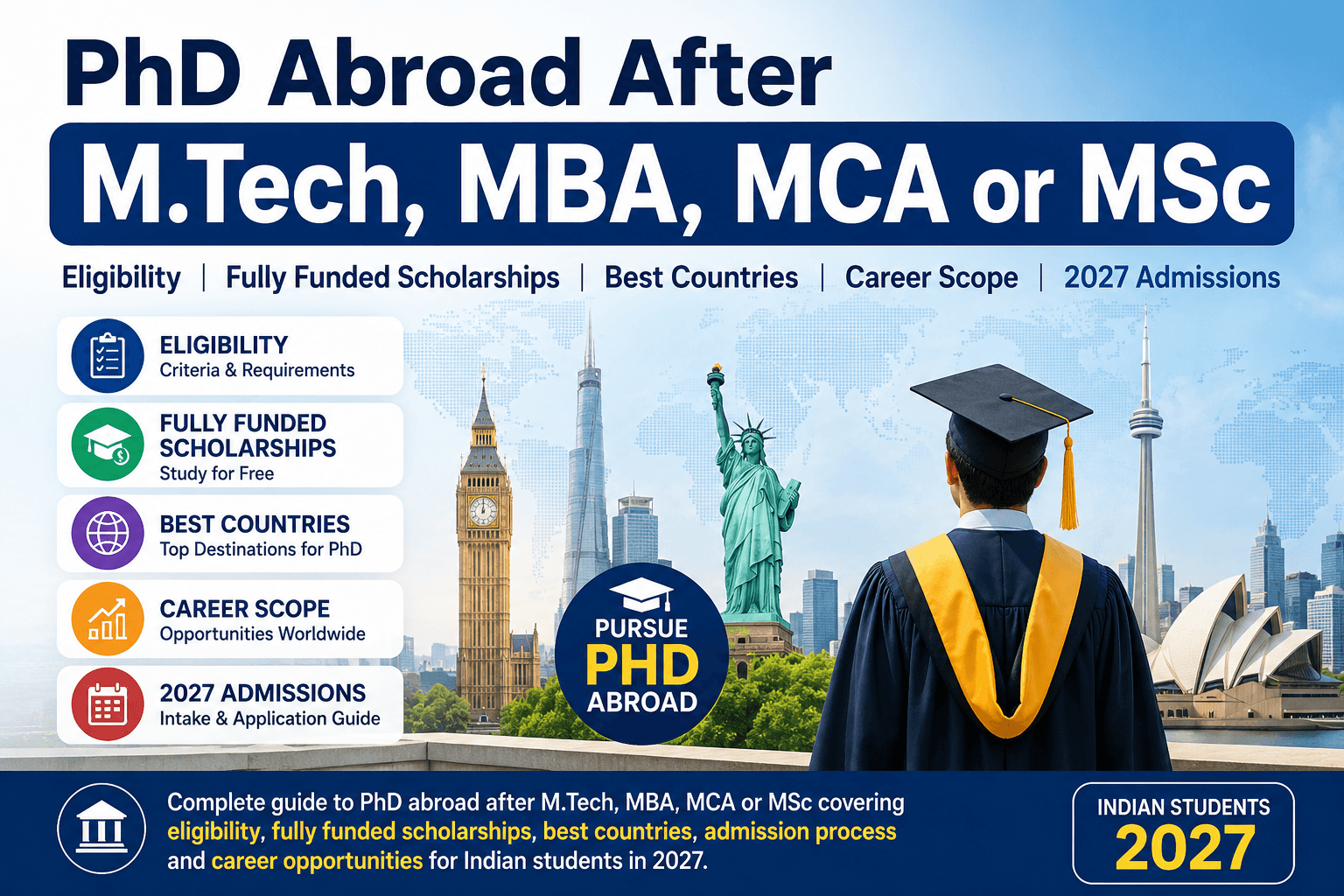
Can you pursue a PhD abroad after M.Tech, MBA, MCA or MSc?
Yes. Indian students with M.Tech, MBA, MCA or MSc qualifications can apply for PhD programmes abroad, provided they meet the academic, research, English-language and programme-specific eligibility requirements of the university.
A master’s degree can open the door to doctoral study in countries such as Australia, New Zealand, the United Kingdom, United States, Germany, Canada and other European destinations.
However, getting PhD admission abroad is not based only on your postgraduate degree.
Universities may assess:
- Academic performance
- Master’s specialisation
- Research experience
- Dissertation or thesis
- Research publications
- Research proposal
- Research methodology knowledge
- Supervisor fit
- Statement of Purpose
- Letters of Recommendation
- IELTS or TOEFL scores
- GRE or GMAT where required
- Professional or research experience
Students can also apply for a fully funded PhD abroad, where funding may cover tuition fees and provide a living stipend, research support or assistantship.
This EducationMESD guide explains everything you need to know about PhD abroad after M.Tech, MBA, MCA or MSc, including eligibility, best PhD courses, fully funded scholarships, country options, application requirements and career scope for Indian students planning for 2027 admission.
PhD abroad for Indian students
Quick Answer: Can I Do a PhD Abroad After M.Tech, MBA, MCA or MSc?
Yes.
| Qualification | Eligible for PhD Abroad? | Popular PhD Areas | Research Importance |
|---|---|---|---|
| M.Tech / ME | Yes | Engineering, AI, CS, Robotics, Electronics | Very High |
| MBA | Yes | Management, Finance, Marketing, Strategy | Very High |
| MCA | Yes | Computer Science, AI, Data Science, Cybersecurity | High |
| MSc | Yes | Science, Mathematics, Data Science, Biotechnology | Very High |
Key Point: Your master’s degree title is important, but research experience, supervisor fit and programme eligibility can be equally important.
Who Should Consider a PhD Abroad?
A PhD abroad can be suitable if you want to build a career in:
- Academic research
- University teaching
- Artificial Intelligence research
- Engineering R&D
- Scientific research
- Data Science
- Biotechnology
- Management research
- Public policy
- Behavioural research
- Business analytics
- Advanced technology
- Research consulting
- Innovation
- Research-based entrepreneurship
A PhD is fundamentally a research degree, not simply the next academic qualification after a master’s.
PhD Abroad After M.Tech
A PhD abroad after M.Tech is one of the strongest pathways for Indian engineering and technology graduates.
M.Tech students often gain experience in:
- Research methodology
- Master’s dissertation
- Laboratory research
- Simulation
- Programming
- Data analysis
- Technical writing
- Experimental design
This research preparation can make M.Tech graduates competitive candidates for international doctoral programmes.
Best PhD Courses After M.Tech Abroad
Popular PhD options include:
1. PhD in Artificial Intelligence
Research areas may include:
- Machine Learning
- Deep Learning
- Generative AI
- Computer Vision
- Natural Language Processing
- Explainable AI
- Federated Learning
- Responsible AI
2. PhD in Computer Science
Possible specialisations include:
- Algorithms
- Software Engineering
- Distributed Systems
- Cloud Computing
- High-Performance Computing
- Cybersecurity
3. PhD in Data Science
Research areas include:
- Predictive Analytics
- Statistical Learning
- Big Data
- Data Mining
- Business Intelligence
- Computational Modelling
4. PhD in Robotics
Possible areas include:
- Autonomous Systems
- Medical Robotics
- Human-Robot Interaction
- UAVs
- Industrial Robotics
Other PhD Options After M.Tech
- Electrical Engineering
- Electronics Engineering
- Mechanical Engineering
- Civil Engineering
- VLSI
- Semiconductor Technology
- Biomedical Engineering
- Renewable Energy
- Materials Science
- Internet of Things
- Cybersecurity
- Computational Engineering
Eligibility for PhD Abroad After M.Tech
Typical requirements may include:
- Recognised bachelor’s degree
- Recognised M.Tech or ME degree
- Strong academic performance
- Research dissertation
- Relevant research experience
- Research proposal
- IELTS/TOEFL where required
- GRE where applicable
- Academic CV
- Letters of Recommendation
- Supervisor approval where required
Students with journal publications, conference papers, patents or R&D experience can further strengthen their applications.
Fully Funded PhD After M.Tech Abroad
M.Tech graduates can search for:
- University doctoral scholarships
- Government research scholarships
- Research assistantships
- Teaching assistantships
- Supervisor-funded projects
- Industry-funded PhD positions
- Doctoral training programmes
Funding may include:
Tuition Fee Waiver + Stipend + Research Funding + Conference Support
fully funded PhD scholarships for Indian students
Career Scope After PhD Following M.Tech
Potential careers include:
- AI Research Scientist
- Machine Learning Scientist
- Research Engineer
- Robotics Scientist
- Computer Vision Scientist
- Cybersecurity Researcher
- R&D Scientist
- Principal Engineer
- Technology Consultant
- Assistant Professor
- Postdoctoral Researcher
- Research Lab Scientist
PhD Abroad After MBA
Many Indian management graduates ask:
Can I Do a PhD Abroad After MBA?
Yes. MBA graduates can pursue a PhD abroad.
However, an MBA is primarily a professional management qualification, while a PhD focuses on advanced academic research and original knowledge creation.
For this reason, MBA graduates should demonstrate strong research capability.
Best PhD Courses After MBA Abroad
MBA graduates can explore:
- PhD in Management
- PhD in Business Administration
- PhD in Marketing
- PhD in Finance
- PhD in Accounting
- PhD in Strategy
- PhD in Organisational Behaviour
- PhD in Human Resource Management
- PhD in Entrepreneurship
- PhD in Operations Management
- PhD in Business Analytics
- PhD in Supply Chain Management
- PhD in Information Systems
- PhD in Consumer Behaviour
- PhD in International Business
- PhD in Sustainability
- PhD in Innovation Management
Is Research Experience Required After MBA?
Research experience can significantly strengthen an MBA student’s PhD application.
Useful experience includes:
- MBA dissertation
- Research project
- Research-methodology coursework
- Statistical analysis
- Conference paper
- Journal publication
- Research assistantship
- Academic research internship
MBA graduates from coursework-heavy programmes may need to demonstrate research ability through additional projects, publications or academic writing.
PhD vs DBA After MBA
| PhD | DBA |
| Academic research doctorate | Professional doctorate |
| Focus on theory and original research | Focus on applied business problems |
| Common for academic careers | Common for experienced executives |
| Strong research/publication orientation | Strong practical orientation |
| Suitable for professor/research roles | Suitable for senior leadership |
If your goal is university teaching or academic research, a PhD is generally the more traditional option.
Fully Funded PhD After MBA Abroad
MBA students can also apply for funded doctoral programmes.
Possible funding includes:
- Full tuition waiver
- Doctoral stipend
- Research assistantship
- Teaching assistantship
- Business-school fellowship
- Conference funding
- Research grants
Fully funded management PhD programmes are competitive, so applicants should build strong quantitative, research and academic profiles.
Career Scope After PhD Following MBA
Potential careers include:
- Business School Professor
- Management Researcher
- Marketing Scientist
- Finance Researcher
- Consumer Behaviour Researcher
- Strategy Researcher
- Business Analytics Researcher
- Organisational Behaviour Researcher
- Policy Researcher
- Innovation Consultant
- Think-Tank Researcher
PhD Abroad After MCA
A PhD abroad after MCA can be an excellent option for students interested in advanced computing and information technology research.
Can MCA Students Do a PhD Abroad?
Yes. MCA graduates can apply for PhD programmes abroad, particularly in computer science and related disciplines.
Universities may assess:
- Programming background
- Mathematics
- Algorithms
- Data structures
- Statistics
- Computer science fundamentals
- Dissertation
- Research methodology
- Proposed research area
Best PhD Courses After MCA Abroad
MCA graduates can pursue:
- PhD in Computer Science
- PhD in Artificial Intelligence
- PhD in Machine Learning
- PhD in Data Science
- PhD in Cybersecurity
- PhD in Software Engineering
- PhD in Cloud Computing
- PhD in Blockchain
- PhD in Human-Computer Interaction
- PhD in Information Systems
- PhD in Computer Vision
- PhD in Natural Language Processing
- PhD in Internet of Things
Is MCA Equivalent to MSc for PhD Abroad?
There is no universal international rule stating that an MCA is automatically equivalent to every MSc.
Universities may evaluate:
- Bachelor’s degree
- MCA duration
- Academic credits
- Computer Science coursework
- Mathematics background
- Research component
- Dissertation
- Proposed PhD specialisation
Students should therefore check individual programme requirements before applying.
Fully Funded PhD After MCA Abroad
MCA graduates can search for funded opportunities in:
- Computer Science
- Artificial Intelligence
- Data Science
- Cybersecurity
- Software Engineering
- Information Systems
Strong programming ability, mathematics and research experience can improve competitiveness.
Career Scope After PhD Following MCA
Career options include:
- Computer Scientist
- AI Researcher
- Machine Learning Researcher
- Data Scientist
- NLP Scientist
- Cybersecurity Scientist
- Software Research Engineer
- Information Systems Researcher
- Assistant Professor
- Research Scientist
PhD Abroad After MSc
A PhD abroad after MSc is one of the most common pathways to doctoral research.
MSc students often have strong theoretical knowledge and may complete laboratory work, a dissertation or an independent research project.
Best PhD Courses After MSc Abroad
| MSc Background | Popular PhD Options |
| MSc Computer Science | AI, ML, Data Science, Cybersecurity |
| MSc Mathematics | Mathematics, Statistics, Computational Science |
| MSc Physics | Physics, Quantum Science, Materials Science |
| MSc Chemistry | Chemistry, Nanotechnology, Materials |
| MSc Biotechnology | Biotechnology, Bioinformatics |
| MSc Microbiology | Immunology, Microbiology |
| MSc Statistics | Statistics, Biostatistics, Data Science |
| MSc Economics | Economics, Econometrics |
| MSc Psychology | Psychology, Behavioural Science |
| MSc Environmental Science | Climate Science, Sustainability |
Fully Funded PhD After MSc Abroad
MSc graduates may apply for:
- University PhD scholarships
- Government scholarships
- Research council funding
- Laboratory-funded PhD positions
- Research assistantships
- Teaching assistantships
- European doctoral networks
Students with a strong MSc dissertation or research publications may have an advantage.
Career Scope After PhD Following MSc
Potential careers include:
- Research Scientist
- Data Scientist
- Biostatistician
- Computational Scientist
- Environmental Scientist
- Research Economist
- Behavioural Scientist
- Scientific Consultant
- Assistant Professor
- Postdoctoral Researcher
PhD Abroad Eligibility for Indian Students in 2027
The exact PhD abroad eligibility for Indian students varies by country and university.
However, applicants commonly need the following.
1. Recognised Master’s Degree
Typical qualifications include:
- M.Tech
- ME
- MBA
- MCA
- MSc
- MA
- MCom
- MPH
- MPharm
- MPhil
Some US PhD programmes also admit students directly after a bachelor’s degree.
2. Strong Academic Performance
There is no universal percentage required for PhD admission abroad.
Universities may use:
- GPA
- Percentage
- First Class
- Distinction
- B+ equivalent
- Upper Second-Class Honours equivalent
Competitive programmes may expect stronger academic performance than their minimum published eligibility.
3. Research Experience
Strong research evidence can include:
- Master’s dissertation
- Journal publication
- Conference paper
- Research assistantship
- Research internship
- Patent
- Research project
- Industry R&D
- Independent research
Are Publications Required for PhD Abroad?
No. Publications are not mandatory for every PhD programme.
However, high-quality publications may strengthen your application because they demonstrate:
- Research capability
- Academic writing skills
- Methodological understanding
- Subject knowledge
- Ability to complete research
Research quality matters more than simply having a large number of publications.
Research Proposal for PhD Abroad
A strong PhD research proposal is particularly important in research-focused admission systems.
A good proposal should explain:
Research Background
What is already known?
Research Problem
What issue will your study address?
Research Gap
What remains unanswered?
Research Questions
What exactly will you investigate?
Research Objectives
What will your research achieve?
Methodology
How will the research be conducted?
Expected Contribution
How will your study add new knowledge?
A strong structure is:
Background → Problem → Research Gap → Research Questions → Objectives → Methodology → Contribution
how to write a research proposal for PhD admission abroad
How to Find a PhD Supervisor Abroad
Supervisor fit can play an important role in your application.
Before contacting a professor, review:
- Research interests
- Recent publications
- Current projects
- Laboratory webpage
- Research group
- Funded projects
- PhD vacancies
- Previous doctoral students
Your proposed research should align with the professor’s current expertise.
how to find and contact a PhD supervisor abroad
How to Contact a Professor for PhD Supervision
Your email should include:
- Brief academic introduction
- Master’s qualification
- Research experience
- Proposed research area
- Research gap
- Why the professor is a suitable supervisor
- Academic CV
- Research proposal where appropriate
Avoid mass-emailing professors with the same template.
Personalised, research-focused communication is more effective.
IELTS Requirements for PhD Abroad
Indian students may need to demonstrate English-language proficiency through:
- IELTS Academic
- TOEFL iBT
- PTE Academic where accepted
Requirements vary by programme.
Many universities use IELTS requirements around 6.5–7.0 overall, but some disciplines may require higher scores.
Always verify the exact requirement directly with the university.
IELTS requirements for PhD admission
Can I Do a PhD Abroad Without IELTS?
Sometimes.
An IELTS waiver may be possible when:
- Previous education was completed in English
- The university accepts a Medium of Instruction certificate
- Applicants satisfy alternative English-language requirements
However:
An MOI certificate does not automatically guarantee an IELTS waiver.
Always verify the university’s official English-language policy.
Can I Do a PhD Abroad Without GRE?
Yes.
GRE is not universally required.
PhD in the UK
GRE is generally not required for most programmes.
PhD in Australia
GRE is usually not a standard requirement.
PhD in New Zealand
GRE is generally not required.
PhD in Germany
Requirements vary by programme.
PhD in the USA
Some universities require GRE, while others make it optional or do not require it.
Business PhD
Some business schools may ask for:
GRE or GMAT.
Best Countries for PhD Abroad After M.Tech, MBA, MCA or MSc
Popular destinations for Indian PhD students include:
- Australia
- New Zealand
- United Kingdom
- United States
- Germany
- Canada
- Netherlands
- Sweden
- Finland
- Switzerland
The best country depends on:
- Research area
- Supervisor availability
- Funding
- University research strength
- Programme duration
- Career goals
- Cost of living
- Visa conditions
PhD in Australia After M.Tech, MBA, MCA or MSc
Australia is a popular destination for international doctoral research.
Strong research fields include:
- Artificial Intelligence
- Engineering
- Computer Science
- Biotechnology
- Medical Research
- Climate Science
- Renewable Energy
- Business
- Management
Students can explore:
- University doctoral scholarships
- Research Training Program-related opportunities
- Faculty-funded projects
- Industry PhD programmes
fully funded PhD in Australia for Indian students
Research Training Program (RTP)
PhD in New Zealand After M.Tech, MBA, MCA or MSc
New Zealand offers research-focused doctoral programmes across:
- Engineering
- Computer Science
- Agriculture
- Environmental Science
- Business
- Management
- Health Research
Research preparation and supervisor alignment can be important parts of doctoral admission.
PhD in New Zealand for Indian students
University of Auckland doctoral entry requirements
PhD in the UK After M.Tech, MBA, MCA or MSc
The UK offers:
- Individual research PhDs
- Advertised funded projects
- Doctoral training programmes
- Research council-funded opportunities
- University scholarships
Many UK PhDs are designed around approximately 3–4 years of full-time research, although actual programme duration varies.
PhD in the UK for Indian students
PhD in the USA After M.Tech, MBA, MCA or MSc
The US PhD model often includes:
Coursework → Qualifying Examination → Research → Dissertation
Students may receive funding through:
- Research Assistantships
- Teaching Assistantships
- Fellowships
- Departmental funding
- University scholarships
A master’s degree is not compulsory for every US PhD programme.
PhD in Germany After M.Tech, MBA, MCA or MSc
Germany offers two common doctoral pathways:
Individual Doctorate
Research under an individual professor.
Structured Doctoral Programme
Research within an organised doctoral school or programme.
Germany is particularly strong in:
- Engineering
- Automotive Research
- Manufacturing
- Artificial Intelligence
- Computer Science
- Physics
- Chemistry
- Energy
- Biotechnology
Fully Funded PhD Abroad for Indian Students
A fully funded PhD abroad for Indian students may cover:
- Full tuition fees
- Monthly or annual stipend
- Research expenses
- Conference travel
- Health insurance
- Research allowance
- Relocation assistance
Funding varies by university and scholarship.
best fully funded PhD scholarships
Popular Fully Funded PhD Scholarships and Funding Routes
Indian students can explore:
- Australian Research Training Program-related scholarships
- Australian university doctoral scholarships
- New Zealand university doctoral scholarships
- UKRI-funded opportunities
- Commonwealth-related scholarships
- DAAD funding in Germany
- Marie Skłodowska-Curie doctoral opportunities
- US university fellowships
- Research Assistantships
- Teaching Assistantships
- Supervisor-funded PhD projects
Always check current funding rules and deadlines on official websites.
Can I Change My Subject for a PhD Abroad?
Yes.
Interdisciplinary research is common.
Examples include:
M.Tech Computer Science → PhD in Medical AI
M.Tech Electronics → PhD in Robotics
MCA → PhD in Artificial Intelligence
MSc Mathematics → PhD in Machine Learning
MSc Biotechnology → PhD in Bioinformatics
MBA Marketing → PhD in Consumer Behaviour
MBA Finance → PhD in FinTech
MBA HR → PhD in Organisational Behaviour
The transition should have a clear academic and research justification.
How to Apply for PhD Abroad After M.Tech, MBA, MCA or MSc
Follow this step-by-step process.
Step 1: Choose Your Research Area
Start with your research interest rather than university ranking.
Ask:
What problem do I want to research?
Step 2: Conduct a Literature Review
Read recent journal papers.
Step 3: Identify the Research Gap
Determine what remains unanswered.
Step 4: Select Countries
Compare research environment, funding and career opportunities.
Step 5: Shortlist Universities
Consider:
Supervisor + Research Group + Facilities + Funding + Research Strength
Step 6: Find Potential Supervisors
Review professors’ recent research.
Step 7: Prepare Your Research Proposal
Develop a clear research gap and methodology.
Step 8: Prepare Academic Documents
Collect:
- Transcripts
- Certificates
- CV
- SOP
- LORs
- Dissertation
- Publications
Step 9: Take IELTS, TOEFL, GRE or GMAT if Required
Check programme-specific requirements.
Step 10: Contact Supervisors
Send customised research-focused emails.
Step 11: Apply for Scholarships
Search for funding separately from admission.
Step 12: Submit Applications
Check all university and scholarship deadlines carefully.
Documents Required for PhD Abroad
You may need:
- Passport
- Bachelor’s degree certificate
- Bachelor’s transcripts
- Master’s degree certificate
- Master’s transcripts
- Academic CV
- Statement of Purpose
- Research proposal
- Letters of Recommendation
- Master’s dissertation
- Research publications
- IELTS/TOEFL
- GRE/GMAT where required
- Work-experience certificates
- Writing sample where required
PhD Abroad Application Timeline for 2027
12–18 Months Before Admission
- Choose research area
- Identify countries
- Build research profile
- Start literature review
9–12 Months Before Admission
- Shortlist universities
- Identify supervisors
- Prepare proposal
- Update academic CV
6–9 Months Before Admission
- Contact supervisors
- Take IELTS/TOEFL
- Prepare SOP and LORs
- Search for scholarships
3–6 Months Before Admission
- Submit university applications
- Submit scholarship applications
- Prepare for interviews
Important: Scholarship deadlines may close earlier than general admission deadlines.
Career Scope After PhD Abroad
A PhD abroad can lead to opportunities across:
- Universities
- Research institutes
- Technology companies
- Government laboratories
- Pharmaceutical companies
- Biotechnology companies
- Consulting firms
- Financial organisations
- Healthcare research
- Think tanks
- International organisations
- Research startups
Top Career Opportunities After PhD Abroad
Academic Careers
- Assistant Professor
- Associate Professor
- Professor
- Postdoctoral Researcher
- Research Fellow
Industry Research
- Research Scientist
- R&D Engineer
- AI Scientist
- Machine Learning Scientist
- Data Scientist
- Research Consultant
Business and Management
- Strategy Researcher
- Marketing Scientist
- Finance Researcher
- Business Analytics Specialist
- Management Consultant
Government and Policy
- Policy Researcher
- Scientific Advisor
- Government Research Scientist
- Economic Researcher
PhD Abroad After M.Tech vs MBA vs MCA vs MSc
| Factor | M.Tech | MBA | MCA | MSc |
| Research Preparation | Strong | Varies | Moderate–Strong | Strong |
| Dissertation | Common | Varies | Often Available | Common |
| Popular PhD Route | Engineering/AI | Business/Management | Computer Science | Science/Research |
| Fully Funded Opportunities | Strong | Available | Strong | Strong |
| Interdisciplinary Scope | High | High | High | Very High |
There is no single best qualification.
A competitive application depends on:
Academic Performance + Research Experience + Research Proposal + Supervisor Fit + Funding Match
Common Mistakes While Applying for PhD Abroad
Avoid these mistakes:
- Choosing universities only by ranking
- Applying without identifying a research gap
- Copying a research proposal
- Sending generic emails to professors
- Ignoring supervisor research fit
- Applying to unrelated disciplines
- Assuming a master’s degree guarantees admission
- Assuming publications guarantee admission
- Ignoring scholarship deadlines
- Using the same SOP everywhere
- Assuming IELTS is always compulsory
- Assuming GRE is always required
- Ignoring programme-specific requirements
Is a PhD Abroad Worth It After M.Tech, MBA, MCA or MSc?
A PhD abroad can be highly valuable if your goal involves:
- University teaching
- Academic research
- Industrial R&D
- Artificial Intelligence research
- Scientific innovation
- Business research
- Policy research
- Advanced consulting
- Research entrepreneurship
However, a PhD may not be the right choice if your only motivation is:
- Getting another degree
- Increasing salary quickly
- Avoiding employment
- Moving abroad without genuine research interest
A PhD requires sustained commitment to original research.
Frequently Asked Questions About PhD Abroad After M.Tech, MBA, MCA or MSc
Can I do a PhD abroad after M.Tech?
Yes. M.Tech graduates can apply for PhD programmes in engineering, computer science, AI, robotics and related interdisciplinary fields.
Can I do a PhD abroad after MBA?
Yes. MBA graduates can apply for PhDs in management, marketing, finance, strategy, organisational behaviour, business analytics and related areas.
Can I do a PhD abroad after MCA?
Yes. MCA graduates can apply for PhDs in computer science, artificial intelligence, data science, cybersecurity and software engineering, subject to university requirements.
Can I do a PhD abroad after MSc?
Yes. MSc is one of the most common pathways to PhD programmes abroad.
Can I get a fully funded PhD after M.Tech?
Yes. M.Tech graduates can compete for university scholarships, research assistantships, funded projects and government scholarships.
Can MBA students get a fully funded PhD abroad?
Yes. Many business schools offer funded PhD programmes, although competition can be very high.
Can MCA graduates get fully funded PhD opportunities?
Yes. MCA graduates with strong computing, mathematics and research backgrounds may compete for funded Computer Science, AI and Data Science PhD positions.
Is MSc enough for a PhD abroad?
An MSc can satisfy academic eligibility for many PhD programmes, particularly when it contains a substantial research component.
Are publications compulsory for PhD abroad?
No. Publications are valuable but are not mandatory for every PhD programme.
Can I do a PhD abroad without GRE?
Yes. Many universities do not require GRE. Requirements vary by programme.
Can I do a PhD abroad without IELTS?
Possibly. Some universities provide English-language exemptions or accept alternatives, subject to their official policies.
Can I pursue a PhD abroad without work experience?
Yes. Work experience is not compulsory for most academic PhD programmes unless specifically required.
Can I change my subject for a PhD abroad?
Yes, especially in interdisciplinary research, provided you have sufficient academic preparation.
Which country is best for PhD abroad for Indian students?
Australia, New Zealand, the UK, USA and Germany are popular destinations. The best option depends on your subject, supervisor, funding and career goals.
Can I get a fully funded PhD abroad in 2027?
Yes. Students can apply for doctoral scholarships, research assistantships, teaching assistantships and advertised funded PhD positions for 2027 entry.
How long does a PhD abroad take?
A PhD typically takes around 3–7 years, depending on the country, discipline and doctoral structure.
Is there an age limit for a PhD abroad?
Most universities do not impose a standard upper age limit, although some scholarships may have separate conditions.
Final Verdict: PhD Abroad After M.Tech, MBA, MCA or MSc
A PhD abroad after M.Tech, MBA, MCA or MSc can create excellent opportunities in global academia, scientific research, engineering, artificial intelligence, management research, business analytics and industrial R&D.
However, your master’s degree is only one part of your application.
A strong PhD profile combines:
Relevant Master’s Degree + Strong Academic Record + Research Experience + Research Proposal + Supervisor Fit + Funding Strategy
M.Tech graduates can build careers in advanced engineering and technology research.
MBA graduates can pursue management, marketing, finance, strategy and organisational research.
MCA graduates can move into computer science, artificial intelligence, cybersecurity and data science.
MSc graduates can enter research across science, mathematics, biotechnology, economics, psychology and interdisciplinary areas.
The most important question is not simply:
“Am I eligible for a PhD abroad?”
Instead, ask:
“What research problem can I solve, which supervisor can support that research, and where can I find the strongest funded PhD opportunity?”
Starting early and building a research-focused application can significantly improve your chances of securing a fully funded PhD abroad in 2027.